America’s beaches and other low-lying areas aren’t as attractive as they used to be, according to a new Redfin report which found that more people are moving out of flood-prone areas than are moving in.
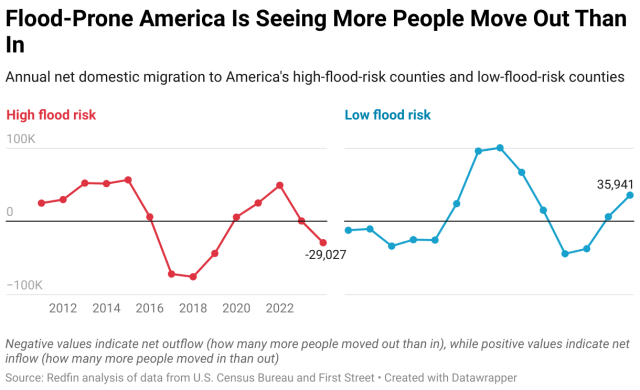
Redfin’s analysis of domestic migration patterns found that counties at high risk for flooding lost nearly 30,000 more residents last year than gained.
By comparison, counties with a low risk for flooding gained nearly 36,000 more people who moved in rather than out. That’s the largest gain since 2019.
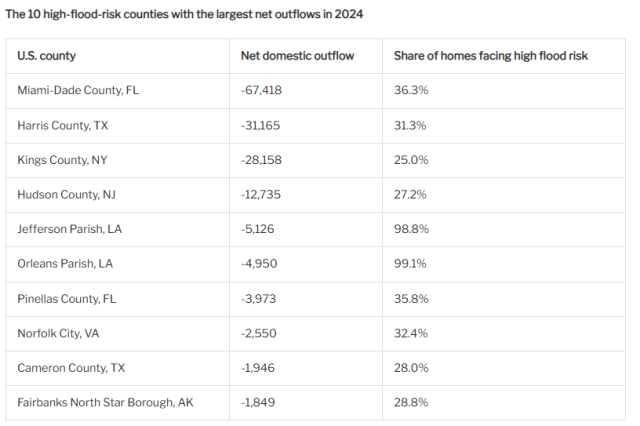
The outward trend was driven largely by outflows from Miami and Houston, two metro areas highly susceptible to hurricanes and the resulting floods. Major hubs in coastal Florida, Texas, New York, and Louisiana were also driving forces behind the national net outflow last year.
Other factors behind the trend is the ever-rising cost of homeowners insurance and increasing homeowner association (HOA) dues and special assessments.
Ozzie Linares, a Redfin agent in Miami, said his insurance premium has risen from less than $2,000 two years ago to $6,700 per year today. And his flood insurance premium has climbed from $400 to $1,250.
Miami-Dade County, where more than a third of the homes face high risk of flooding, lost approximately 67,500 residents, the largest net outflow among the 310 high-risk counties Redfin analyzed.
“A lot of people moved to Miami during the pandemic, thinking life would be a vacation,” said Linares. “Many of those people are now leaving because they’ve realized living here isn’t a piece of cake — the city has become increasingly expensive and extreme weather events are on the rise.”
Harris County, Texas, the home to Houston, experienced a net outflow of 31,165 people, while Kings County, New York, home to Brooklyn, lost 28,158. Surprisingly, Orleans Parish, Louisiana, home to New Orleans, lost just 5,000 residents even though 99% of all the houses there face flood risk.
“People are always nervous about flooding,” Houston agent Roze Swartz said. “But it’s no longer the top concern like it was after Hurricane Harvey.”
Nearly one-third of the houses in Harris County, Texas are susceptible to flooding. But now, Swartz said, the main concern is over the cost of living.
“A lot of people moved to Texas during the pandemic because it was relatively affordable, but property taxes and insurance costs have gone up so much that some homeowners are being forced to sell,” the agent said.
“I just met a seller who bought her home a year ago and now has to sell it because she can no longer afford her monthly payments, which isn’t an uncommon situation. I even have one seller who went into foreclosure.”
In something of another surprise, many flood-prone areas continue to experience population growth, thanks in large part to immigration.
For example, Miami-Dade County’s population jumped 2.3% to 2.8 million in 2024, outpacing national population growth. That can be explained by net international migration of 123,835, the most of any county in the nation.
“Many of the Americans who left flood-prone areas last year were replaced by immigrants, who in the past were able to evacuate to shelters when disaster struck,” said Redfin Chief Economist Daryl Fairweather.
“But with the government cracking down on immigration enforcement, some immigrants are now hesitant to leave their homes during storms because they are afraid they could be detained.”
On the flip side, some people don’t seem to be concerned about flooding. Among the 310 high-flood-risk counties Redfin analyzed, 178 has net inflows of new residents, and again, many of them are in Florida and Texas.
St. Johns County, Florida, just south of Jacksonville saw 11,661 more people move in than out last year, the largest net inflow of any high-flood-risk county. Next comes Fort Bend County, Texas, just outside of Houston, with a net inflow of 10,467, and Volusia County, Florida, home to Daytona Beach, with a net inflow of 9,724.
Flood-prone places with the biggest net inflows are on average more affordable than flood-prone places with the biggest net outflows, Redfin said, which may explain why there are still more people moving in than out.