
Goldman Sachs: Housing Affordability Biggest Challenge For Market – NMP Skip to main content

Goldman Sachs: Housing Affordability Biggest Challenge For Market

Mar 20, 2023
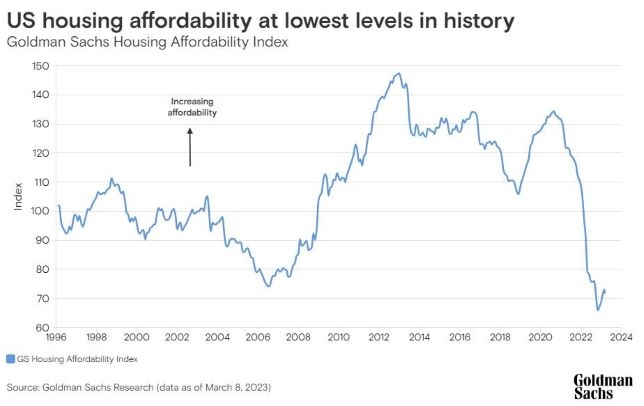
Goldman Sachs Housing Affordability March 2023

Says its housing affordability index is at an historically low level.

Affordability is the biggest challenge facing the U.S. housing market, according to strategists with Goldman Sachs Research. 

In a report included in its Briefings newsletter, the strategists said the Goldman Sachs Housing Affordability Index — which measures the extent to which a typical household can afford a new mortgage — fell to around 70 as of March 8, well below a level deemed healthy.

The index attempts to quantify the ratio between the median monthly income and the median monthly mortgage payment. When the index is at 100, affordability is at an equilibrium level. When it falls below 100, affordability declines. 

Despite rising income levels in recent years, two key factors have driven housing affordability down in the U.S., the strategists said: higher home prices and mortgage costs.

According to credit strategist Vinay Viswanathan, deteriorating affordability could have significant implications for the U.S. housing market:

Some lower-income households, which might have been on the cusp of buying a house, now can't afford it, he said. Instead, they've been forced to continue renting. 

“Owning a home is an important part of most people's lives, and this is certainly making it harder,” Viswanathan said.

In addition, it means people aren't buying homes. Instead, they are waiting for mortgage rates to fall and for better financing conditions to come, he said. 

Homeowners also likely won't want to sell because there aren't better options right now, he said, explaining the “lock-in effect.” It's when people aren't buying or selling homes as they have in the last 20 years because their existing mortgage rate is far below those now available.

Viswanathan said he expects declining affordability to cause home prices to slip further. Overall, his team expects U.S. house prices to fall an additional 6% in 2023.

About the author
David Krechevsky was an editor at NMP.
Published
Mar 20, 2023
Better Will Miss September Break-Even Target, Interim CEO Says

Platform volume overtook DTC, but costly enterprise integrations have yet to deliver, and new partnership growth is not expected until Q4

Aug 07, 2026
loanDepot Nears Break-Even, But Adjusted Profitability Still Lags

Home equity and purchase lending lifted production economics, while management characterized its relaunched wholesale channel as a supporting business rather than a major growth engine

Aug 06, 2026
Lower-Payment Mortgage Applications Nearly Match Median Rent

Principal-and-interest payments reached $1,522 for lower-payment purchase applicants in June, just $9 below the national median asking rent

Aug 03, 2026
Home Price Cuts Keep Purchase Market Moving

One in five listings had a price reduction in July, while pending sales increased for the eighth consecutive month

Aug 03, 2026
Higher Mortgage Rates Shrink Purchase Demand, Expand Buyer Leverage

Pending sales fell to their lowest level since early April, but lower asking prices and reduced competition give originators more options to structure deals for qualified borrowers

Jul 31, 2026
Even Stable Public-Service Careers No Longer Guarantee Homeownership

Younger teachers, health care workers, first responders, and military households can afford median-priced homes in only a fraction of major metros

Jul 31, 2026


