With mortgage rates sliding, the nation’s rental market is following suit, having declined again in September, according to data from Realtor.com.
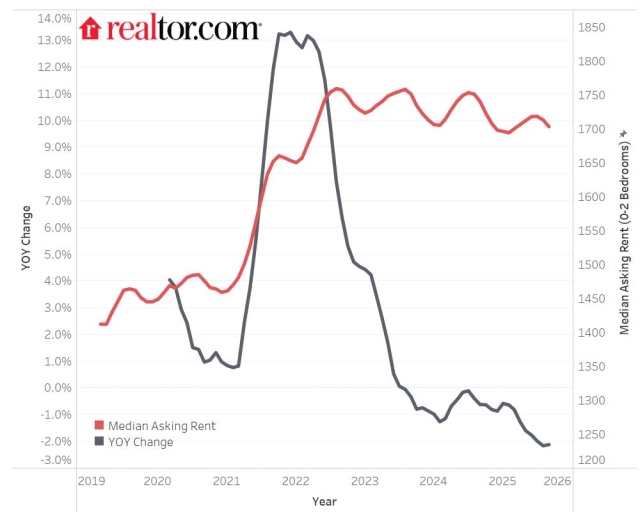
In its September Rent Report, Realtor.com reveals the extension of a two-year stretch of easing prices and modestly improving affordability for typical households. The latest drop, the second month-over-month decline reported since March 2025, reflects the housing market's normal cooling effect as we head into fall and close out the year.
Realtor.com found the median asking monthly rent for zero- to two-bedroom properties in the 50 largest metros stood at $1,703 in September, down $36 (-2.1%) year-over-year, and $10 lower than August 2025’s total. Monthly rents now sit $56 (-3.2%) below their August 2022 peak, but remain $241 (16.5%) higher than before the pandemic. Overall, rent growth has been subdued in 2025, with median asking prices up just 0.4% year to date, compared with a 1.9% increase during the same period in 2024.
"Two years of gradual rent declines have given renters a bit more breathing room," said Danielle Hale, Chief Economist at Realtor.com. "Still, even as a typical household spends a smaller share of income on rent than a year ago, affordability remains stretched in major markets, particularly along the coasts."
Renters earning the typical household income devoted 23.4% of their income to lease a typical home in September 2025, down from 24.9% one year ago. This shift reflects both modest rent declines and income growth over the past year. Rents declined year-over-year across all unit sizes, led by one-bedroom units at $1,582 (-2.3%), followed by two-bedroom units at $1,885 (-2.2%), and studios at $1,426 (-1.0%).
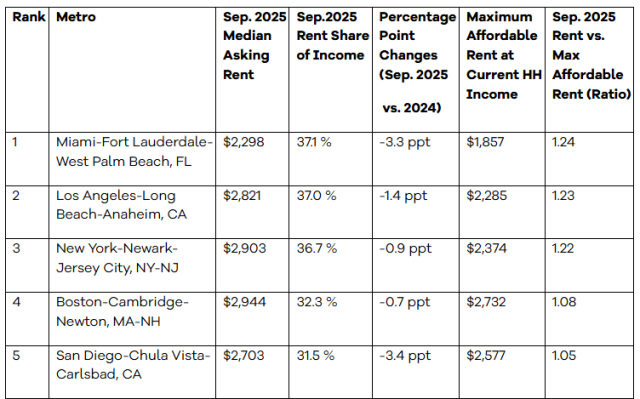
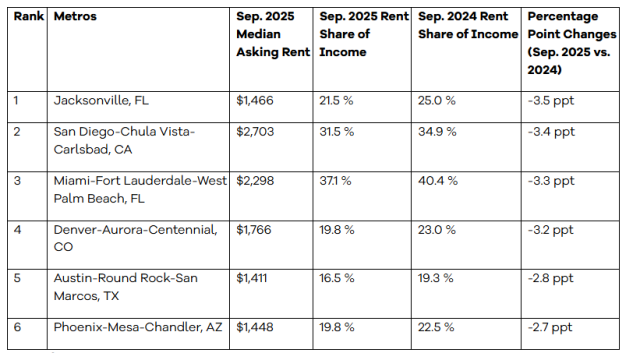
In September, renters faced the steepest costs in Miami, where housing consumed 37.1% of the typical household income. Los Angeles (37%), New York (36.7%), Boston (32.3%), and San Diego (31.5%) rounded out the top five. Still, rent burdens in each of these markets declined slightly compared with a year ago, showing modest improvement in some of the nation's most expensive metros.
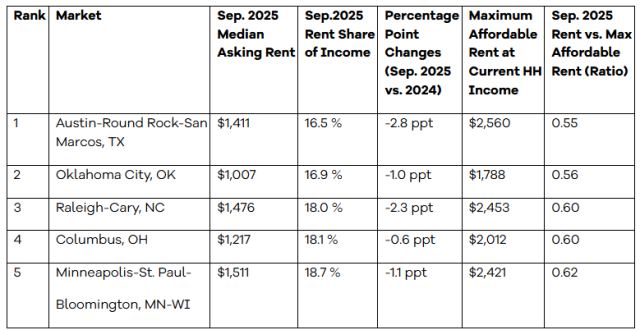
At the other end of the spectrum, Austin, Texas overtook Oklahoma City, Oklahoma to become the most affordable rental market, with renters spending just 16.5% of income on a typical lease. Oklahoma City took the second most-affordable spot (16.9%), followed by Raleigh, North Carolina (18%), Columbus, Ohio (18.1%), and Minneapolis (18.7%).
Markets in the South and West regions, including Jacksonville, Florida; San Diego, California; and Miami, Florida saw the strongest improvements in rental affordability. Increased rental supply in these regions continues to help moderate price pressures.
"More new rentals coming to market means renters have additional choices and a bit more leverage," said Jiayi Xu, Senior Economist at Realtor.com. "Greater supply is allowing some renters to find homes that better fit their budgets, though affordability challenges persist in historically high-cost markets."
For their analysis, Realtor.com calculated the affordable monthly rent by applying the 30% rule to the estimated 2025 monthly median household income nationwide ($7,263) across the 50 largest U.S. metros, (on average) and in each metro. The monthly median household income is derived from the annual median household income data sourced from Claritas.