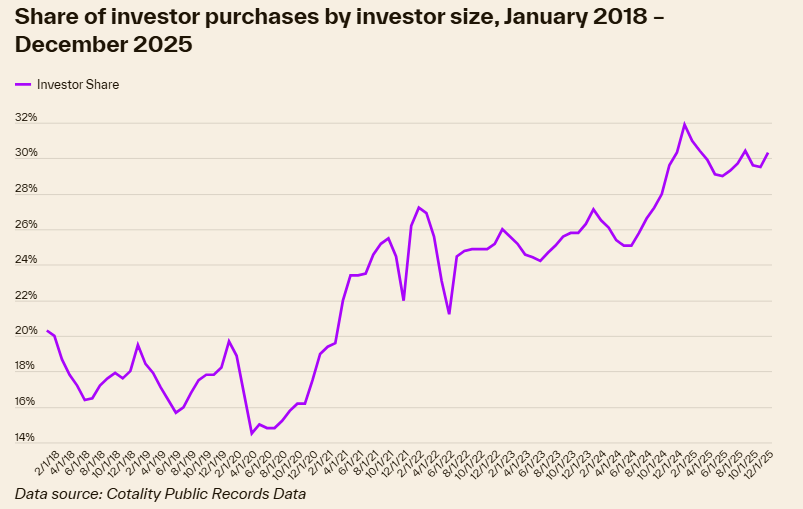
Investors have maintained a substantial presence in the U.S. single-family home market in 2025, capturing roughly 30% of all purchases through the end of the year, according to the latest Cotality Home Investor Report Q4 2025.
That figure marks a slight year-over-year uptick compared with the 29% share recorded at the close of 2024.
Residential affordability pressures continue to deter traditional owner-occupant buyers, leaving a structural opening that investors have filled. Rising mortgage rates and persistently high home prices have reduced first-time buyer participation, prompting many to remain renters or delay purchases. Amid that backdrop, strong rental demand has sustained investor activity even as overall market sales have softened.
“Fewer first-time homebuyers mean more people are staying in the rental market, and investors are responding to that demand,” said Thom Malone, principal economist at Cotality. “The current landscape differs significantly from the pandemic-era surge, which was fueled by rapid price appreciation. Now, while real estate is no longer the ‘hottest’ asset, strong rental demand and the ability to secure acquisitions below list price are keeping investors engaged even as traditional buyers retreat.”
Cotality’s data show that investors purchased between 80,000 and 100,000 homes per month in late 2025, a pace largely consistent with 2024 levels. Small and medium-sized investors (owning fewer than 100 properties) accounted for the bulk of activity, collectively representing nearly 25% of total home purchases. Large and mega investors (holding 100 to more than 1,000 homes) comprised the remaining ~5% of investor share.
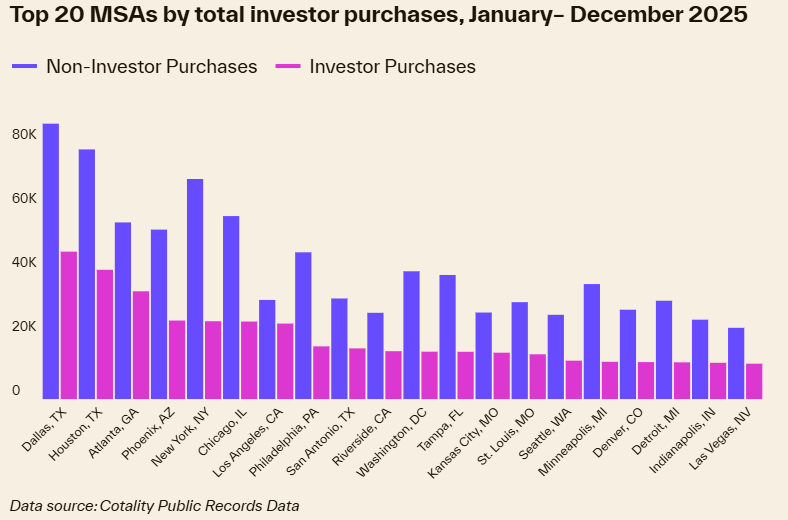
Geographically, Dallas, Houston, Atlanta, Phoenix, and New York emerged as the top markets for investor acquisitions. While high-cost California metros like San Jose and Los Angeles saw elevated investor market shares, some Sun Belt cities registered high purchase volumes but lower relative shares due to stronger owner-occupant activity.
Looking ahead, Cotality forecasts investor market share to hover near current levels into early 2026, with seasonal dips possible as traditionally stronger owner-occupant demand returns in spring. However, without significant declines in interest rates or meaningful improvements in affordability, investors are expected to remain a durable force in the housing market.