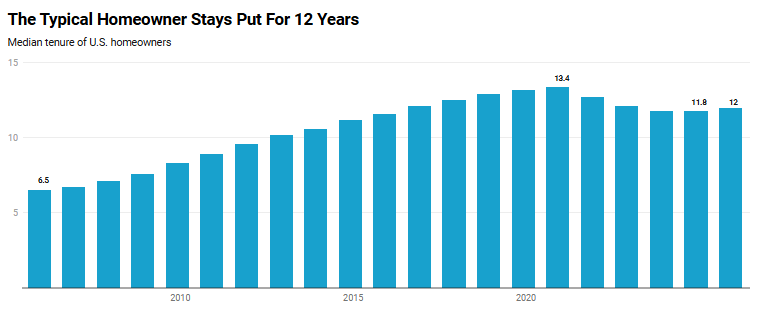
After ticking down since 2020, homeowner tenure began rising again last year, according to the latest Redfin report.
The typical owner in 2025 had been in their home for 12 years, the longest median tenure since 2022, and roughly doubling the average length of time owners held their homes before moving on 20 years ago.
Owner tenure peaked at 13.4 years in 2020, then gradually declined until last year. The declines were the result of the pandemic-driven buying and selling frenzy when record-low mortgage rates and remote work motivated many Americans to move.
Tenure inched up from 11.8 years in 2024 to 12 years in 2025 as home sales slowed due to high housing costs.
Still, that’s almost twice as long as owners did two decades ago. In 2005, the typical owner stayed home 6.5 years before selling.
Over the ensuing years, though, people remained in their homes longer as the American population grew older.
“Baby boomers and Gen Xers became increasingly likely to age in place because they’re financially incentivized to stay put,” Redfin said.
Today, nearly half of all owners hold their places free and clear, and those who do have a mortgage likely have a much smaller payment than a buyer would today. Older people also typically have less reason than younger people to relocate. They’re not as likely to move for a new job, for example, or grow their families.
However, lengthy tenures can be an obstacle for first-time buyers. A 2024 Redfin analysis found that empty-nest baby boomers own 28% of America’s three-bedroom-plus homes, twice as many as Millennials with kids.
“While it’s understandable that older Americans want to hold onto their low housing payments — or no housing payment — the flip side is that it depletes inventory of starter homes and pushes home prices higher,” the real estate brokerage firm noted.
“High mortgage rates and home prices perpetuate a cycle that locks up housing inventory,” commented Chen Zhao, Redfin’s head of economics research. “It can keep existing homeowners in place and financially discourage them from moving to a different home or a different neighborhood, which drives prices up even higher for first-timers trying to break into the market.”
Tenure increased in 28 of the 41 metros in this analysis from 2024 to 2025, led by Los Angeles; Denver; and Raleigh, North Carolina. Los Angelenos typically hold their homes for 20 years, the longest tenure in the nation.
Tenure is shortest in Louisville, Ky., where the typical owner spends just 8.3 years in their house before selling.