Valentine’s Day is right around the corner, and love is in the air, but new findings from Redfin reveal a stark divide in housing affordability between single and married Americans, underscoring ongoing affordability pressure in the housing market.
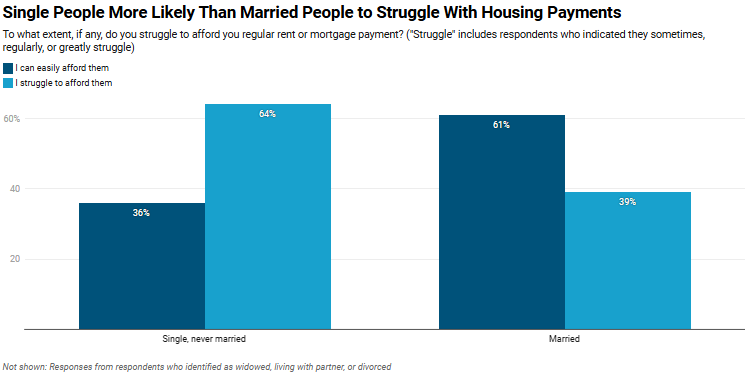
According to a Redfin-commissioned survey conducted by Ipsos of 4,000 U.S. adults last November, 64% of single respondents report struggling to afford their regular rent or mortgage payments, compared with 39% of married respondents.
The disparity signals that individuals living on a single income face significantly more financial strain in today’s expensive housing environment. Nearly half (48%) of single respondents reported annual household earnings below $50,000, compared with just 9% of married households — a gap that contributes directly to affordability challenges. Married couples are also three times more likely to have household income between $100,000 and $500,000.
Redfin’s analysis points to several factors driving this disparity. In addition to lower average earnings, single people tend to be younger and earlier in their careers, with less time to build savings or pay down debt such as student loans. Married couples often benefit from dual incomes, shared living expenses, and taxpayer advantages unavailable to single filers.
The report also quantifies what it describes as the “singles tax.” In Washington, D.C., for example, a typical condo’s annual housing costs — including mortgage and HOA fees — amount to nearly $18,000 more per year for a single owner than they would for a couple splitting those costs. In high-cost markets like San Francisco, that penalty exceeds $40,000 annually.
Affordability constraints also influence mobility, as single respondents were nearly twice as likely as married respondents to say they cannot afford the type of home they want and are more likely to remain in place because moving is too costly.