The typical starter home became affordable in the past year in four U.S. metros where it was previously unaffordable. They’re all in Texas or Florida, whose housing markets have softened recently amid growing climate risks and surging inventory.
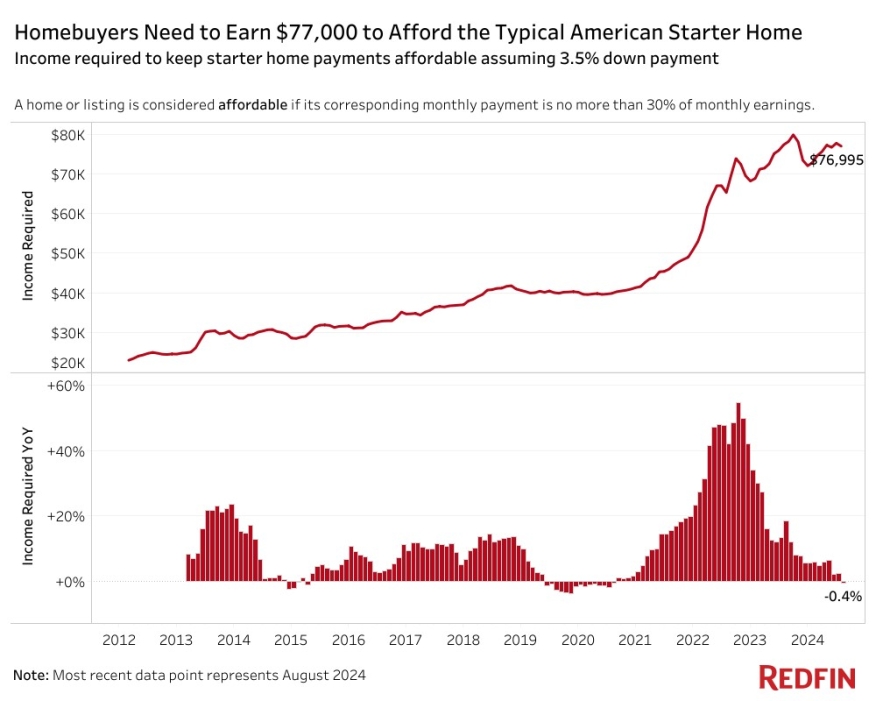
The income necessary to afford the median-priced starter home – priced at $250,000 – declined 0.4% annually to $76,995 this August, according to a new report from Redfin. This marks the first annual decline since August 2020, when mortgage rates were nearing their record low.
“It’s great news that starter homes are becoming a little more affordable, but there’s a catch,” Redfin Senior Economist Elijah de la Campa commented. “Starter homes aren’t what they used to be. A decade ago, a turnkey four-bedroom house in a nice neighborhood was often considered a starter home, but today, a small fixer-upper condo is often all a first-time homebuyer can afford. The American Dream is changing; for many, it no longer involves a house and a white picket fence.”
Thanks, Rates
The income needed to afford a starter home fell – despite starter-home prices being up 4.2% year over year – because mortgage rates fell enough to offset the higher prices.
The average interest rate on a 30-year mortgage fell to 6.5% in August from 7.07% a year earlier, the first annual decrease in three years. It has since declined further, now sitting at 6.08%. Still, the income needed to afford a starter home is only 3.6% below the record high of $79,857 hit last fall.
Starter home affordability is not expected to improve much more by the end of this year, analysts cautioned.
“The Federal Reserve’s latest interest rate cut and its plans for future cuts were highly anticipated, meaning they’re mostly priced into mortgage rates already,” the report read. “When the Fed cuts short-term interest rates, long-term rates like mortgage rates don't always move down nearly as much. Home prices also tend to rise over time, so waiting to buy likely means a higher price tag and down payment.”
The typical household earns an estimated $83,853 per year – 8.9% more than the threshold to afford the median-priced starter home. Although an improvement from last August, when the typical household only earned 3% more than they needed, it’s still dividends lower than before the pandemic. In August 2019, the typical household earned 57.1% more than they needed to afford the median-priced starter home, and in August 2012, they earned 113% more or over twice as much as they needed.
Then record-low mortgage rates hit, which combined with the pandemic home buying frenzy and a severe inventory shortage sent home prices skyrocketing.
Catch Up, Income
Starter-home prices are now 51.1% higher than they were in August 2019 and 163% higher than they were in August 2012. Household income has not risen to match the price hikes.
The income needed to afford a starter home has tripled since 2012, while the median household income hasn’t even doubled.
Three-quarters (75.8%) of starter-home listings are affordable for a household making the median income. That’s up 72.6% from last August, but down from nearly 100% in 2019 and 2012.
“While many people make enough on paper to afford a starter home, they often have other expenses like student debt that are preventing them from buying,” said Blakely Minton, a Redfin Premier real estate agent in Philadelphia. “Starter-home buyers are skewing older than they used to. When I first started working in real estate 20 years ago, they were kids fresh out of college. Now grads are saddled with huge student loans and are moving back in with Mom and Dad or renting,” Minton said. “I bought my first house at 23, but that’s hard to do today, in part because first-time buyers are competing with older Americans who want to downsize and are able to make higher offers.”
Regional Variances
The annual income needed to afford a starter home varies widely by locale and region.
Home buyers In Anaheim, Calif. need to earn $217,300 a year to afford the median-priced starter home, down 8.1% year over year. Although this represents the largest decline among the 50 most populous U.S. metropolitan areas. Anaheim is still one of the least affordable metros in the nation, with less than 0.1% of starter-home listings affordable for a median-income-earning household.
The next largest YOY declines were in Austin, (-5.8%) West Palm Beach, (-5%) Phoenix, (-4.8%), and Dallas (-4.7%).
The four metros where starter homes became affordable in 2024 – meaning a household on the median income would spend less than 30% of their earnings – were all in Florida and Texas.
In West Palm Beach, a household on the median income would now need to spend 28% of their earnings on housing to buy the median-priced starter home, down from 31% last August.
Fort Lauderdale went to 28.2% from 30.9%, while Dallas went to 29.1% from 32.1% and Fort Worth went to 28.3% from 30.2%.
The list of metros where the income needed to afford a starter home increased was topped by Chicago, where it rose by 15.4% YOY to $77,238. Next came Los Angeles (14.7%), Detroit (14.5%), Cincinnati (9.7%) and Pittsburgh (9.6%).