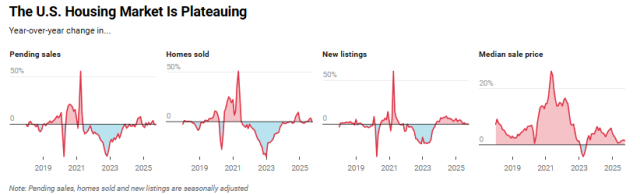
For the first time in 10 months, U.S. home prices appreciated from August to September on a national basis. The increase, according to First American Data Analytics, was a scant 0.1%, but another study from Redfin shows that home prices rose a little more — 0.3.% — between September and October.
From a year earlier, though, prices in October were up 2.9%, a slight dip from the year-over-year increase of 3.1% registered in September.
The numbers show a gradual slowdown from earlier this year, when prices were rising at a better than 5% clip annually, Redfin noted.
Price growth is slowing because active listings are increasing at a considerable rate, giving buyers more options and the power to negotiate, But now, another Redfin study has found that the market has become relatively flat, with sales and new listings little changed in October, both from September and October 2024.
The housing market has been stagnating for a while, but this past year has been especially inactive. “Many would-be homebuyers and sellers are paralyzed by high prices and economic uncertainty,” said Redfin Senior Economist Asad Khan. “Homebuying activity has stabilized at below-normal levels, and while selling activity has also slowed, there are still a lot more sellers in the market than buyers.”
Redfin estimates there are roughly 500,000 more home sellers than buyers actively in the market. The company’s agents report that many owners who are selling now are people who have to sell, be it for a job change, a divorce or another major life event.
Price stabilization is only one indicator of a flat market. Pending sales were little changed from both a month and a year earlier. So were closed home sales and new listings. Existing sales also are flattening out, and Redfin economists expect them to end the year roughly level with 2024, which was the worst year for sales since 1995.
Meanwhile, First American’s Chief Economist Mark Fleming, said the “modest uptick” in his company’s data is “better characterized as price stabilization” as affordability headwinds and gradually increasing supply continue to sap price pressures.
Appreciation remains close to its slowest pace since 2012 and will likely stay that way through the end of the year, Fleming added.
Redfin’s Head of Economic Research Chen Zhao also chimed in, noting that the slowdown in a fresh supply of houses for sale, coupled with the shortage of buyers, “are largely offsetting each other.”
Sales are still slow, and many buyers who don’t need to move are staying on the sidelines, Zhao said. And the sellers who are listing now often need to move. But, Zhao noted, “it’s hard to attract buyers in a market where affordability is stretched and uncertainty remains high.”