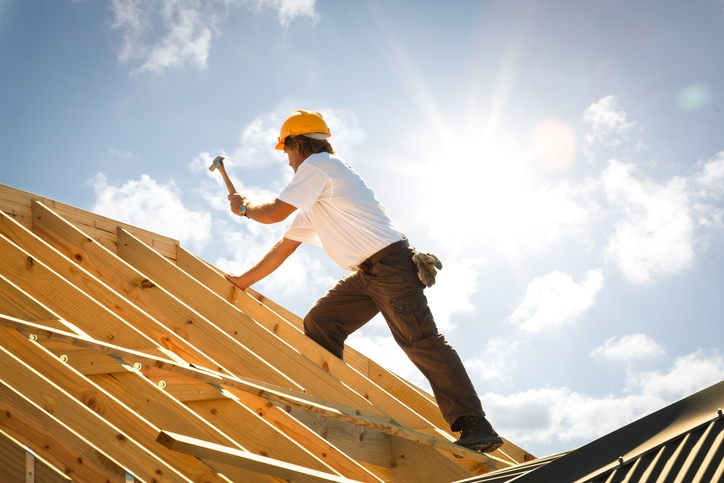
Defying high inflation and supply-chain issues, U.S. home builders unexpectedly broke ground for more new homes in December than a month earlier, the Census Bureau said today.
Privately owned housing units authorized by building permits were started at a seasonally adjusted annual rate of 1.7 million, a 1.4% increase from the revised November estimate of 1.68 million and 2.5% above the December 2020 rate, the Census Bureau reported.
Starts for single‐family housing rose 2.3% to 1.17 million in December; below both the revised November figure of 1.2 million and the December 2020 figure of 1.32 million. For buildings with five or more unit, 524,000 were started in December, up 13.7% from November and up nearly 56% from December 2020.
An estimated 1,595,100 housing units were started in 2021, 15.6% above the 2020 figure of 1,379,600, the Census Bureau said.
The number of building permits authorized in December also spiked, rising 9.12% to a seasonally adjusted annual rate of 1.87 million, up from the revised November rate of 1.72 million. The December rate was also 6.5% higher than the rate a year earlier.
Single‐family authorizations in December were at an annual rate of 1.13 million, 2% above the revised November rate of 1.11 million. Meanwhile, authorizations for buildings with five or more units spiked 19.9% to an annual rate of 675,000 in December from a revised 563,000 in November. The rate also was 42% higher than in December 2020.
The number of privately owned homes completed in December totaled a seasonally adjusted annual rate of 1,295,000, 8.7% below the revised November estimate of 1,418,000 and 6.6% below the December 2020 rate of 1,386,000.
An estimated 1,337,800 housing units were completed in 2021, 4% more than the 1,286,900 completed in 2020.
The report on housing starts came a day after the National Association of Home Builders (NAHB) and Wells Fargo issued their Housing Market Index (HMI) report, which showed that builder confidence in the market for newly built, single-family homes fell by one point to 83 this month. The report cited concerns over inflation, staffing shortages and supply chain issues.
Danushka Nanyakkara-Skillington, the National Association of Home Builders’ assistant vice president for forecasting and analysis, said the HMI is a forward-looking indicator, while the housing starts report is a look backward.
“Sales conditions are looking good with a robust housing market,” she said, while noting that builders still face a number of obstacles to complete new homes. “There are high materials costs — lumber prices continue to go up, especially from Canada — and it takes so much more time now to get the components to build a home.”
Nanyakkara-Skillington added that she expects the HMI to remain around “the 83-84 level” for all of 2022.
Odeta Kushi, deputy chief economist for First American Financial Corp., said the low supply of homes for sale may be one reason for the spike in construction.
“Limited existing homes available for sale have made for a very competitive market,” she said. “The market is ripe for homebuilders to ramp up new home construction to meet the growing demand. This month’s 6.5% year-over-year increase in permits is a welcome sign of new inventory to come.”
Still, Kushi agrees that builders face numerous challenges this year. “Builders are entering 2022 with backlogs they are having a hard time completing due to material and labor shortages,” she said. “Prices for construction materials and labor continue to rise. Average hourly earnings in construction were up 5.3% year over year in December, above the pre-pandemic pace of approximately 2.8%.”
In addition, shortages of skilled labor, materials, and buildable lots serve as “headwinds to increasing the pace of new construction,” Kushi said. “The good news in the December housing starts report is the number of single-family homes permitted, but (homes) not started declined to its lowest level since April 2021, but remains elevated compared to pre-pandemic.”
Despite the supply-side issues and affordability challenges, she said, “strong millennial demand & lean existing-home inventory is supportive of new construction. Builders can't close the gap between supply and demand overnight, but they are trying even in the face of historic challenges.”
Kushi added that housing demand has outstripped supply since 2009. “The last housing starts report of 2021 is a positive step towards bridging the gap between supply and demand, as an estimated 1,337,800 housing units were completed in 2021 – 40% above the 2020 figure. 2021 was a strong year for construction.”