Tech Me Home Tonight – NMP Skip to main content

COVER STORY

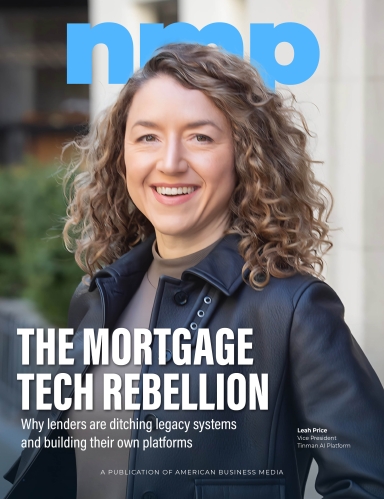
TECH ME HOME TONIGHT

Inside the growing movement of mortgage lenders building tech in-house

By Kathryn Fitzpatrick, Special to National Mortgage Professional

It is a time of digital unrest. Legacy platforms like Encompass and Calyx remain entrenched at the center of the mortgage galaxy, controlling everything from loan origination to close. But their reign is showing cracks. Burdened by rigid contracts, aging infrastructure, and glacial release cycles, they’ve become slow-moving battle stations in a war that now demands speed, precision, and adaptability.

Across the industry, unrest is growing. Lenders are tired of waiting months for updates, paying six figures for routine customizations, and stitching together brittle systems with duct tape and desperation. The Force, or at least, the momentum, is shifting.

A scrappy alliance is rising. Companies like Better, Absolute Home Mortgage, and Sun West are building their own weapons of tech innovation — in-house LOS platforms, point-of-sale tools, and AI copilots. No venture capital legions. No fleets of consultants. Just homegrown code, forged in the fires of real-world production pipelines.

The mission: reclaim control from the vendor overlords and bring balance back to mortgage tech.

Why Lenders Are Building Their Own Tech

The logic behind building in-house is largely about breaking free from the limitations of legacy providers. Most lenders rely on vendor platforms like Encompass or Calyx, but, while widely used, these systems can be expensive, difficult to customize, and slow to adapt to changing compliance or business needs.

And the numbers reflect that. Over 90% of lenders rely on at least one commercial LOS platform for loan applications. With ICE Mortgage Technology’s Encompass holding about 50% of market share and Black Knight’s Empower around 10–15%, together they power roughly two-thirds of all U.S. originations, according to the STRATMOR Group. In spite of the high usage, though, less than 25% of lenders report satisfaction

Encompass was originally developed by Ellie Mae, a company founded in 1997 to bring automation to the mortgage origination process. Since its acquisition by ICE in 2020, the platform has evolved into a cloud-based, end-to-end digital mortgage system — but not without problems.

According to a 2025 MarketWise study, loan boarding (the process of transferring a funded mortgage into a lender’s or servicer’s system for ongoing management) remains one of the most time-consuming and error-prone steps in the mortgage lifecycle, with errors affecting up to 2.77% of loans and missing data impacting more than 3.5% post-boarding. Even with modern tools, originators and servicers often operate in separate systems, leading to duplicated work, redundant audits, and an average of 70 minutes spent per loan on intake. 

“You need to frontload all of the risk management and the mitigants. It’s not, ‘Let’s build this cool thing and then figure out how to make it compliant.’”

> Leah Price after leading fintech and AI strategy at the Federal Housing Finance Agency. Leah Price joined Better to help scale Tinman — the company’s all-in-one, AI-powered mortgage platform that blends origination, pricing, and compliance into a single system.

“You need to frontload all of the risk management and the mitigants. It’s not, ‘Let’s build this cool thing and then figure out how to make it compliant.’”

> Leah Price after leading fintech and AI strategy at the Federal Housing Finance Agency. Leah Price joined Better to help scale Tinman — the company’s all-in-one, AI-powered mortgage platform that blends origination, pricing, and compliance into a single system.

Loan boarding exposes the friction between systems. For example, Encompass may handle the origination side well, but if it can't hand off that loan cleanly into servicing, lenders still face rework, delays, and regulatory risk — the very problems tech is supposed to solve.

Of course, that fragmentation isn’t limited to servicing. “Very few companies are able to leverage the newest technology,” says Leah Price, former head of financial technology at FHFA and now a senior executive at Better. “The technology is fragmented. It’s very old. And it hasn’t allowed for full integration of AI.”

In her previous role, Price studied technological advancements across the mortgage industry, where she saw firsthand how legacy systems and siloed infrastructure prevented the kind of end-to-end automation that modern tech tools require. 

In moving to Better, the choice was deliberate: to join a company that not only built its own technology stack but also had the scale, capital, and leadership commitment to actually use it — without being hamstrung by legacy infrastructure or vendor dependencies.

Better’s solution was to build a unified platform (Tinman AI) designed to serve both the borrower and the internal operations team. Atop that platform sits Betsy, a generative AI-powered voice bot and chat assistant that can answer borrower questions, draft emails, and support loan officers with file status updates and compliance-appropriate prompts.

“She can banter,” Price said, “but she’s very customized to the rules of originating a mortgage.”

For companies like Better, building technology internally offers operational efficiencies and new business opportunities. “We've iterated with this system over the last 10-plus years that has enabled our loan ops staff to be extremely efficient,” Price said. “And now we're really well positioned to offer that to other lenders — something that wasn't previously available to many.”

And Better isn’t alone. Sun West Mortgage likewise began its tech rebellion early. In 2018, the company launched AngelAi, a homegrown platform designed to act as personal assistant, loan officer, and even credit advisor — all in one. Built by sister company Celligence International, AngelAi automates loan processing, assists with compliance, and helps borrowers improve credit scores through automated dispute resolution.

More than that, though, it was built to feel human. AngelAi uses “empathetic technology” — tracking tone, typing patterns, and behavior to tailor responses and promote fairness in lending. It offers financial guidance, supports real estate agents with SEO-boosted listings, and runs 24/7, never taking a break.

“There’s no carrot and no stick,” CEO Pavan Agarwal told NMP in a 2024 interview. “But because AngelAi learned, she was promoted.”

Better and Sun West built proprietary platforms tailored to their internal workflows — not initially for resale, but to gain a strategic edge. At Better, that meant streamlining the entire borrower journey through a fully integrated, AI-native system. At Sun West, it meant deploying Morgan (the early iteration of AngelAi), an in-house assistant designed to supercharge communication.

For Matthew VanFossen, the goal wasn’t branding or buzz. It was fixing what wasn’t working. Big POS, the white-label frontend developed by Mortgage Automation Technologies, similarly began as an internal project at Absolute Home Mortgage during the early months of 2020. Built atop Encompass, it was designed to give lenders more control over how loan data is collected, displayed, and routed without replacing the LOS itself. 

“When I look at point of sale, I think that our customer lives in there,” VanFossen said. “Our loan officer works inside of there. And our real estate referral partners work inside of there.”

What started as a custom fix for internal inefficiencies evolved into a commercial product now used by more than 35 independent mortgage companies. Its design emphasizes transparency, modularity, and speed — a direct contrast to the rigid, slow-moving vendor tools VanFossen had grown frustrated with.

Why Most In-House Projects Fail

Despite these success stories, the track record for in-house mortgage tech is overwhelmingly poor. Rick Roque, a former Silicon Valley engineer turned mortgage executive, has spent the last two decades advising lenders on tech strategy, acquisitions, and system integrations. He’s seen the pitfalls up close. “Probably the biggest fool's gold has been mortgage companies attempting to build their own loan origination system,” Roque says. “Over the last 15 years, companies have wasted tens of millions of dollars … and they fail.”

Roque cites several reasons for these failures: lack of capital, absence of experienced product managers, and the immense technical debt that accrues when building complex systems in a highly regulated industry.

“They don't have the capital to keep up,” he explains. “You really need to have a product manager mindset — someone who understands user experience, competitive requirements, and regulatory trends. Most mortgage companies don't know how to hire for that.”

In truth, there is often little overlap between loan officers and tech wizards, with lenders struggling to bridge the gap between people who know how mortgages work and people who know how software should be built.

“As you build more and more stuff in-house, all of that tech debt accumulates. Then it's hard to move quickly and pivot when you decide you want to do that.”

> Leah Price

Originators understand borrowers, guidelines, and turn times, but they’re not thinking in sprints or scalable architecture. Meanwhile, engineers might be brilliant at writing code, but they often underestimate just how complex, Byzantine, and regulation-heavy mortgage really is. The result is a communication breakdown where product decisions get lost in translation and the final tool ends up serving no one particularly well.

At Better, however, that gap is narrower by design. Offering a totally online mortgage experience means that product, engineering, compliance, and operations are forced to work in lockstep from day one. “This company attracts people who want to work on hard problems, who want to work with really smart people, and who want to be able to make a difference quickly,” Price said. “That’s not everybody. It’s very uncomfortable for some folks who are used to being in a more traditional environment.”

Leah Price echoed the challenge of maintaining momentum post-launch. “As you build more and more stuff in-house, all of that tech debt accumulates,” she said. “Then it's hard to move quickly and pivot when you decide you want to do that.”

One of the clearest cautionary tales is Interfirst Mortgage, which, after shuttering in 2017, re-entered the market in 2020 with an ambitious plan to relaunch as a tech-driven lender. The company raised $175 million and built its own AI-powered LOS. But by the end of 2021, Interfirst had laid off dozens of loan officers and retrenched. Their platform simply hadn’t delivered results fast enough to justify its cost. 

Another example is Open Mortgage, which once relied on an in-house LOS until new compliance rules under TRID rendered it unworkable. The company attempted to replace it with a vendor solution in early 2015, but the first rollout failed. Under pressure from regulators, they scrapped the project and started over with a second vendor, racing to implement a compliant LOS in just 50 days.

In both cases, the firms were forced to walk away from years of work — and likely millions in sunk costs. It’s a painful reminder that building software in-house offers control, but at a steep price.

“When I look at point of sale, I think that our customer lives in there. Our loan officer works inside of there. And our real estate referral partners work inside of there.”

> Matthew VanFossen A longtime mortgage operator and fintech founder, Matthew VanFossen built Big POS to give lenders more control over their tech stack — transforming a homegrown sales portal into a white-label platform now powering over 35 mortgage companies.

“When I look at point of sale, I think that our customer lives in there. Our loan officer works inside of there. And our real estate referral partners work inside of there.”

> Matthew VanFossen A longtime mortgage operator and fintech founder, Matthew VanFossen built Big POS to give lenders more control over their tech stack — transforming a homegrown sales portal into a white-label platform now powering over 35 mortgage companies.

The real challenge, as Comidor observes, isn’t the code, necessarily, but everything around it. “You need to decide on teams, supervise them, and, in some scenarios, even micro-manage them,” they write. Between high upfront costs, long ramp-up times, and the constant pull on executive attention, the effort often outweighs the return. The tech doesn’t necessarily fail because the code is broken. It fails because no one has the time, budget, or stamina left to wield it.

What Makes A Build Succeed?

The companies that do manage to build effective in-house tools tend to follow a few hard-earned principles; lessons learned not from whitepapers, but from shipping code in the middle of a pipeline backlog.

Still, these successful builds are the exception, not the norm. Across the industry, fewer than 10% of lenders have deployed AI tools at scale according to data from Fannie Mae, and even fewer have pursued fully custom LOS or POS platforms. 

One reason is cost: while tools like eClosing have been shown to reduce transaction costs by up to $444 per loan, fewer than 14% of lenders have adopted eClosings across 80% or more of their pipeline, largely due to upfront investment and integration complexity.

That gap between ambition and execution explains why internal builds are so rare — and why, when they work, they matter. The companies that succeed aren’t trying to win awards or land on stage at a conference. They’re solving their own problems first.

First, they build for themselves before they build for others. Both Better and Big POS started as internal tools, solving internal pain. There were no press releases, no client roadshows, just ops teams and originators using the product day after day. That tight feedback loop created something a vendor demo can’t: real-world validation.

“We experiment on ourselves,” VanFossen said. “Sometimes it goes really bad.” But when it goes well, it means you’ve got a product that’s actually lived through the workflow it’s supposed to support.

Second, they embed compliance and risk mitigation early. Baked in rather than added on. Mortgage isn’t a space where you get to ask for forgiveness later. “You need to frontload all of the risk management and the mitigants,” said Price. “It’s not, ‘Let’s build this cool thing and then figure out how to make it compliant.’”

That means involving legal and QC from day one. It means structuring your product sprints around regulatory deadlines and testing edge cases like they’re use cases. And it means accepting that some features won’t launch on time — because in mortgage, “done” isn’t done until it’s audit-proof.

 “Adoption is everything. You can build the best system in the world, but if it doesn’t make the LO’s life easier by day three, they’re going to ignore it.”

> Dr. Rick Roque With a background in both Silicon Valley and mortgage banking, Dr. Rick Roque has spent two decades advising lenders on how to modernize — and warning them of the steep risks in building technology without the right capital or expertise.

 “Adoption is everything. You can build the best system in the world, but if it doesn’t make the LO’s life easier by day three, they’re going to ignore it.”

> Dr. Rick Roque With a background in both Silicon Valley and mortgage banking, Dr. Rick Roque has spent two decades advising lenders on how to modernize — and warning them of the steep risks in building technology without the right capital or expertise.

Third, they maintain a narrow focus. Ambition kills more builds than bad code ever will. Better, for instance, chose not to build its own document capture or processing tools. Instead, they license vendor tech for commodity functions, and reserve their engineering talent for what matters most: customer experience, pricing logic, and internal workflow automation. “We focus on what we can turn into valuable intellectual property for ourselves,” Price said. “And what we probably won’t.”

Fourth, they get leadership aligned early and stay aligned throughout. In failed builds, it’s common to hear that the CEO “approved the budget,” but wasn’t involved in the roadmap — or that ops was told to use the system but wasn’t asked what they needed from it. Successful builds don’t work that way. They’re driven by senior leaders who treat tech as infrastructure, not accessories. Product decisions aren’t punted down. They’re owned from the top.

And finally, they obsess over adoption. It’s not enough to ship the code. People have to want to use it. That means simple interfaces, clear training, and continuous iteration based on user feedback. If your loan officers are still keeping sticky notes on their monitors after rollout, your build didn’t land.

“Adoption is everything,” said Roque. “You can build the best system in the world, but if it doesn’t make the LO’s life easier by day three, they’re going to ignore it.”

Taken together, these principles represent the bare minimum for surviving an in-house tech build. Companies that forget this don’t just end up with bad software. They end up with broken workflows, frustrated staff, and a very expensive reminder that building tech is only worth it if it works in the wild.

Looking Ahead

Even with the potential for failure, the appetite for in-house tech is evolving. Fast.

For example, AI is no longer a hypothetical. At Better, it’s baked in. Betsy, rather than your standard pre-fab chatbot, is a compliance-aware virtual assistant who speaks to borrowers, responds to loan officers, and integrates with internal systems in real time.

“She can say things like, ‘Here’s what’s missing in your file,’ or, ‘Here’s what you need to do next,’” Price explains. “She can even initiate contact with borrowers and help ops staff draft templated communication.”

What’s more important than Betsy’s personality is her plug-in, Tinman AI. It’s what makes Better’s system fast, adaptive, and, at least for now, difficult to replicate.

Roque believes this kind of automation is going to explode over time, radically reshaping headcount, industry-wide. “You’re going to see 120,000 people laid off in mortgage,” he says. “Not because they’re not good at their jobs, but because AI will be doing them.” Underwriters, processors, marketing staff — anything repetitive is at risk.

Additionally, Roque predicts a murky future for the legacy platforms themselves. “Five years from now, my view is that we’ll be in fullscale automation like AI automation and personalization. Tactically speaking, the loan origination platform won’t need to exist,” he says. ““There won’t [be a] loan application because the loan application will just automatically be assembled by AI through just various questions being asked to the consumer. Loan officers 5 years from now will not be logging into Encompass.”

Price is more optimistic about the future. She envisions a world where artificial intelligence streamlines the tedious, time-consuming parts of the mortgage process — chasing W-2s, checking statuses, drafting boilerplate emails — so that humans can focus on what they do best: connecting.

“In five years, all of us are going to be a lot more comfortable with AI tools,” she said. “It just makes the excruciating parts flow better.” As the machines take over the paperwork, the human edge becomes more clearly defined and more valuable. “The most successful people will be the best at soft skills,” she said. “They will really be able to tap into things like empathy and one-on-one coaching and making consumers feel more comfortable with the human aspects of the transaction.”

But getting to a utopian paradise of soft skills is another matter altogether because building mortgage tech in-house is still a gamble.

It demands capital, vision, compliance fluency, and a willingness to break things in full view of your sales floor. Most lenders won’t do it. Some will try and fail. 

But a few will pull it off, and in doing so, will redraw the map for everyone else.

Key Takeaways: Pros And Cons Of Building Mortgage Tech In-House

PROs

1. Customization And Control
Building in-house gives mortgage lenders direct authority over how their systems function. Instead of being boxed in by vendor limitations, companies can fine-tune their platforms to meet the specific needs of borrowers, loan officers, and referral partners. 

2. Strategic Advantage
For companies with the right talent and vision, custom tech can provide a defensible edge. In some cases, these systems mature into standalone products, creating new revenue streams and extending the lender’s reach beyond origination.

3. Faster Iteration Through Real-World Testing
When the software team sits in the same building as the sales team, product development becomes more responsive. Issues surface quickly, feedback is specific, and fixes can be deployed rapidly. 

4. Proactive Compliance And Risk Management
The best internal builds treat compliance as a foundational input, not an afterthought. Legal, QC, and product teams work together to ensure that features are aligned with current regulations from day one. This minimizes costly retrofits and reduces the chance of future violations or breakdowns.

5. Intellectual Property Ownership
Owning the codebase offers long-term strategic benefits. Lenders that develop proprietary systems can retain their IP, customize freely, and avoid being locked into rigid contracts. If the company is ever sold or spun off, its valuation is bolstered by the presence of unique, revenue-generating technology.

CONs

1. High Failure Rate Across The Industry
Despite the allure, most internal tech initiatives in mortgage fail. Common pitfalls include underestimating cost, overestimating internal capacity, and failing to sustain development over time. Many lenders start strong but stall out when faced with unforeseen technical or regulatory challenges.

2. Long-Term Tech Debt
Every system built today becomes a maintenance burden tomorrow. Over time, legacy decisions pile up, making it harder to pivot when markets shift or regulations change. Without disciplined planning and architecture, the very code that was once a strength can become an anchor.

3. Talent Gaps Between Mortgage And Tech
Mortgage expertise and software engineering rarely overlap. Loan officers understand guidelines and turn times but aren’t trained to manage sprints or product roadmaps. Engineers can build tools but often lack awareness of compliance-heavy mortgage processes. Bridging this divide requires hybrid leadership that’s hard to find and harder to retain.

4. Capital And Bandwidth Constraints
Sustaining an internal build requires both money and attention. When the business is booming, leadership has funds but no time to implement. When things slow down, they have time but not budget. This cyclical mismatch often leads to abandoned projects and wasted investment.

5. Adoption Risk
Even the most elegant platform will fail if no one uses it. Many internal builds struggle to gain traction because they’re imposed without sufficient input from users — or because they don’t immediately improve daily workflows. Without clear benefits and strong training, loan officers may revert to old habits, leaving the new tech underutilized.

This article originally appeared in National Mortgage Professional, on the week of August 31, 2025.
About the author
Kathryn Fitzpatrick is an associate editor at NMP.
Published on
Aug 28, 2025
More from NMP Magazine
NMP
Not Your Conforming Comfort Zone

Non-Agency originations could reach $500 billion this year. Are you ready to tap in?

Tom Davis
NMP
The Liquidity Squeeze In FHA Servicing

The long tail of loss mitigation is now coming into view as FHA’s post-pandemic relief tools give way to repeat defaults, exhausted options, and a swelling foreclosure pipeline

Katie Jensen
NMP
The NEXA Disruption

A bold rebrand tests the broker–retail divide

Katie Jensen
NMP
The More AI, The More LO

AI makes human loan officers more essential, not less

John Cady
NMP
Homes For People, Not Portfolios

Trump’s housing directive targets bulk buyers — but the real impact hinges on definitions, supply, and migration to build-to-rent

Seamus Nally
NMP
The Offense Mindset For M&A

Lenders turn consolidation into a competitive weapon

Katie Jensen
Connect with your local mortgage community.

Meet your your colleagues, both national and local, by attending an event in your area.