In the autumn of 2025, the American housing market stood at a crossroads. After decades of rising prices and tightening credit, the dream of owning a home seemed increasingly distant for many renters.
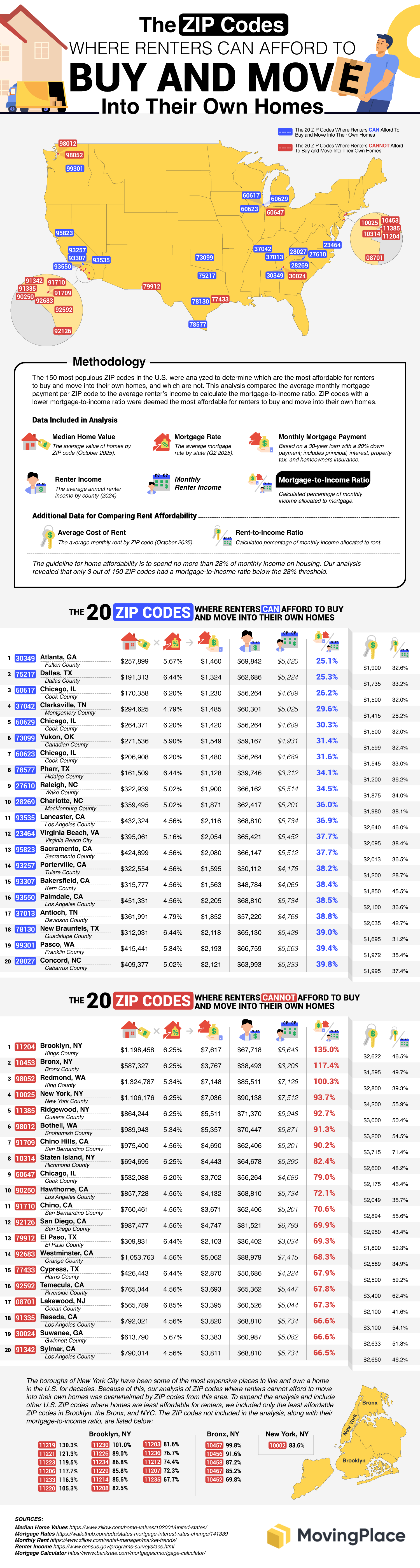
Yet, amid this challenging landscape, a new analysis from MovingPlace revealed that some ZIP codes still offered a realistic path from renting to owning.
The study examined 150 of the most populous ZIP codes in the U.S., calculating a key affordability metric called the mortgage‑to‑income ratio. This ratio compares the average monthly mortgage payment — including principal, interest, taxes, and insurance — with the typical renter’s income in the area. Using standard lending guidelines, which recommend that no more than 28% of gross income is spent on housing costs, the researchers identified which communities offered genuine opportunities for renters to become buyers.
Leading the list was ZIP code 30349 in Fulton County, Georgia. Found within the greater Atlanta region, this community stood out with the lowest mortgage‑to‑income ratio among the 150 ZIP codes studied. With median home values significantly below national urban averages, a household earning typical renter income in 30349 could reasonably meet monthly mortgage payments without exceeding conventional lending thresholds. For many young families and career professionals, this ZIP code represented a rare chance to transition into homeownership without sacrificing financial stability.
Not far behind were ZIP codes in Dallas (75217) and Chicago (60617), each offering similarly attractive ratios for prospective homeowners. These neighborhoods combined relatively affordable housing stock with sufficiently strong local renter incomes to put ownership within reach for many residents. Together, these and other ZIP codes on the list illustrated that affordability pockets still existed in major metro areas across the country.
However, the picture was starkly different at the other end of the spectrum. In cities like Brooklyn, New York (11204) and parts of the Bronx (10453), median home values had soared so high that mortgages would consume far more than 100 percent of typical renter income in those areas. In these ZIP codes, owning a home was not just difficult — by conventional measures, it was effectively impossible for renters without significant additional income or financial support.
Overall, the analysis underscored a tough truth: only a tiny fraction of ZIP codes in the largest U.S. markets met conventional affordability standards. Yet for renters determined to find a path to ownership, the data pointed to specific communities where that path, while narrow, was still clearly defined.
By MovingPlace.com