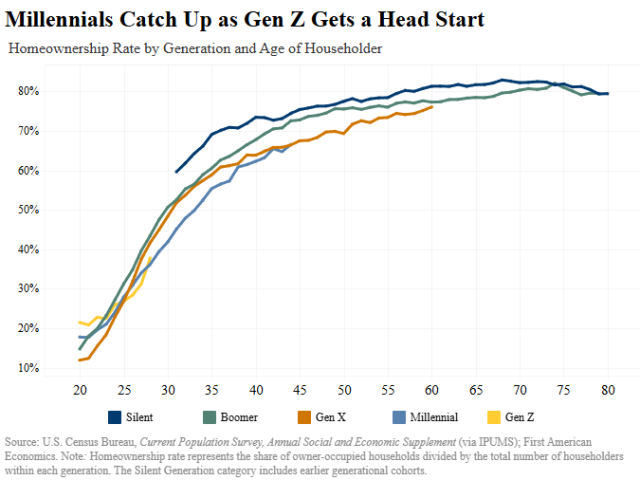
After a slower start, younger generations are rapidly catching up in homeownership, fueled by rising incomes, career stability, and family formation, with millennials now buying homes in their 30s at rates comparable to Gen X in their early 40s
Despite numerous headwinds that have forced millennials and GenZers to delay the pursuit of homeownership, the two generations are now “steadily” making progress on the ownership trail.
Sam Williamson, senior economist, First American
That’s the word from Sam Williamson, senior economist at First American, in his latest housing market commentary.
Williamson says millennials are accelerating their home purchases until their 30s, matching Gen Xers by their early 40s. Now, they are positioned to “modestly surpass” Xers as their incomes grow and family formations continue.
GenZers, meanwhile, are now “entering the housing market with surprising strength,” the economist writes, outperforming earlier cohorts in their early 20s and running 1.7 percentage points ahead of millennials at age 28.
Once upon a time, baby boomers and GenX’ers typically married, started families, and settled into careers earlier in their lives, which often led to buying homes in their late 20s or early 30s.
Get the NMP Daily
Essential stories, every weekday.
Millennials and GenZers, on the other hand, have spent more time in school and building careers. And as a result, they now face tighter housing supply and significant affordability headwinds, delaying marriage, parenthood, and buying their initial house.
The delay, according to Williamson, has widened the homeownership gap through their early 30s. By age 30, roughly half of boomers and Gen Xers owned a home. But millennials didn’t reach that mark until 33, while GenZers appear to be on a similar trajectory.
Millennials, the economist points out, are the largest and most educated generation in U.S. history. Once branded as “forever renters,” they are now “rapidly buying homes” in their 30s and reaching parity with GenXers by their early forties, “proving the dream of homeownership wasn’t dashed, just delayed.”
GenZers, he writes, are the newest face on the ownership ladder and they have “benefitted from pandemic-era low borrowing costs, wage gains, and remote work flexibility, which helped them buy sooner than previous generations.”
Their early-20s ownership rate tops prior cohorts and, by age 28, GenZ’ers are 1.7 percentage points ahead of millennials. According to the First American executive, “for a generation still in its 20s, this early strength suggests their ownership curve could match — or even edge past — millennials in their early 30s.”
GenXers, aka the housing market's “middle child,” also are reaching new milestones, Williamson reports. As the oldest Gen Xers hit their 60s, he says, they are narrowing the gap with boomers that opened in their 40s and 50s during the Great Financial Crisis. Xers “trail boomers by just 1.7 percentage points, and the distance shrinks each year,” he says.
The economist also believes boomers may finally provide a boost for which the market has long been waiting. Their ownership rates remain high well into their 70s, as most continue to age in place.
But as more hit their 80s, boomers are expected to finally but “gradually” return well-located properties to the market. This, Williamson says, will create a “demographic tailwind of supply that could accelerate younger buyers’ path to homeownership.”
With all this in mind, the economist’s forecast is a positive one.
“With affordability improving, inventory loosening, and buyer activity slowly gaining momentum into 2026,” he says, “the outlook sets a solid backdrop for younger generations to catch up as Gen Z rounds out its 20s and millennials settle into their late 30s and 40s.”
Lew Sichelman has been covering the housing and mortgage sectors for 52 years. His syndicated column appears in major newspapers throughout the country.
Wholesale lenders have adopted different rules for appraisal transfers, loan product changes, and reporting formats, adding complications for brokers and appraisers ahead of the Nov. 2 mandate
Brokers preparing for next week's appraisal deadline face more than a change in reporting forms. Depending on the wholesale lender, an appraisal ordered before Nov. 2 may be subject to different acceptance rules, a transferred report may face additional requirements, and a c...
Rocket Mortgage data shows purchases involving older co-applicants have remained resilient
Young Americans are buying fewer homes than they were seven years ago, but purchases involving older co-applicants are bucking the trend.Home purchases by borrowers under 35 have fallen 15% since 2018, while purchases involving a co-applicant age 55 or older have increased r...
First American’s September report shows higher-end appreciation leading in most tracked markets, while starter-home prices continue climbing in several Midwest and Northeast metros
DPR’s Q3 report identifies 311 programs without income limits and 1,080 without first-time buyer requirements, though funded availability grew more slowly than the overall count