Non-Agency originations could reach $500 billion this year. Are you ready to tap in?
AI makes human loan officers more essential, not less
Meet your your colleagues, both national and local, by attending an event in your area.
By Mortgage Banker Magazine
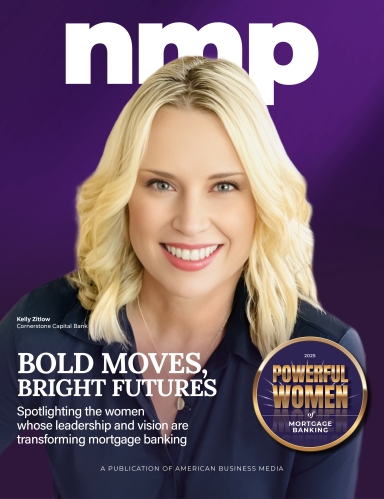
Mortgage Banker highlights the women who are making an impact. We recognize and honor the Powerful Women of Mortgage Banking — it’s important for women to see women leaders within the industry, especially in areas where they may not expect to see them in great numbers, such as technology, finance, and the C-suite.
Read about the women who are moving the needle by setting an example and holding the door for their peers and the next generation of powerful women in mortgage banking.
By Mortgage Banker Magazine
Mortgage Banker highlights the women who are making an impact. We recognize and honor the Powerful Women of Mortgage Banking — it’s important for women to see women leaders within the industry, especially in areas where they may not expect to see them in great numbers, such as technology, finance, and the C-suite.
Read about the women who are moving the needle by setting an example and holding the door for their peers and the next generation of powerful women in mortgage banking.
“A borrower’s financing options should be determined by their ability to repay, not by the type of third-party documentation utilized to paper the loan application.”
My mortgage experience is rooted in alternative lending, and my educational background in art history trained me to view ideas as contradictory. As such, I am solution-oriented while challenging the status quo. This perspective, combined with a strong command of the Non-QM space, has contributed to growth and advancement in the non-agency industry. Specifically, in the second lien space, at Vista Point, we brought to the market equity options for borrowers that need alternative income documentation types. Considering the interest rate environment and HPA since late 2020, this is an incredibly important financial tool that homeowners broadly did not have access to for the last decade.
Over the last five years there have been some dramatic ideological shifts transferring focus away from traditional agency lending — namely, the growth of Non-QM and second liens. However, with the binary approach of QM versus Non-QM, there is a gap in terms of the breadth of accessibility and pricing for the consumer. There needs to be a mindset shift towards broad adoption of alternative documentation that is omnipresent from bond investors to Loan Officers. A borrower’s financing options should be determined by their ability to repay, not by the type of third-party documentation utilized to paper the loan application.
Broadly, the next generation of homeowners struggle with financial overwhelm and muted trust in traditional institutions. It is our responsibility to empower future homeowners with financial education through clear, visual, and inclusive formats. From my seat, product offerings need to be relentlessly developed to mirror the evolving ways that we work. In the Non-QM space, we need to continue fine-tuning and advancing our income documentation and qualification methodologies to stay ahead of various employment and financial pathways. Simultaneously, it will be crucial to foster industry education promoting uniformity of underwriting standards. It is imperative that continuity and liquidity remain in a positive feedback loop between origination and capital markets execution.
“Known internally as a resourceful problem-solver, she leads with empathy and integrity, creating a culture where exceptional service is the norm even amid rapid growth.”
The following winner profile was written from the information provided in the nomination.
As Vice President of Customer Success at Argyle, Shelby Bohannon is redefining what it means to deliver white-glove service in the mortgage industry. Leading a fast-growing team of customer success managers and engineers, she ensures more than 150 mortgage lenders extract maximum value from Argyle’s income, employment, and asset verification platform.
Promoted twice in just three years, Shelby has built the systems and standards that underpin Argyle’s success. She designed onboarding and training processes, implementation frameworks, and customer-facing analytics that empower lenders to achieve measurable ROI quickly and sustainably. Her collaborative leadership style has enabled her team to scale by 800%, supporting a tenfold increase in verification volume in just one year. Today, Argyle maintains industry-leading conversion rates above 55% while helping lenders reduce verification costs by up to 80% — results directly tied to Shelby’s leadership.
Beyond operations, Shelby serves as a critical link between Argyle’s clients and product teams. She translates customer feedback into innovation, drives adoption of new features, and mentors her team not only to support but to strategically advise lenders. Known internally as a resourceful problem-solver, she leads with empathy and integrity, creating a culture where exceptional service is the norm even amid rapid growth.
Shelby’s influence extends beyond Argyle’s customers to the mortgage industry at large. At a time when practices such as trigger leads are under bipartisan scrutiny, she is helping lenders embrace a transparent, consumer-permissioned model of data usage. By championing Argyle’s privacy-first verification technology, Shelby is enabling lenders to align with both regulatory requirements and consumer expectations — reshaping the industry’s approach to borrower trust and data ethics.
From onboarding Argyle’s very first mortgage client in 2021 to now advising some of North America’s largest lenders, Shelby has been instrumental in scaling a platform that is not only operationally efficient but also values-driven. Her ability to combine strategic insight with human-centered leadership ensures her legacy will be one of innovation, transformation, and raising the standard for customer experience across the mortgage ecosystem.
“Finally, the industry must commit to personalization at scale. Borrowers no longer fit into one-size-fits-all mold.”
“Finally, the industry must commit to personalization at scale. Borrowers no longer fit into one-size-fits-all molds; products, underwriting, and servicing must evolve to reflect financial realities, not just credit scores.”
With nearly 30 years of credit and risk management experience spanning both commercial and residential mortgage lending, I bring a unique cross-sector perspective to the private lending space. My expertise lies in building scalable, ground-up mortgage operations that balance efficiency with responsible risk practices. I've worked across every operational facet — credit, technology, production — which allows me to apply a risk-aware, common-sense approach grounded in operational reality. I’ve also championed the integration of evolving tech stacks to optimize processes and enhance value to brokers and their investor clients. By bridging the precision of traditional lending with the agility of private capital, I’ve helped shape more cost-effective, tech-forward, and market-responsive lending platforms.
Leadership wasn’t my initial goal — I entered the industry wanting to contribute, learn, and drive results. But over time, it became clear that leading meant more than managing: it meant creating structure, trust, and vision that empower others. My current role as Chief Credit Officer at Constructive Capital represents a culmination of my journey. I’ve implemented best practices from traditional lending into the private mortgage sector, bringing disciplined credit practices and a scalable tech-driven operations model to a fast-evolving space. Seeing how these systems produce consistent results — and witnessing the confidence of my team — showed me that leadership is less about titles and more about building environments where people thrive and ideas execute. That’s when I recognized my own influence and responsibility as a leader.
Three bold shifts are necessary. First, the industry must fully embrace data accessibility and utilization. This is not just data collection — but thoughtful deployment that empowers precision and transparency. Second, technology must be democratized — providing small and mid-size lenders with tools that improve operational efficiency and guard against fraud. This also enhances the customer experience and regulatory compliance. Finally, the industry must commit to personalization at scale. Borrowers no longer fit into one-size-fits-all molds; products, underwriting, and servicing must evolve to reflect financial realities, not just credit scores. This new reality will require collaboration across tech, capital, and policy stakeholders. Together, these changes will define a mortgage ecosystem that is smarter, more inclusive, and better equipped to meet the diverse needs of future homeowners and investors alike.
“Technology should enhance human connections, not replace them. ”
The turning point for me came when I realized my instinct to immediately jump in and solve problems could actually empower others if channeled differently. Early in my operational leadership role, I found myself constantly firefighting — which people appreciated, but the approach didn't necessarily develop their capabilities. I shifted from being the problem-solver to being the enabler of problem-solvers. When I started asking questions instead of providing answers, and when I began giving teams the authority to implement their solutions, I saw exponential improvements in both performance and engagement. That's when I understood that true leadership power comes from multiplying others' capabilities, not showcasing your own.
The defining shift will be moving from transaction-focused to relationship-focused operations. Technology should enhance human connections, not replace them. Future leaders will understand that while automation can handle routine processes, the mortgage journey involves life-changing decisions that require empathy, guidance, and personalized support. The innovation lies in seamlessly blending digital efficiency with human insight. Leaders who can create systems that use technology to free up their teams for higher-value interactions — coaching customers through complex decisions, providing education about homeownership, building long-term relationships — will differentiate themselves. Success will be measured by customer lifetime value and return clients rather than just closing speed.
We need fundamental process redesign that better prioritizes transparency and education. The industry must move beyond compliance-driven thinking to create genuinely customer-centric experiences. This means building systems that help borrowers understand their options, not just qualify for products. We need to eliminate redundant documentation requirements and create seamless data sharing between stakeholders while maintaining security. Most importantly, we must develop flexible lending models that recognize diverse income patterns and life circumstances that define modern careers. The bold change is treating homeownership as a long-term partnership rather than a single transaction, providing ongoing support and guidance throughout the entire homeownership journey.
“If you can get people to work with one another and listen to each other, you can achieve great things.”
In my current role as Chief of Staff I have the opportunity and responsibility to work with all levels of the organization to find roles for women and underrepresented voices. I am proud to say that at CMG four of the twelve members of our Executive Management Team are women and half of our Senior Sales leaders are women. This is something that I and CMG take very seriously. We are big proponents of promoting from within and everyone at CMG has a voice.
My background is Financial Services but not Mortgage so I had a big learning curve. I was a sponge to the knowledge my fellow leaders shared with me. I think the willingness to learn, to get one another to work with each other, no matter what different backgrounds you come from matters. If you can get people to work with one another and listen to each other, you can achieve great things. I'm proud of the teams I've brought together, the work we've done to onboard 1,100 people on one day, and the continued effort our teams put in every day to achieve amazing results. Leading is about listening and encouraging. We do it together.
We can't lose sight of why we're in this business. We need to get people into homes. Help people create wealth for their families. If we can stay focused on those goals and educate, I think we'll be just fine. Change is inevitable and we can't fight it, we just need to be smart and work with it.
“Equally important is Jennifer’s dedication to mentoring and advocacy. She has long believed that progress in mortgage banking requires empowering people as much as innovating systems.”
The following winner profile was written from the information provided in the nomination.
Jennifer McGuinness has spent more than 25 years shaping and advancing the mortgage banking industry, leaving an indelible mark through innovation, leadership, and advocacy. Her rare “full lifecycle” expertise — covering lending, banking, aggregation, servicing, securitization, and structured finance — sets her apart in an industry where professionals often specialize in only one discipline.
Her career is defined by a series of groundbreaking milestones. Jennifer was a principal of the first hedge fund to issue AAA-rated Residential Mortgage-Backed Securities (RMBS) collateralized by newly originated mortgage loans. She helped pioneer the single-family rental asset class, bringing the DSCR mortgage product to market at a time when it was only an idea. She later designed the first secondary market–tradable first-lien HELOC product by eliminating the traditional bank sweep structure and creating a custom servicing solution. Today, she leads the first woman-owned mortgage loan aggregator and asset manager, further cementing her role as a trailblazer.
Jennifer’s contributions extend well beyond product innovation. During the housing crisis, she worked in Washington, D.C. to help design programs that could stabilize both borrowers and investors. Currently, she and her team at Pivot are creating a securitization framework that gives small- to mid-sized lenders direct access to liquidity — providing them with flexibility, independence, and a greater opportunity to compete in the market. Pivot’s asset management division also supports lenders through due diligence services, repurchase defense, loss mitigation optimization, and litigation support, helping institutions navigate complex challenges with confidence.
Equally important is Jennifer’s dedication to mentoring and advocacy. She has long believed that progress in mortgage banking requires empowering people as much as innovating systems. This year, she partnered with the Mortgage Women Leadership Council to launch Breaking Barriers, a live webinar series designed to help hundreds of industry professionals — both men and women — address the real challenges they face daily and develop strategies for success.
Jennifer McGuinness embodies the qualities of a true industry leader: innovative, resilient, and committed to the betterment of the entire mortgage ecosystem. From creating first-of-their-kind financial products to mentoring the next generation of talent, her influence reaches every corner of the profession. Her career reflects not only perseverance and vision, but also a passion for ensuring the industry evolves in ways that benefit lenders, borrowers, and communities alike.
“On the leadership side, it’s a different challenge entirely — I find that it's about paying attention to how my words and behaviors spur other people to take action.”
A turning point took place while I was at Fannie Mae and was looking to move into a leadership role. An executive told me to think about the difference between being a strong manager and a strong leader, and pointed out that few are good at both. That’s when I realized that I would need to work on both as separate skills entirely.
On the manager side, I’m lucky to have experienced Fannie Mae’s Way of Working program, which gave me access to 1x1 manager coaching over a period of many months. Structured feedback and coaching, performance management, organizational design are all important aspects of being a manager.
On the leadership side, it’s a different challenge entirely — I find that it's about paying attention to how my words and behaviors spur other people to take action. It’s more about understanding my own values and being deliberate about how I show up.
I strive to work on both skills every day.
Future generations will demand frictionless experiences that are tailored to their preferences. As a borrower, I should be able to quickly access information about loan options through any kind of “front door” that meets my needs, whether that is an app on my phone, or a voice-bot like Betsy, a loan officer avatar, or an actual human being.
The bold change that must happen is that mortgage lending leaders have to actually do the hard work of reimagining the experience and putting it into place. And that probably requires building technology from scratch, which is what the Better team began 10 years ago. Now the rest of the industry can benefit from that hard work as Better is licensing its Tinman AI Platform to other lenders.
Artificial intelligence, specifically generative AI and agentic systems will redefine every industry, and the winners will be the ones that test and learn and fail fast and iterate.
Mortgage banking is not known to be an industry that is able to pivot quickly — the leaders of the future will realize that it is an easy competitive advantage to be able to change, and therefore the technology platforms of the future will be those that are most flexible.
“That moment taught me that my power as a leader isn’t in giving orders — it’s in lifting others up and creating space for them to shine.”
This question is so personal for me. I had no one clearing a path for me; I had to carve it out myself. And I made a promise: no one coming up behind me should have to do it alone. I’ve mentored women and underrepresented professionals across every stage of my career by helping them see strengths they didn’t know they had, advocating for their promotions, and connecting them with meaningful opportunities. I’ve been told more than once, “You see me. Thank you.” That stays with me. I believe leadership is about using your seat at the table to make room for others. I challenge outdated norms and make it a point to spotlight talent that might otherwise be overlooked. Watching someone I’ve mentored rise is the most rewarding part of my work. For me, it’s all about clearing the path and making sure others can run — even faster than you.
We need to stop thinking in terms of incremental improvements to meet the needs of future generations. That means using technology to make lending more transparent, more inclusive, and more user-friendly. AI should help reduce bias and accelerate decision-making. Regulations must strike a balance between protecting consumers and enabling innovation, rather than stifling it. Affordability programs also need to be modernized to reflect today’s economic realities, ensuring homeownership remains attainable for diverse communities. Ultimately, the industry’s future depends on its ability to deliver a lending experience that is efficient, equitable, and adaptable — for everyone.
The real shift happened when I stopped trying to control every outcome. It meant trusting my team and creating space for them to thrive. Early in my career, I thought leadership meant having all the answers. But the moment I stepped back and trusted my team to lead, I saw something amazing happen: stronger outcomes, faster problem-solving, and a culture of ownership. That moment taught me that my power as a leader isn’t in giving orders — it’s in lifting others up and creating space for them to shine. Once I understood that, everything changed. The results got better, but so did the energy. People thrived. That’s when I knew I had found my power: not in directing traffic, but in building confidence and clearing obstacles so others could lead.
“By marrying tech efficiency with people-centered service, future leaders will create an industry that is more transparent, inclusive, and sustainable.”
As a first-generation Dominican American and licensed mortgage professional, I bring a unique perspective rooted in resilience, representation, and financial literacy. My expertise lies in bridging the gap between underserved communities and access to capital — helping individuals and small business owners see homeownership and wealth-building as achievable. I’ve impacted the industry by blending cultural awareness with financial strategy, making complex lending processes approachable and inclusive. This perspective not only drives better outcomes for clients but also inspires other professionals to lead with purpose and empathy.
The next generation of mortgage leaders will be defined by balancing technology with humanity. Automation and AI will streamline processes, but true leadership will come from empathy, cultural competence, and trust-building. Instead of focusing solely on transactions, leaders will shift toward transformation — empowering clients with knowledge, financial literacy, and accessible tools. By marrying tech efficiency with people-centered service, future leaders will create an industry that is more transparent, inclusive, and sustainable. This mindset shift will set apart those who see lending not just as numbers, but as a way to change lives.
My true turning point came when I founded Leona Capital, a commercial brokerage dedicated to serving Latino small business owners. Helping entrepreneurs secure funding to expand their businesses showed me leadership isn’t about titles but about impact. I recognized my power when I saw the ripple effect of my work: business growth, community uplift, and inspiration for future leaders. That moment cemented that my voice and vision mattered — not only to my clients, but to other women and underrepresented professionals who could see themselves reflected in my journey.
“To me, leadership is about serving, influencing, and helping others grow into the best versions of themselves.”
I have never viewed leadership as power. To me, leadership is about serving, influencing, and helping others grow into the best versions of themselves. I have always had a genuine desire to see others succeed, walking alongside them as they grow, coaching them through challenging moments, and picking them up when they fall.
The turning point came when I recognized the impact of leading by example. By consistently showing up, sharing what I know, and being honest about not always having all the answers, I saw how it gave others permission to do the same. That was when I understood the true weight of influence and that leadership, at its best, is about creating space for others to thrive.
I have always believed that progress comes from leaning into change early, even when it is not yet comfortable. In 2013, I launched my first YouTube channel focused on delivering value to real estate agents. At the time, very few professionals in the mortgage space were using digital platforms or video in this way, and it truly felt like new territory.
That early move not only gave me a front row seat to the power of technology, video, and social media to educate, connect, and build trust, but it also helped me establish and grow my personal brand. Today these tools are common, but being an early adopter allowed me to help shape how our industry began to think about showing up, providing value, and creating community online. That willingness to innovate and adapt is what I believe has had the greatest impact on my work and the industry.
For me, creating opportunities in mortgage banking begins with the courage to take a seat at the table and use my voice. I’ve made it a priority to mentor and spotlight others in the industry, so they recognize that their perspective matters. That same commitment led me to co-found Women Building America, which introduces young women to careers in the homebuilding trades they may not have considered. Along the way, I’ve focused on showing up, opening doors, and helping others believe there is a place for them to grow and lead in this industry.
Non-Agency originations could reach $500 billion this year. Are you ready to tap in?
AI makes human loan officers more essential, not less
Meet your your colleagues, both national and local, by attending an event in your area.