The latest industry data points to a continued decline in mortgage rates and cash sales, along with a mixed prediction of homeownership break-even timelines and a positive forecast for the commercial real estate world.
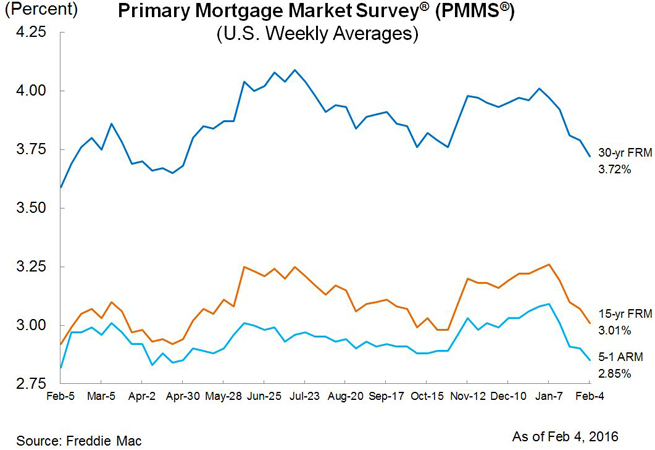
According to the Freddie Mac Primary Mortgage Market Survey (PMMS), the 30-year fixed-rate mortgage (FRM) averaged 3.72 percent for the week ending Feb. 4, down from last week when it averaged 3.79 percent. The product is now at its lowest point since the week of April 30, 2015 when it averaged 3.68 percent. The 15-year FRM this week averaged 3.01 percent, down from 3.07 percent last week, while the five-year Treasury-indexed hybrid adjustable-rate mortgage (ARM) averaged 2.85 percent this week, down from last week when it averaged 2.90 percent.
Sean Becketti, chief economist at Freddie Mac, tried to spin the bad news by making lemonade from the lemon-heavy data.
“These declines are not what the market anticipated when the Fed raised the Federal funds rate in December,” Becketti said. “For now, though, sub-four-percent mortgage rates are providing a longer-than-expected opportunity for mortgage borrowers to refinance.”
Potential homebuyers might also appreciate the data results from Zillow's Breakeven Horizon analysis for the fourth quarter of 2015, which determined that Americans can break even on a home purchase in less than two years in 70 percent of metros markets. While some major markets would require at least three years before home buyers can break even–most notably in the pricey Bay Area–the combination of low interest rates and optimistic home value forecasts created a vibrant homeownership environment for many.
Yet Zillow Chief Economist Svenja Gudell warned that many Millennials would not benefit from this situation, adding that they might want to delay homeownership unless they planned to put down roots in their current locations.
"Even with record-high rents in job centers like San Jose, Boston and Washington, D.C., putting off a home purchase might be the best financial decision for a young person who has saved enough for a downpayment, depending on how long they intend to stay in their jobs and homes," Gudell said. "Young workers face a lot of hurdles on the way to homeownership, including saving for a downpayment in the first place and deciding where and when to settle down. The latest Breakeven Horizon gives young people another data point to consider when they're making this important financial decision."
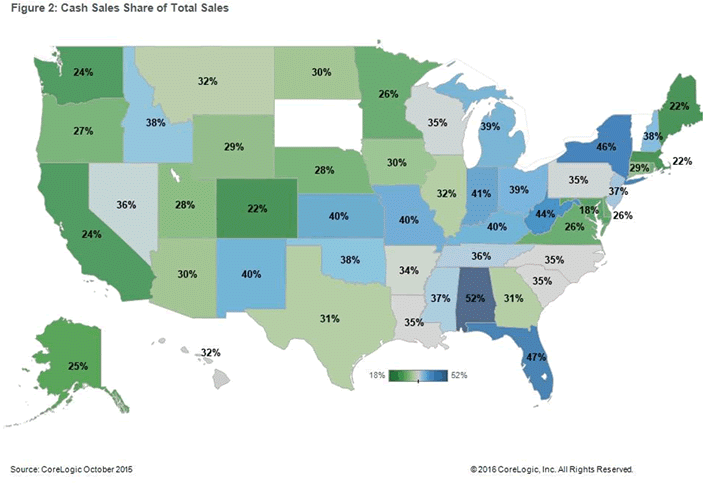
On the industry side, some mixed news for mortgage professionals came via CoreLogic, which reported that cash sales accounted for 33.9 percent of total home sales in October 2015, down 2.6 percent from a year earlier age but up 1.4 percent from the previous month. Real estate-owned (REO) sales had the largest cash sales share in October 2015 at 59.7 percent, but these transactions accounted for only 7.3 percent of all sales in October.
Alabama had the largest cash sales share of any state at 51.7 percent, followed by Florida (46.7 percent), New York (46.3 percent), West Virginia (44.4 percent) and Indiana (40.8 percent). Florida’s Miami-Miami Beach-Kendall market had the highest cash sales share for a major metro area at 51.6 percent, while Syracuse, N.Y., saw the lowest metro market cash sales share at 13.9 percent.
But there was good news on the commercial real estate side of the industry: the newly published “Expectations & Market Realities in Real Estate 2016—Navigating through the Crosscurrents” is forecasting gradual growth in all commercial sectors. The report, which is published jointly by Situs Real Estate Research Corporation, Deloitte and the National Association of Realtors (NAR), predicted a slight decline in vacancies for all property types except in the apartment sector, where a modest increase is expected by the end of the year.
“Supported by solid hiring in most parts of the country, the demand for ownership and rental housing will continue to increase in 2016 despite another year of meager economic expansion,” said Lawrence Yun, NAR chief economist. “While supply shortages will weigh on housing affordability and push home prices and rents higher, the housing sector will keep the U.S. economy afloat and lead the residential investment component of GDP growth by up to 10 percent this year.”
Data is curated by credio.com