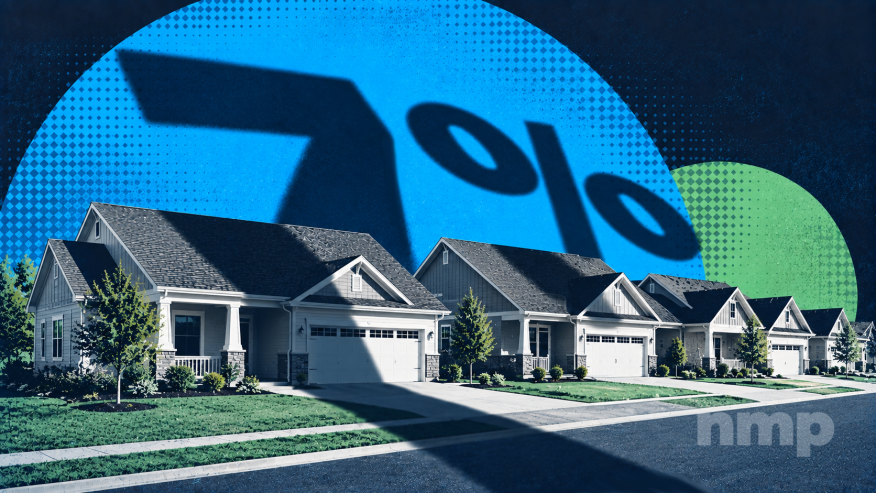
Mortgage rates have officially broken back above 7%, just as builders were showing some success getting buyers across the finish line.
The average 30-year fixed mortgage rose to 7.03% for the week ending Sept. 24, up from 6.95% a week earlier and 6.30% a year ago, according to Freddie Mac. The 15-year fixed climbed to 6.42% from 6.26% the previous week and 5.49% a year earlier.
The move has been swift. Freddie's 30-year average stood at 6.76% on Sept. 10, meaning it has increased 27 basis points in two weeks.
The timing is notable because new government data released Thursday showed that one part of the purchase market had just gained some traction.
Builders Find A Way To Move Buyers
New-home sales rose to a seasonally adjusted annual pace of 684,000 in August, up an estimated 6.4% from July but still 2% below a year earlier, according to the U.S. Census Bureau and Department of Housing and Urban Development.
The median new-home price fell 5.8% from a year earlier to $393,700. That was $35,400 below the $429,100 median price of an existing home sold in August, extending a stretch in which new homes have been cheaper than existing homes.
First American Senior Economist Sam Williamson said new homes have now been cheaper than existing homes for six consecutive months.
“New-home sales bounced back in August as builders continue to meet buyers where their budgets are,” Williamson said. “Price cuts, incentives, and a shift toward smaller, more affordable homes are helping builders get deals across the finish line.”
The sales mix reinforces that shift.
Williamson noted that 52% of new homes sold in August were priced below $400,000, up from 46% a year earlier. Nearly three-quarters, or 74%, sold for less than $500,000, compared with 65% in August 2025.
Some of that change reflects builder discounts, Williamson said, while product mix is also playing a role as builders construct and sell smaller homes.
Builders are not relying on one affordability lever. They are changing the product, cutting prices, and using financing incentives at the same time.
Incentives Are Doing More Of The Work
Builders are leaning harder on incentives, too.
In September, 66% of builders offered sales incentives, up from 63% in August and the highest share since December, according to NAHB. Another 38% cut prices, up from 35%, while the average reduction held at 6%.
Rate buydowns and closing-cost assistance give builders another lever to lower buyers’ monthly costs. As NMP recently reported in More New Homes Are Underway, But Financing May Decide Who Wins, that can also give builder-affiliated lenders an advantage when competing for purchase loans.
Still, builders aren't signaling a strong market. The NAHB/Wells Fargo Housing Market Index fell three points to 32 in September, its lowest reading in a year. Measures of current sales and sales expectations also declined.
Ali Wolf, chief economist at NewHomeSource and Zonda, described the market as “slow, competitive, and challenging.”
“Your dollars can stretch further with new homes than resale homes right now, especially as more builders are lowering prices and offering attractive rate buydowns,” Wolf said. “It’s tough out there, but the new home market continues to hold its ground.”
Mortgage Demand Tells A More Cautious Story
Mortgage applications for newly built homes fell 6% from July and 5.5% from a year earlier in August, according to the Mortgage Bankers Association's Builder Application Survey. It marked the fifth consecutive monthly decline and the lowest application level of 2026.
FHA loans accounted for 35% of builder applications during August, while the average loan amount declined to $373,194.
That product mix provides another sign of how payment-sensitive new-home buyers have become.
The Census sales report and MBA application survey measure the market differently and should not be read as contradictory. Census estimates completed sales contracts, including cash transactions, while MBA's Builder Application Survey tracks mortgage applications through builder-affiliated lenders and uses those data to estimate sales.
Taken together, the reports suggest builders are finding ways to close transactions, but they are having to work harder to do it.
What 7% Does To The Payment
The latest mortgage-rate move makes that work harder still.
At August's $393,700 median new-home price, a buyer putting 20% down would finance about $314,960. At 6.30%, the Freddie Mac rate a year ago, principal and interest would be about $1,950 a month. At 7.03%, it rises to roughly $2,102, an increase of $152 a month or more than $1,800 a year, according to an NMP calculation.
The calculation excludes taxes, insurance, and other housing costs.
That gap helps explain the power of builder-funded rate buydowns. The competition isn't necessarily about matching a subsidized rate. It's about helping borrowers understand what the incentive is worth, whether the buydown is temporary or permanent, and how the total financing cost compares with an outside offer.
The pressure isn't limited to new construction. Existing-home sales fell 2% in August to a 3.98 million annual pace even as inventory climbed to 1.62 million homes. Buyers have more choices and sellers have more competition, but with mortgage rates back above 7%, converting that leverage into an affordable monthly payment remains the challenge.
The Fed Isn't Setting That 7.03%
The latest move gives originators a timely borrower conversation.
The Fed controls a short-term interest rate used by banks, not the rate on a 30-year mortgage. Mortgage rates are influenced more directly by what investors are willing to pay for longer-term bonds, particularly mortgage-backed securities, with the 10-year Treasury often serving as a key benchmark.
Those markets react to inflation, economic growth, and expectations about where interest rates are headed. So mortgage rates can rise or fall regardless of what the Fed does at a particular meeting.
That's not widely understood. Rocket Mortgage research previously reported by NMP found 63% of Americans surveyed were unclear about the Fed's role in mortgage rates, while 35% believed the Fed directly sets them.
For originators, the takeaway is practical: a Fed announcement doesn't guarantee a better or worse mortgage rate. What matters to the borrower is the rate available when they're ready to lock and what that rate does to the monthly payment.
Buyers may have more inventory, negotiating room, and builder incentives available, but those advantages only go so far if the payment no longer works. At 7% and above, helping borrowers understand their options and structure a workable payment may be what gets a purchase loan to closing.