
Are Homeowners Better Off in Red or Blue States? – NMP Skip to main content

Are Homeowners Better Off in Red or Blue States?

Oct 05, 2016
While few politicians are talking about housing issues in this election year, it appears that both parties have reason to shine some partisan light on their local housing markets

While few politicians are talking about housing issues in this election year, it appears that both parties have reason to shine some partisan light on their local housing markets.

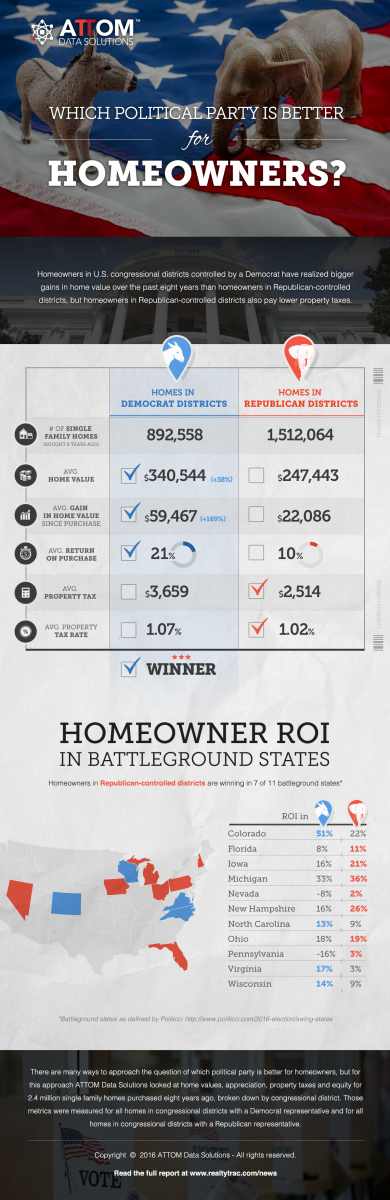
According to a new study by ATTOM Data Solutions, homeowners living in congressional that are currently in Democrat control gained more than twice as much in housing wealth over the past eight years as homeowners living in Republican-controlled districts. In a national number-crunch of 2.4 million single family homes purchased eight years ago, ATTOM affirmed that congressional districts with a Democrat in the House of Representatives gained an average $59,467 in value since their 2008 purchase, or a 21 percent return, compared to a $22,086 average increase in value, or a 10 percent return, for the homes in Republican-controlled districts.

However, homeowners in Republican-controlled districts enjoy much lower property taxes: $2,514 on average representing a 1.02 effective tax rate, versus the $3,659 representing a 1.07 percent tax rate for homeowners living in Democrat-controlled districts. And in seven of the 11 battleground states up for grabs in this year’s presidential election, homeowners in Republican-controlled districts enjoy higher returns on investment.

About the author
Published
Oct 05, 2016
MISMO Launches AI Governance Framework For Mortgage Lenders

New FRAME toolkit gives lenders, servicers, and technology providers a roadmap for managing AI risk while supporting innovation

CFPB Tells Lenders Immigration Status Can Factor Into ATR Analysis

CFPB frames immigration status as a potential ability-to-repay factor when future U.S.-based income is at risk

UAD 3.6 Deadline Nears; First American Earns Verification

First American's ACI Sky Workbench gains verification ahead of the Nov. 2 implementation date for the GSEs' updated appraisal reporting requirements

MISMO Introduces New Loan Boarding Standard

Wrapper Files support standardized data transfers between origination and servicing systems, with potential savings of $60 to $160 per loan

The GLBA Compliance Gap Your AI Deployment Just Opened

Old statutes, new models, and the vendor contract you signed before machine learning became operational

FHA Keeps Tri-Merge Credit Reports While Expanding Approved Scoring Models

HUD says FHA lenders will continue using three-bureau credit reports even as the agency adopts newer scoring models aimed at increasing competition and modernizing mortgage underwriting


