Last week, the Consumer Financial Protection Bureau (CFPB) released a public inquiry asking what studies are available that measure the impact of closing costs on overall costs, housing affordability, access to homeownership, or home equity. Coincidentally, a relevant report was published, April 2024, by JPMorgan Chase Institute that points to race, income, and financial literacy among the driving factors.
In the April 2024 report, “Hidden Costs of Homeownership: Race, income, and lender differences in loan closing costs,” it found that closing costs vary significantly by the type of lender, with banks having less expensive closing costs, on average, than nonbanks and brokers.
“The choice of lender plays a pivotal role, significantly impacting the financial strain a borrower may face,” the report stated. “We noted marked differences in pricing structures across the various lending institutions in our sample.”
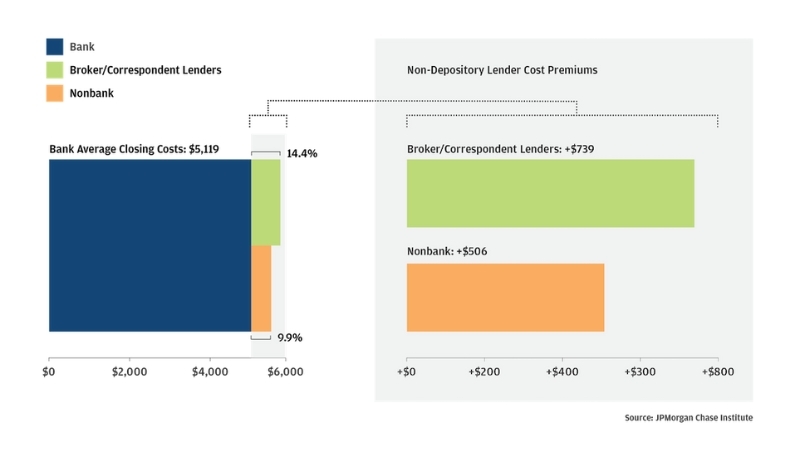
Borrowers with bank-originated loans paid an average $5,119 in closing costs, which the report calls a significant burden for borrowers with low incomes. The baseline cost for borrowers in the lowest income quartile averaged 11.6% of their average annual income. However, the picture gets worse when analyzing closing costs among brokers and nonbanks.
According to the report, borrowers who choose broker-intermediated loans can expect their loans to be, on average, $739 more expensive than if they had dealt with a bank, amounting to a 14.4% surcharge. Similarly, those opting for nonbanks are likely to face an average markup of $506, or an additional 9.9%.
Additionally, the report found racial disparities in closing costs among all lender types, with Black and Hispanic borrowers facing a higher average closing cost compared to white borrowers. Black borrowers, on average, paid $256 more in loan fees, and Hispanic borrowers, on average, paid $270 more in loan fees compared to white borrowers. At nonbanks, the differences increase to $336 and $462 for Black and Hispanic borrowers, respectively. For broker/correspondents, the differences increase to $812 and $590 for Black and Hispanic borrowers, respectively.
The report acknowledges that nonbanks, including brokers, are more likely to serve minority borrowers than traditional banks, though it comes with a cost.
“While this specialization expands access to credit in underserved communities, it may inadvertently lead to additional closing cost burdens for these groups,” the report stated. “A factor not entirely captured by assessing racial disparities alone.”
The report also mentions how financial literacy may be an underlying factor that is driving up closing costs, suggesting that it affects the consumer’s ability to shop for mortgage efficiency and use cost saving techniques.
“Just 28.4% of those surveyed understand the relationship between points and interest rates. Not understanding the mechanics of this trade-off can lead to costly decisions that are cost-effective in the short term but significantly increase costs over the loan’s lifetime,” the report read.