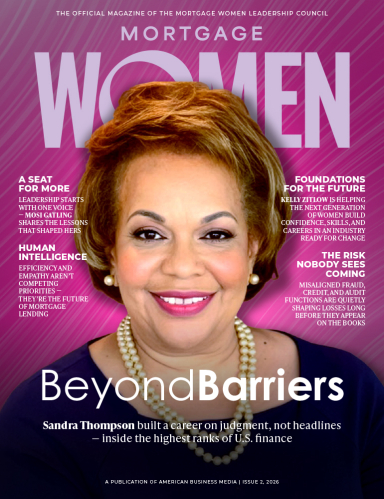
Sandra Thompson on reading it, leading it, and embracing the fact that perfection is never the requirement
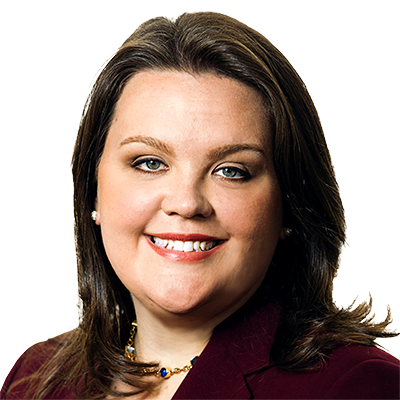
By Jennifer McGuinness-Lubbert, CEO, Pivot Financial, Special To Mortgage Women Magazine
COVER STORY
BeyondBarriers
Sandra Thompson on reading it, leading it, and embracing the fact that perfection is never the requirement
By Jennifer McGuinness-Lubbert, CEO, Pivot Financial, Special To Mortgage Women Magazine
Sandra Thompson’s rise to the top of financial regulatory oversight — spanning leadership at the Federal Deposit Insurance Corp. (FDIC) and the Federal Housing Finance Agency (FHFA) — was driven not by the obstacles she faced, but by her refusal to be constrained by them.
In a career marked by historic firsts, Thompson became the first African American and the first woman to lead bank supervision at the FDIC. She later broke new ground as the first female Director of FHFA. Her legacy is measured not by the barriers she overcame, but by the discipline, judgment, and leadership she brought to roles at the very center of the U.S. financial system.
In this conversation, Jennifer McGuinness-Lubbert sits down with Thompson to discuss her career, the decisions and perspective that guided her ascent—and how her experience offers lessons other women can draw on as they build their own careers in financial services.
Sandra Thompson’s rise to the top of financial regulatory oversight — spanning leadership at the Federal Deposit Insurance Corp. (FDIC) and the Federal Housing Finance Agency (FHFA) — was driven not by the obstacles she faced, but by her refusal to be constrained by them.
In a career marked by historic firsts, Thompson became the first African American and the first woman to lead bank supervision at the FDIC. She later broke new ground as the first female Director of FHFA. Her legacy is measured not by the barriers she overcame, but by the discipline, judgment, and leadership she brought to roles at the very center of the U.S. financial system.
In this conversation, Jennifer McGuinness-Lubbert sits down with Thompson to discuss her career, the decisions and perspective that guided her ascent—and how her experience offers lessons other women can draw on as they build their own careers in financial services.
Jennifer McGuinness-Lubbert: When you were growing up, did you plan a career in financial services and in Washington, D.C.?
Sanda Thompson: My career was not planned. I knew I was good at math, and I wanted to work with numbers. Right before I began my freshman year at Howard University’s School of Business, I read an article in the Chicago Tribune about an African American partner at Arthur Andersen — one of few, if not the only, black partner, he was a Howard graduate. I took a chance and called his office, and he invited me to spend a day shadowing him.
That experience left a lasting impression. I saw what success could look like. In between meetings, he gave me advice I’ve carried with me ever since: he said, “don’t just do what you’re good at — do what you love.” At the time, I told him I just wanted to make money. He smiled and said, “You can do both.”
I initially majored in accounting, but it wasn’t for me. I switched to finance, which I loved. After graduating, I began my career as a programmer. This role gave me a deep understanding of how loans work — payments, interest, amortization — I found it fascinating and then moved into mortgage finance at Goldman Sachs.
The pivotal moment of my career came when I moved to Washington, D.C. and joined the Resolution Trust Corporation (RTC) during the savings and loan crisis. I helped “stand up” the government’s securitization program and later continued that work at the FDIC, which then led to me joining FHFA and ultimately becoming Director.
JML: What advice would you give to women beginning their career in this industry?
ST: Be fearless — but with finesse. Be confident, be prepared, and be willing to speak up — but do it with professionalism and respect. Don’t be intimidated by people who know more than you do, you don’t have to be perfect. Know when to speak, and just as importantly, know when to listen. Manage your ego, don’t use your position to diminish others. Treat everyone — at every level — with dignity and respect. Focus on what you can control. Do excellent work. First impressions matter.
At the same time, don’t carry unnecessary weight, don’t let fear or self-doubt limit how you show up. Keep your word, be on time or early, reputation matters more than people realize.
Seek out mentors who you can speak with candidly about understanding how organizations function, there are office dynamics and then there’s politics. Having people you trust to help you navigate is invaluable.
Be fearless — but with finesse. Be confident, be prepared, and be willing to speak up — but do it with professionalism and respect. Don’t be intimidated by people who know more than you do, you don’t have to be perfect.
> Some of Sandra Thompson's advice to women beginning their career in this industry.
Be fearless — but with finesse. Be confident, be prepared, and be willing to speak up — but do it with professionalism and respect. Don’t be intimidated by people who know more than you do, you don’t have to be perfect.
> Some of Sandra Thompson's advice to women beginning their career in this industry.
JML: What advice would you give to women moving into a leadership role?
ST: Leadership is not about status, it’s about responsibility. Learn how to lead in all directions. Manage up, down, and across. Support your team, but don’t shy away from making tough decisions. You won’t please everyone, and that’s okay — but you do have to be accountable. Take responsibility for your team, and don’t throw people under the bus, even when mistakes happen. Surround yourself with people who are smarter and more experienced than you are — and just as importantly, people who will tell you the truth, not just what you want to hear.
Set boundaries. Be kind and collaborative but understand that not everyone will interpret kindness correctly. Be polite, but firm. Know where your line is and don’t be afraid to hold it.
Finally, never lose sight of what matters most. For me, that’s family. Your career is what you do — it is not who you are.
JML: Our industry is seen generally as male dominated, has this held you back? What advice would you give on how to navigate this?
ST: Our industry is, in many ways, still male dominated — but I can’t say that it has held me back. I’ve had the privilege of serving in some of the highest-ranking roles in the federal government, including as the first African American and the first woman to lead bank supervision at the FDIC, and later as the first female Director of FHFA.
That said, I have often been the only woman in the room — and at times, the only person of color. Those experiences shape you. I grew up on the south side of Chicago, where I was grounded in both fearlessness and love. My parents instilled in me the importance of working hard and striving to be the best, regardless of circumstances. Howard University instilled the expectation that you had to be twice as good — and had a responsibility to show up as your best self every day.
Early in my career, I spent time worrying about how I was perceived. I missed several of my son’s early birthdays because I was working. I didn’t feel comfortable sharing that I had a young child. I wanted to prove that I could keep up and was committed. Looking back, some of that pressure was in my head. When you are different from the majority, you need a thick skin and believe you must consistently demonstrate your capability. There can be unspoken preconceived notions about who belongs and who doesn’t and this can influence decisions about opportunities and advancement. One lesson I wish I learned earlier is not to be afraid of failure. You will make mistakes — we all do. The real question is how quickly you recover. Early in my career, I would dwell on mistakes. I held myself to a level of perfection that wasn’t realistic. Over time, I’ve learned to recover more quickly. My male colleagues didn’t dwell on those moments — they moved on. I had to learn to adopt this mindset and I wish I had done it sooner.
JML: Did you have a mentor? Someone who significantly influenced your career path?
ST: I’ve had several mentors — at almost every place I’ve worked. Formal mentorship programs aren’t common, so I sought out people I respected, who were genuinely invested in my success and took the time to get to know me — not just my work. Individuals I could be honest with. They were supportive and direct. They told me what I was doing well and where I needed to improve. It taught me to balance accountability and encouragement.
Sandra Thompson ringing the bell as the Director of the FHFA at the New York Stock Exchange.
Sandra Thompson ringing the bell as the Director of the FHFA at the New York Stock Exchange.
A mentor at the FDIC had a profound impact on me. He saw me through both struggles and successes and taught me lessons that have stayed with me to this day — the importance of confidentiality, the value of listening, and how to “execute with a velvet glove,” meaning how to make tough decisions in a thoughtful and respectful way. He also emphasized the importance of “reading the room” — understanding not just what is being said, but what isn’t.
Even when I wasn’t in the room, he was one of my strongest advocates. When opportunities came up, he would simply say, “You should do this,” or just as directly, “I don’t think that’s the right move.” His leadership style wasn’t loud or overbearing, but it was incredibly effective — and deeply respected.
I had a similar relationship with a mentor at Goldman Sachs. After meetings, he would pull me aside and offer very direct feedback — what I did well and what I could have done differently. He made sure I had access to meaningful opportunities and wasn’t overlooked on important assignments.
I’m proud to say that they both attended my swearing-in ceremony when I became Director of FHFA. It meant a great deal to be able to acknowledge their impact on my career publicly, as it was significant.
They both taught me to give back, to mentor others, and to be that same source of support and honesty for the next generation as they were for me.
JML: Did you always want to be a leader? How did you become an effective one?
ST: I’ve always wanted to lead, but I had to learn what leadership meant for me. Early on, I often defined leadership by what I didn’t like — I knew the boss I did not want to be. I tried to imitate styles that worked for others, but that didn’t feel natural. Over time, I realized that effective leadership must be authentic. I had to develop a style that fit who I am — how I communicate, how I make decisions, and how I show up. Once I embraced that, I became much more confident and effective as a leader.
JML: How do you handle difficult conversations?
ST: I try to approach them with the goal of a win-win — not in terms of outcomes, but in how people feel. The answer may not always be what someone wants to hear, but they should leave the conversation feeling respected, not diminished. I stay focused on the issue, not the person, and I try to deliver even tough messages with care.
JML: How do you maintain calm when in the “hot seat”? What are some strategies that work for you?
ST: The first thing I do is pray. Whether I’m preparing for a congressional hearing, delivering a speech, or navigating a difficult conversation, I pray — consistently. That grounds me, centers me, and gives me clarity before I walk into any high-pressure situation.
Leadership is not about status, it’s about responsibility. Learn how to lead in all directions. Manage up, down, and across. Support your team, but don’t shy away from making tough decisions.
> Some of Sandra Thompson's advice to women moving into a leadership role.
Leadership is not about status, it’s about responsibility. Learn how to lead in all directions. Manage up, down, and across. Support your team, but don’t shy away from making tough decisions.
> Some of Sandra Thompson's advice to women moving into a leadership role.
Beyond that, preparation is key. I do as much homework as I can, and I write my thoughts down, it’s how I process information, stay organized, and focused. I always carry a notebook, and I’ll even use my phone to capture thoughts if I need to.
When I’m preparing for a speech, I don’t just write it — I record it and listen to it. This helps me hear how it flows and whether my message is clear. I’ll also have others listen, including people who are not familiar with the topic, because if they can understand what I’m saying, I know I’m communicating effectively.
I also had to learn not to take things personally. For example, when testifying before Congress, people can be direct — or even harsh — in their delivery. You must stay composed, respond respectfully, and not react emotionally in the moment. That takes discipline, and it’s something I’ve worked to develop over time.
JML: What changes would you like to see in our industry to promote women professionals?
ST: We don’t always support othWe don’t always support other women in the way we should. That’s an area where we can — and should — do better. There is very little we can’t achieve together.
I would start with early exposure. Many young women simply don’t know this industry exists or what the opportunities are. We should be more intentional about showing up in high schools, at career fairs, and on college campuses—so women can envision themselves in these roles before they’ve made critical career decisions.
Sharing our experiences — both the successes and the challenges — can help demystify the path. Many of the issues women face today are not new, and it’s important for the next generation to understand that other women have navigated these challenges and succeeded.
Visibility matters. I would like to see more women highlighted — not just within women’s organizations, but across the broader industry and in national forums. Representation should not feel like an exception — it should feel expected.
Finally, we need to emphasize the importance of sponsorship, not just mentorship. Mentors advise you, and sponsors advocate for you — they open doors, create opportunities, and help position you for advancement. Increasing this kind of active support will make a meaningful difference in how women progress in this industry.
JML: You recently moved onto a new chapter following your time as Director of FHFA, what are you focusing on now and what drives you today versus when you started?
ST: I am truly enjoying this chapter of my life. I feel incredibly grateful to have had such a fulfilling career — one that took me places I never imagined and gave me experiences that are sometimes hard to put into words without feeling overwhelmed with gratitude.
Thompson with her sons.
Thompson with her sons.
Today, I serve on two boards as an independent director, I continue to speak at conferences, and I’ve launched my own consulting practice. I’m just as busy as I was before — but at a pace and a rhythm that I now choose, and I genuinely enjoy my days.
I’m still closely connected to the industry, but my focus has shifted. Now I’m more focused on being helpful and sharing what I’ve learned. The mortgage market is complex, with many stakeholders and moving parts. When you’ve worked in it for a long time, it’s easy to forget that not everyone has that same level of understanding. I am helping to make those connections clearer.
Early in my career, I was driven by opportunity — by learning, advancing, and proving that I could succeed. Today, I’m driven by purpose and impact. I’m motivated by the ability to give back, to share knowledge, to support organizations in a meaningful way, and to help others navigate their own paths.
I’ve learned to make a difference, while also honoring the journey and the sacrifices I’ve made. I hope that I have shown others who look like me that the possibilities are endless and that dreams do come true. I’m a living example of that.
JML: What is the most important lesson you’ve learned over the course of your career?
ST: The most important lesson I’ve learned is the critical importance of public confidence—particularly in the financial system. Public confidence is incredibly fragile. It is easy to lose and very difficult to rebuild. And yet, it is foundational — because no matter how strong the economy is, or how sound the structure of the financial system may appear, if people lose confidence and trust, the system will not hold. There is no greater responsibility than maintaining that confidence. It requires discipline, transparency, and an unwavering commitment to doing what is right — even when it is difficult. Safety, soundness and access to credit are not mutually exclusive; all are essential to a healthy and functioning system.
I’ve had the unique responsibility of working at the center of this during some of the most challenging periods in our nation’s economic history. At RTC, we were addressing the aftermath of the savings and loan crisis. At the FDIC, I was involved in supervision during the Great Financial Crisis. And at the FHFA, I led after the uncertainty of the pandemic.
The opportunity to work on behalf of the American people — to help restore and maintain confidence in the banking and housing finance systems — was the most meaningful aspect of my career. I did my best to honor the trust placed in me — by the President and by the American people. That trust is something I never took for granted, and it is what defined my work.
JML: Away from work, what are your hobbies and what do you like to do in your free time?
ST: Family is at the center of everything. I’m blessed that my parents are still living at 91 and 90, and I cherish every moment I have with them. I also spend as much time as I can with my two sons, my brother, and his children.
I make it a priority to stay connected to the people who have poured into me over the years with love and kindness. This includes lifelong friends from grammar school, high school, Howard University, and from my career. I’m also involved in my church and my sorority, Alpha Kappa Alpha Sorority, Incorporated. All of these are important parts of my life and allow me to stay connected, be of service and part of the community.
I stay active by walking and recently completed my first 5K, a personal milestone for me.
I enjoy traveling, going to the theater, and trying new restaurants, but I also appreciate the simple things — quiet moments, reflection, and time well spent with the people I love.
Jennifer McGuinness-Lubbert is the CEO of Pivot Financial and host/creator of the MWLC's “Breaking Barriers” series
platforms consolidate and vendors gain leverage, the lenders who stay disciplined about data, adoption, and exit terms will be the ones who keep control of their own tech stack



 Built with Shorthand