Margie Hennessey strives to make homeownership more accessible to the Deaf community through direct communication via ASL
By Sloan Brewster, Special To Mortgage Women Magazine
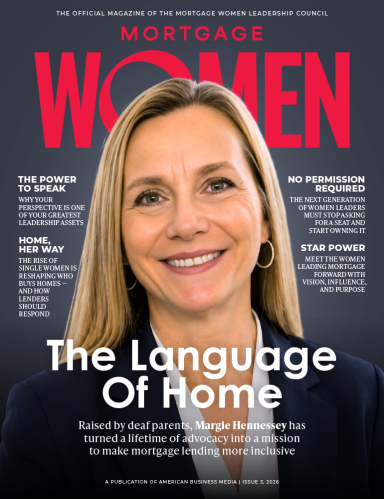
Margie Hennessey has been a leader in the mortgage industry for 15 years, but her true calling is paving the way to homeownership to members of the Deaf community.
Hennessey, vice president of Eastern Region Sales for Waterstone Mortgage in Ashburn, Virginia boasts that mortgage is her third and favorite career. Raised by deaf parents, she started out as a self-employed American Sign Language interpreter in the District of Columbia Metro area.
She went into interpreting as a means to pay her way through college, but was so enamored with the work she stayed in it for 15 years.
After that, she entered management leadership — the field she studied in college — taking a role at the Library of Congress representing management in union negotiations.
Eventually, she realized serving as a federal employee wasn’t a good fit and wanted to continue exploring entrepreneurship. Sign language interpreting had become taxing and caused overuse injuries, so she sought something different.
“But I definitely wanted to stay tied with the Deaf community,” she said.
Believing professions in housing are “people driven” and having a love for problem solving and “the black and white nature of numbers,” Hennessey became a loan officer. Since the profession entails working on straight commission, it also sparked her entrepreneurial side.
In addition, she could work with the deaf community, which she said would give her a happy balance.
Hennessey has coached deaf and hearing candidates on how to overcome hurdles to entering the mortgage industry. As the leader of Signing Home Loans, a new team at Waterstone, she wants to hire deaf and hearing individuals and set them up for success.
Getting behind other peoples’ success fills her cup, she said.
“I’m a good loan officer, and I do have passion around it, but the difference I make is really when I can bring communication access that people don’t otherwise get. That’s where I really feel my differentiation.”
> Margie Hennessey
Over the years, Hennessey has guided many deaf people through the process of buying homes. She has seen men get their first bachelor pad, then marry and step into a larger home for their growing families.
“And now, I’m doing loans for their kids,” she said. “There’s nothing greater than that. To me, that’s number one.”
The mortgage industry has also been “lifechanging” for Hennessey and her family financially and from a lifestyle perspective, she said. She wants to create similar opportunities in the Deaf world.
Noting she would “be remiss” if she didn’t point out she has many stories of helping people in the Deaf community, she shared one that took place earlier this month when she was working with a couple with a deaf husband and hearing wife.
Although they had purchased homes prior to working with Hennessey, this was the first time their lender was fluent in sign language.
In a remote meeting, they discussed details such as the rate market, world happenings that could impact their rate, and decisions about structuring their loan.
At the end of the call, the husband said it was the first time he felt “completely equal,” able to understand and involved through “complete communication access to the transaction.” The wife noted she was grateful she could participate in the conversation instead of interpreting for her husband.
“I’m a good loan officer, and I do have passion around it, but the difference I make is really when I can bring communication access that people don’t otherwise get,” Hennessey said. “That’s where I really feel my differentiation.”
Staying true to her Deaf community roots is important to Hennessey not just because her parents were deaf. It’s also about a cultural connection — shared linguistic and cultural experiences.
“There’s an acronym that’s used, a ‘child of deaf adults’ and that’s just universally known. When you say that you’re a CODA, that’s what that means. You grew up with deaf parents,” she said. “I’m hearing. I’m communicating like anyone else, but inside, you know, I am … I feel, you know 50–50. I feel deaf. There’s a part of me that feels, you know, that I have deafness in me. And then I have the hearing person.”
> Portraits of Margie Hennessey's parents, both of whom were deaf, making Margie a CODA, or ‘child of deaf adults.’
> Portraits of Margie Hennessey's parents, both of whom were deaf, making Margie a CODA, or ‘child of deaf adults.’
Hennessey recalled playing the violin as a child and how her mother, despite being completely deaf, would attend recitals, a habit that often confused hearing people.
“She would attend, as any mother would, and just watch me, you know, playing in this dress. She couldn’t hear,” Hennessey said. “I’d have mothers coming up to me crying and I would feel like, why are you crying, you know. My mom loves me. She’s here for my school event. It’s nothing extra special.”
Born in the South in 1970, Hennessey recalled times when she had to assure hearing people that her parents, despite being deaf, could drive and were “fine.”
She noted that growing up as a CODA brings a level of responsibility.
“From a young age … you’re an interpreter, you’re an advocate,” she said. “You’re a cultural mediator, you know, between two cultures and whether you ask for it or not, you know, this is kind of how life goes.”
Since she was growing up, she added, progress has been made and people have a higher awareness of the Deaf community.
Hennessey said her parents, who were divorced, were trailblazers and inspirational.
Community oriented individuals who served as presidents of state associations of the Deaf, they instilled the importance of giving back.
Her mother, Alberta De Lozier Smith, who died in 2019, served as principal of a state school for the deaf and was involved in the Tennessee state legislature helping to improve the lives of deaf people.
Similarly, her father, Clyde Smith, who died in 2017, was a teacher in Illinois and “blazed his own paths in horse racing” by working to overcome hurdles preventing him from getting licensed in harness racing.
He also became a deaf pilot and was the founding President of the International Deaf Pilots Association.
“So I think, genetically, my parents instilled in me that you’re not just part of the community,” Hennessey said. “You have responsibility in this community.”
Jenna Connour, Communications Coordinator, for Waterstone Mortgage in Brookfield Wisconsin, was researching for a press release announcing Hennessey’s role and her efforts to expand accessible homeownership for the deaf and hard of hearing community, she said. She did an internet search looking for others who do the same thing.
“We actually could find nothing, like no one online, except for Margie was the only one that came up,” she said. “We knew right away that it was such a unique story.”
“From a young age … you’re an interpreter, you’re an advocate. You’re a cultural mediator between two cultures and whether you ask for it or not, this is kind of how life goes.”
> Margie Hennessey
For 20 years, Hennessey has partnered with Real Estate Agents Ann Meehan and Elizabeth Kalis-McGuire of The Signing Group of Compass Real Estate in Potomac, MD.
Working with Hennessey saves time and makes the team stronger, they said. Deaf clients benefit by being able to speak directly to Hennessey without an interpreter, which paves the way for an understanding of all the complexities of the financial side of transactions.
“We were so lucky that we found Margie,” Meehan said. “(Clients) feel more comfortable talking to her, having direct communication.”
The women had stories about clients working with Hennessey sans a third party. They said often they work with couples with a hearing and deaf spouse. Hennessey makes it possible for the hearing spouse to step away from the role of interpreter and participate in the dialogue.
Buying a home is not a simple thing, Kalis-McGuire noted, describing the myriad complexities from inspections to appraisals to negotiations to financials.
Clients need to understand what’s happening through each step and are entitled to equal information without gaps, she said.
“They need to know everything about what they are signing and what they’re getting themselves into, so not having direct communication is tough,” she said.
Hennessey has even stepped in when clients have been working with other lenders and the deal has fallen apart.
“Margie has saved several deals over the years,” Kalis-McGuire said. “Margie was able to step in and save the day.”



 Built with Shorthand