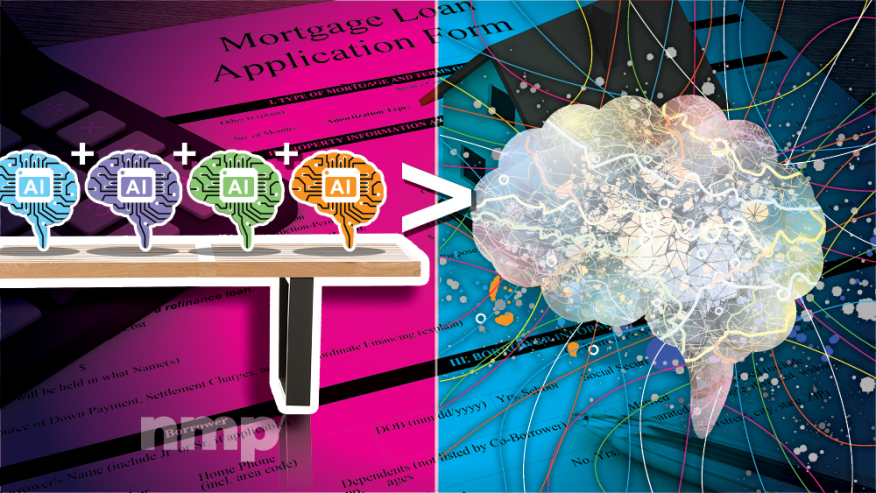
The prevailing narrative in mortgage technology today holds that artificial intelligence (AI) will deliver total operational transformation through a single sweeping implementation. Lenders are being told to adopt the platform, trust the algorithms, and watch as loans flow through the system faster, cheaper, and with minimal human intervention. The promise is that intelligence, once embedded in the system, will simply handle the complexity of mortgage operations.
It is an appealing proposition, and one that is driving significant investment across the industry. However, the mortgage executives who will outperform are not the ones waiting for AI to magically transform their operations. They are the ones building deliberately by deploying focused AI capabilities to solve specific, high-friction problems, measuring results at each step, and expanding only where the evidence justifies it. The competitive advantage will not come from the boldest transformation promise. It will come from the most disciplined implementation.
The Three-Year Reality Check
The transformation narrative is compelling at the board level, but its arc is predictable. Year one produces strategy decks, vendor demos, and steering committees. Year two produces data integration work and more steering committees. Year three, if the initiative survives budget season, delivers a pilot that can answer basic questions and draft routine emails while senior staff still doesn’t fully trust it. Meanwhile, processors remain buried in conditions, margins stay compressed, and the AI initiative becomes something mentioned in investor updates rather than delivering accurate and timely loans. This is not a failure of ambition, but a failure to translate capability into operational reality. The “one giant brain” concept collides directly with the complexity of how mortgage operations actually function.
A Business Built On Specialists
Consider how a mortgage operation works today. There is no single person who “does mortgages.” Loan officers originate and build relationships. Processors manage files and chase documents. Underwriters assess risk and apply guidelines. Closers, post-closers, secondary, compliance, and servicing teams each own a distinct function, operate in different systems, follow different rules, and measure success differently. Every one of those roles exists precisely because the complexity of that function justifies a dedicated specialist. Attempting to collapse all of it into one system, digital or otherwise, means fighting the fundamental architecture of the business.
The more productive path is to build AI the same way the business is already built, including a team of focused digital helpers, each with one clearly defined job, working alongside people rather than replacing them. This approach also reflects where AI technology itself is heading, away from single monolithic systems and toward networks of smaller, specialized tools that collaborate. The engineers building these products have largely reached that conclusion, and the strategic implications for lenders are the same. A bench of reliable specialists will outperform a single generalist every time.
What It Looks Like Across The Loan
At the beginning of the loan cycle, a focused AI helper can respond to inbound leads, answer basic questions, and book appointments on an LO’s calendar, keeping the conversation moving and handing off to a human the moment complexity warrants it. A second helper monitors LOS notes and call logs overnight and delivers each LO a morning briefing identifying the borrowers most at risk of falling out of the pipeline and the reasons why. Narrow in scope, but directly measurable in impact.
In processing and underwriting, the opportunity is more substantial. A helper dedicated to document intake can identify what it receives, verify that date ranges are current, and flag anything missing before a file ever reaches the processor’s queue. A second helper analyzes income documents and produces a structured summary for the underwriter, including employment type, W-2 history, variable income patterns, along with flagged items that warrant a second look under the lender’s guidelines. Critically, this helper is not clearing files or rendering credit decisions; it is functioning as a sharp analyst who has reviewed everything and organized it for a senior professional to evaluate. A third helper translates underwriter notes into clearly written conditions that processors and borrowers can act on. The outcome is not a replacement of the underwriting function, it is underwriters who spend their time on judgment rather than gathering documents.
In compliance and QC, the narrow-scope model delivers its clearest advantage. A helper whose only function is checking disclosure timing, another that samples files daily and surfaces those most likely to create audit exposure. These tools replicate what skilled professionals already do, with greater consistency and without fatigue. When a regulator asks what a system is doing, the answer is a single sentence. That is a fundamentally different conversation than explaining how an all-encompassing AI platform arrived at its decisions on individual borrowers.
Why This Approach Fits Lenders
There are four structural reasons this model works better for mortgage lenders than the platform alternative. The first is organizational alignment. Rather than asking operations staff to adapt to a sweeping transformation, leadership can walk into a branch meeting and say, “We are piloting an assistant that reads files and drafts conditions. Every decision still belongs to the underwriter. It saves 20 to 30 minutes per file.” That is a conversation people can engage with immediately, not in three years.
The second is regulatory defensibility. A large, general-purpose AI system that handles multiple functions is nearly impossible to fully explain or audit. A helper with a narrow, well-defined scope is straightforward to document: what data it sees, what it is permitted to output, and where human review is required before anything moves forward. Privacy controls, fairness monitoring, and plain-language explainability are not features to be added later, they are design requirements that belong in the architecture of every helper from the outset.
The third is affordability. Building one giant brain is a multi-year, seven-figure undertaking with uncertain returns. Deploying a series of focused helpers is a measured, iterative investment: identify a high-friction workflow, address one specific piece of it, run a contained pilot, measure results in terms the profit and loss statement understands, and then expand or redirect based on evidence. That model fits the current margin environment considerably better than a single large bet.
The fourth is change management. Announcing that a large AI system will transform how staff do their jobs reliably produces resistance. Introducing a digital assistant that removes the most tedious parts of the workday produces a different response, and staff who have a positive early experience with one helper become advocates for broader adoption rather than obstacles to it.
Getting Started Without Overreaching
The most productive entry point is the work no one puts on a resume, such as reading the same document types repeatedly, writing the same follow-up notes, and moving data between systems that do not talk to each other. Document review and conditions drafting are reliable starting areas. The scope is contained, the volume is high, and the impact is directly measurable in time saved per file, reduction in touches, and error rate trends. Pilot with a receptive team, evaluate the results honestly, and let the evidence drive what comes next. The objective is not a complete AI strategy on day one. It is to begin building one well-defined specialist at a time.
The Strategic Choice Ahead
The mortgage industry is approaching a meaningful fork in its AI journey. One path is passive adoption through selecting a vendor, trusting their roadmap, and waiting for transformation to materialize through black-box automation. The other is active implementation, by deploying AI capabilities deliberately, one high-value use case at a time, with clear accountability for what each tool does and measurable evidence that it is delivering results. The difference is whether AI is something that happens to the operation or something the operation controls.
Lenders who take the second path will do so because their leadership teams made a deliberate choice about how AI gets deployed, which tasks are ready for automation, which decisions must remain with trained professionals, and how transparent, auditable workflows create compounding gains in speed, quality, and cost over time. The result, built through disciplined iteration, is an operation with faster turn times, lower per-loan costs, reduced staff burnout, cleaner regulatory exams, and borrowers who have warranted confidence that their data was protected and their file was evaluated fairly.
None of that depends on one “big brain” AI platform. It begins with clarity. Leadership teams must identify the highest-friction points in their operations and determine which tasks can be consistently executed by focused digital helpers operating within clearly defined guardrails. That prioritization becomes the roadmap.