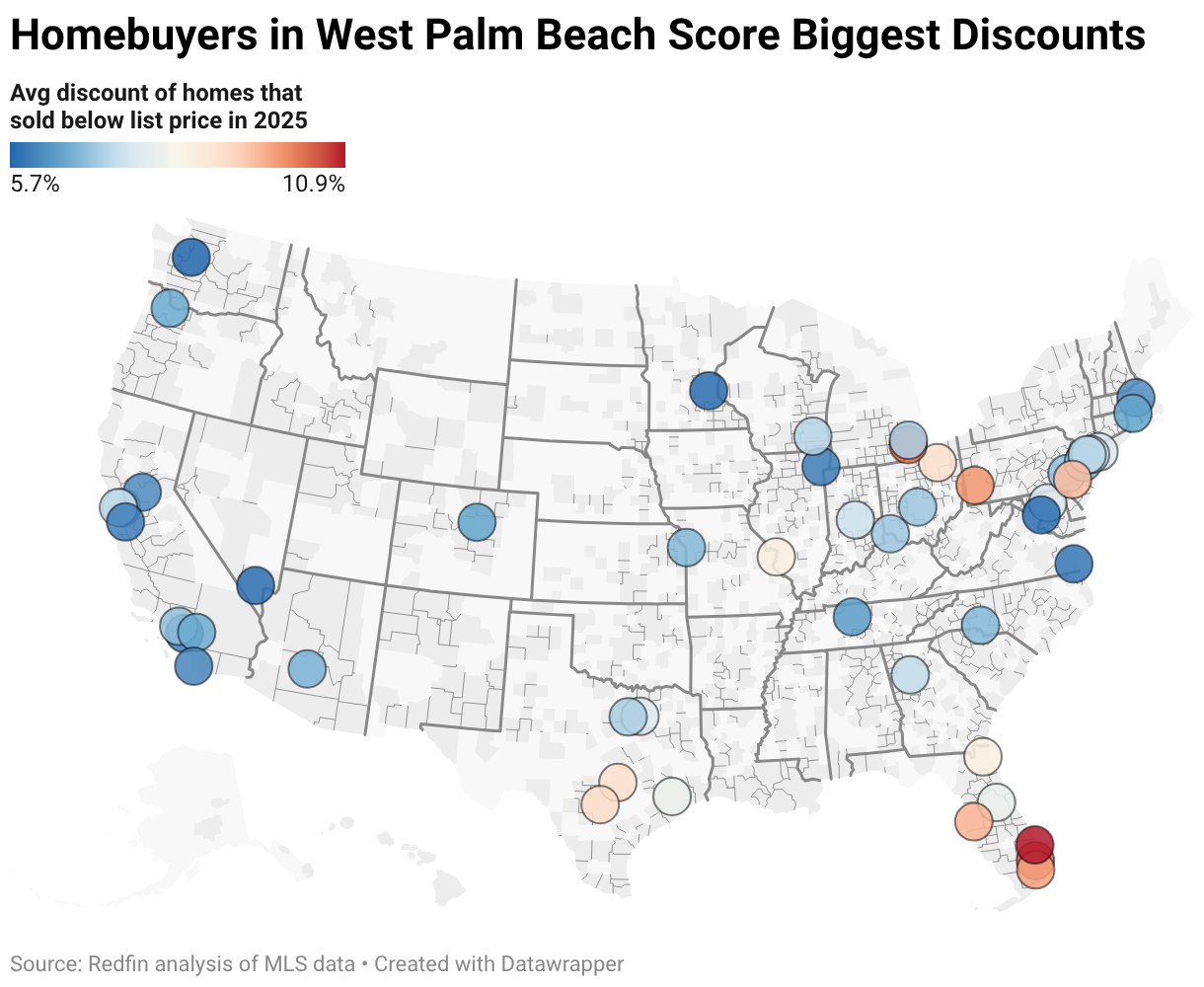
A newly released Redfin analysis of 2025 Multiple Listing Service (MLS) data shows homebuyers nationwide secured the biggest discounts off list prices in 13 years, marking a significant shift in the real estate market toward buyer leverage.
The typical buyer who bought below the asking price in 2025 received a 7.9% discount, the largest average reduction since 2012, according to Redfin data. In dollar terms, this equates to an average savings of about $31,592 on a home with a median original list price of roughly $399,900. Across all buyers — including those who paid full price or above — the average discount was 3.8%.
Nearly 62.2% of buyers paid below the list price last year, the highest share since 2019, while just 22.8% paid more than asking, the lowest share in the same period. Roughly 15.6% paid exactly the list price.
Analysts attribute the trend to an unusually strong buyer’s market brought on by record inventory compared with demand. Redfin notes there were 47% more sellers than buyers — a historic gap that has shifted negotiating power toward buyers, who are benefiting from more choices and less competition. This imbalance partly stems from high mortgage interest rates and elevated home prices that have dampened buyer activity relative to supply.
Discounts vary by housing type and metro area. Condo buyers saw 8.1% typical discounts when buying below list, outpacing single-family and townhouse discounts. In West Palm Beach, Florida, buyers got more than 10% off asking prices on average, the largest metro discount in the report. Conversely, only four large metros — including San Francisco and Newark, New Jersey — saw typical sales above asking, with San Francisco buyers paying nearly 3.8% over list price.
“Homebuyers in 2026 shouldn’t write off homes that are slightly above their budget because there’s a good chance they’ll get some sort of concession from the seller, be it a price cut, money toward closing costs or funds for repairs,” said Redfin Senior Economist Asad Khan. “This marks a reversal from the pandemic homebuying frenzy, when house hunters were advised to search for homes below their budget because fierce bidding wars were causing properties to sell far above the asking price.”