Notorious Houston native Beyonce Knowles-Carter sang it best in her twentieth track on her latest album, Cowboy Carter: “Wildfire burnt his house down / Insurance ain’t gon’ pay no Fannie Mae.”
The quippy lyric is just one of Beyonce’s many pointed cultural references to the harsh realities of living in America. As a nod towards the country’s unforgiving affordability crisis. she belts “Are you tired, workin’ time and a half for half the pay?”
The lyrics briefly brush on themes of housing costs and wildfire devastation, suggesting a commentary on the escalating toll of natural disasters on homes, possibly exacerbated by climate change. Beyonce’s brief, albeit impactful, line underscores how insurance may not always provide the needed relief in the face of such challenges.
Advertisement
It’s not just pop moguls like Queen Bey who have noticed that insurance is skyrocketing. According to S&P Global analysis, insurance premiums in Texas jumped 23% last year, the highest increase in the country and more than double the national rate increase of 11%, exacerbated by inflation, high costs of building supplies, and an influx of natural disasters in the Lone Star State. The Texas Department of Insurance (TDI) denotes factors such as a home’s age, location, the cost to replace a home, credit score, and claim history as what goes into an insurance premium. From that list, one factor has reigned superior in the past year: where the home is located.
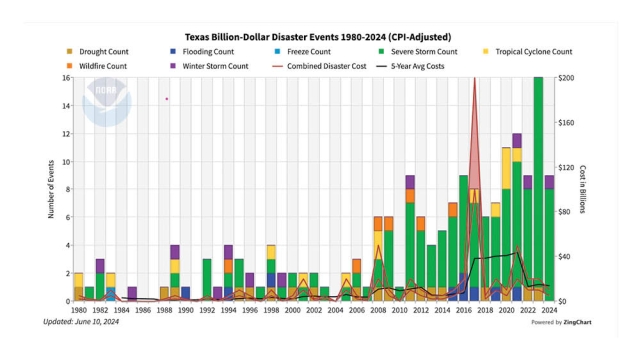
Per the National Oceanic and Atmospheric Administration, between 1980 and 2023 Texas experienced an average of four natural disasters — including droughts, floods, storms, tornadoes, wildfires, and winter storms — per year with damages above $1 billion. It’s only gotten worse, and costlier, in recent years; between 2019 and 2023 Texas suffered an average of eleven billion-dollar events each year, with sixteen in 2023 alone.
The National Oceanic and Atmospheric Administration’s (NOAA) National Weather Service forecasters at the Climate Prediction Center predict above-normal hurricane activity in the Atlantic basin this year. NOAA’s outlook for the 2024 Atlantic hurricane season, which spans from June 1 to November 30, predicts an 85% chance of an above-normal season, a 10% chance of a near-normal season, and a 5% chance of a below-normal season.
The Insurance Squeeze
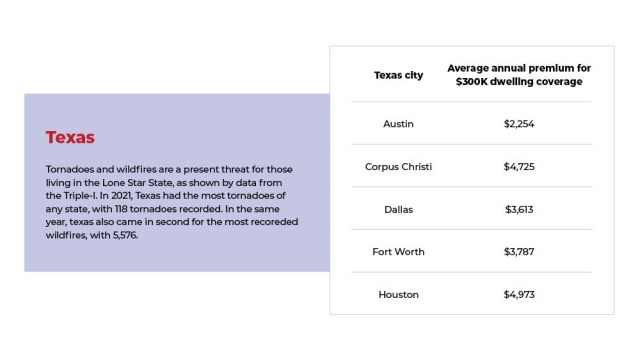
National coverage of rising home insurance rates has focused on Florida and California as high-premium hot spots. However, a recent analysis published in May by Bankrate says although Florida has the highest average premium in the country, at $5,770, Californians only pay an average of $1,403 per year. Texans, on average, pay $4,039.
The Texas Fair Plan Association, which provides coverage to residential properties that are denied by other insurance carriers, reported $74.1 million in direct homeowners premiums in 2023, compared to $48.1 million in the prior year, and $46.9 million in 2021.
Matt Desmond, owner and principal
agent, Desmond-Integra
Matt Desmond, owner and principal agent of Austin-based insurance brokerage Desmond-Integra, says he can attest that a premium over $4,000 is not uncommon. Desmond observes that Texas has a lagging effect on insurance and many companies are refusing to write policies in certain areas. “There’s just not a lot of capacity in the market, meaning a lot of companies that typically will do business and write policies here are no longer doing so. And so you have companies exiting the market altogether,” he explained. “And then you have the companies that are continuing to do business here, but not offering as attractive policies.”
Desmond says this has proven to be a difficult home insurance marketplace. “Part of the issue during the past 18–24 months is that you have some of the lagging effects from when inflation was very high for materials and labor the past two years, but the market hardened here in Texas and pricing in recent years ended up equaling a higher cost,” he added.
“There’s just not a lot of capacity in the market, meaning a lot of companies that typically will do business and write policies here are no longer doing so.”
Matt Desmond, owner and principal agent, Desmond-Integra
Desmond also relayed that certain areas of Texas have few insurance carriers that write policy. Even though Desmond primarily does business in Austin, which he describes as “friendly to do business in,” he’s noticed that in areas like Dallas, there’s a drought of carriers that will write insurance policies.
“There’s so few carriers that even write in Dallas. We get requests for Dallas, we just send it to other agencies,” he admitted, adding that some companies opt to write policy for less risky areas around the country and, subsequently, outside of Texas. “Dallas is more prone to having hail and tornado activity up there. Some of it can be as granular as zip code by zip code reporting for past hail storms. On the Coast, you have hurricane exposure, obviously, or even tornadoes in Houston, which is not the norm, but you have a hurricane on the Coast. Dallas is considered to be the most frequent hail site.”
How Low Can You Go?
Even in the wake of natural disasters and nationwide high premium costs, many people jump to blame the state. That, however, is denied by the Texas Department of Insurance (TDI). Its website reads “Consumers often tell the Texas Department of Insurance that their insurance company or agent told them that their premium went up because the state made them raise rates. TDI doesn’t set the homeowners or auto insurance rates that your insurance company charges. Insurance companies can change their rates and premium formulas by sending them to TDI. This is called a “rate filing.” Companies can use the new rates as soon as they send them to TDI.”
The website also adds rather cheekily, “If your auto or home insurance bill is rising, ask your company to explain the increase and if you’re getting all available discounts. You might want to shop for a better deal.”
Desmond says that it’s not abnormal for him to see people have “year over year [rate increases] of 30%, maybe 35–40%.” And while people may take TDI’s advice and shop around, that’s a risk in itself. “The problem is when you shop around you may find a lower rate but it’s with a deductible that’s twice as high,” Desmond said. “There are ways to make [a premium] go down such as optional coverages like if you want to make a calculated risk by removing those, but there is always the potential for carriers to lower rates at the time of rate renewal. However, that’s extremely rare.”
Desmond says that although seeing a rate go up is more common, it’s important to put the rate in context: how does the current rate compare with other rates provided by carriers of the same quality and service? “Changing coverage, if done at all, should be done thoughtfully,” he quipped.
Premiums Affecting Profits
Eric Boshart, co-president at Parallel Lending, a private credit fund that specializes in providing short-term, non-owner occupied loans backed by real estate primarily in Texas, says that he’s observed disparities in premiums increase over the last few years. “We are seeing the profitability of a lot of our single-family flips be impaired by high interest rates and high premiums. There’s a huge disparity between different insurance brokers that we go to to find the best deals on behalf of our borrowers. Traditionally, the insurance brokers that we go to, which we really only used to go to one or two, now we typically go to five or six, just because there’s such a large discrepancy between premiums,” he said.
Eric Boshart, co-president, Parallel
Lending
But Boshart adds that factoring in high premiums is just like accounting for high inflation that has run rampant nationwide over the past few years. “We have seen average cash on cash returns for our flippers and builders be significantly impaired as a result of having to pay a high premium that’s usually 100% earned,” he explained. “You just have to factor that in. Just like you would factor in inflation costs, if you are looking at a long-term deal, let’s say you’re holding on to a property for 18 months, and if we think prices are going to go up on certain things — building materials, utility costs — you should be thinking about some type of increase in your premium and build that into your return on investment model.”
Boshart says that he’s grateful that premiums haven’t squashed business altogether, and he attests that to location. “I’d imagine investors in Houston are walking away from deals,” he mused. “We haven’t lost any deals specifically due to premiums. Affordability is still really difficult, so flippers are just keeping properties on the market. If they thought they were going to sell their property in five days, it’s taking 60, which is still fine. Thirty days on the market is still a healthy economy, so that’s okay. They’re just not going to get into a new project until they sell their current one.”
Rolling With The Flow
Boshart says that he doesn’t imagine relief anytime soon. “If there’s a major market correction and we go into a deflationary spiral, which seems highly unlikely, then prices could definitely drop because premiums are tied to actual cash value or replacement costs,” he explained. “So, yeah, [I] definitely don’t anticipate things going down. There is typically an ebb and flow, but not to this degree over the past three years.”
“We are seeing the profitability of a lot of our single-family flips be impaired by high interest rates and high premiums.”
Eric Boshart, co-president, Parallel Lending
Desmond says that his business is referral-based with mortgage companies and real estate professionals, which has kept activity afloat. “Activity at certain periods of time over the past 18 months almost came to a halt in Austin specifically, there’s a lot of inventory and a lot of buyers who may not want to get out of their lower rates,” he said. “It’s drastic compared to last year, but we’ve managed to circle back with clients and pick back up within the last couple of months.”
Right now, Desmond says, it’s time to roll with the flow. For originators dealing with client grumblings, Desmond encourages them to form relationships with insurance companies who can offer education on premiums. “I think people come to the table upset about year-over-year increases in their pricing, but the capacity and lack of health in the marketplace isn’t great right now. So it’s all about a holistic view,” he said. “I think there is still an expectation vs. reality outlook in terms of what a premium is supposed to be, and if originators can seek out local resources like us they can get a better idea of what the cost will be like. Things change fast, and if they can become more familiar with underwriting changes that happen week to week, that will help them give their clients more accuracy and a realistic expectation.”
This article originally appeared in National Mortgage Professional, on the week of August 1, 2024.
platforms consolidate and vendors gain leverage, the lenders who stay disciplined about data, adoption, and exit terms will be the ones who keep control of their own tech stack