Lower mortgage rates, increased housing supply, and positive income growth together increased affordability in June.
First American Data & Analytics House Price Index indicated that although affordability improved on a monthly basis, it declined roughly 4% annually. Analysts attributed this to a 5.6% annual increase in nominal house prices and a 0.2 percentage point increase in the 30-year, fixed mortgage rate compared with one year ago.
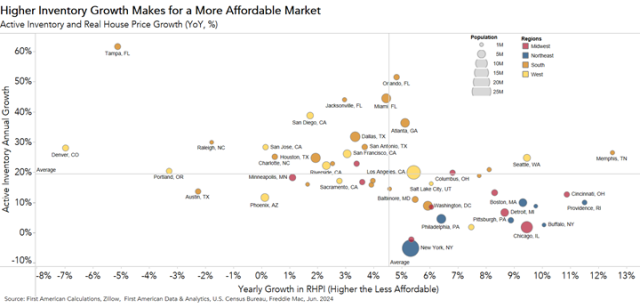
“While inventory nationally and in most markets is higher than one year ago, it remains low from a historical perspective,” First American Chief Economist Mark Fleming pointed out. “Nationally, housing supply is nearly 34 percent lower compared with June 2019, the summer before the pandemic hit. Nevertheless, as this analysis shows, the faster housing supply increases, the more affordability improves and the strength of a seller’s market wanes.”
First American’s index weighs mortgage rates against household income, home prices, housing supply, and other factors in its determination of home buying power in different markets.
“Despite the fact that household income increased 3.8% since June 2023 it was not enough to offset the affordability loss from higher mortgage rates and rising nominal prices,” analysts wrote in their latest report. “The national housing market has been chronically undersupplied for more than a decade. When rising demand meets limited supply, all else held equal, price appreciation accelerates and affordability will decline.”
For-sale inventory increased by more than 21% nationally compared to one year ago, rising in 48 of the top 50 markets tracked on a year-over-year basis. This growth was particularly pronounced in the Southern and Western U.S. markets in June, but more muted in the Northeast and Midwest.
For example, in Tampa, Fla., active inventory jumped nearly 62% annually and affordability improved by 5%. While the demand in Florida has dropped, fierce market competition in markets like Memphis and Seattle has led to lower affordability despite inventory growth.
House prices decreased 1.3% nationally from May to June 2024, but increased 3.9% from June 2023. Consumer house-buying power increased 1.7% from May and 1.7% annually.
On Tuesday the Federal Housing Finance Agency (FHFA) released its seasonally adjusted monthly House Price Index for May, indicating house prices rose 5.7% from May 2023 to May 2024. The previously reported 0.2% price increase in April was revised upward to 0.3%.
“U.S. house price movement was flat in May,” said Dr. Anju Vajja, Deputy Director for FHFA’s Division of Research and Statistics. “The slowdown in U.S. house price appreciation continued in May amid a slight rise in both mortgage rates and housing inventory.”