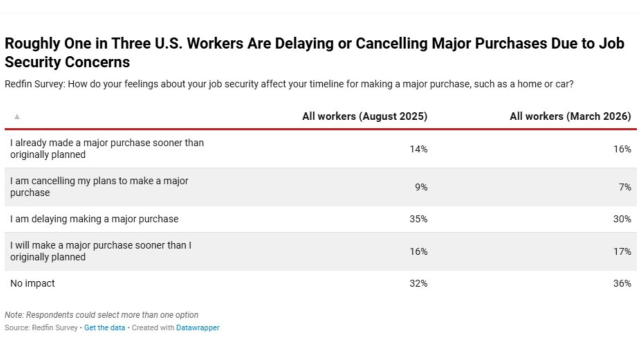
More than one in three American workers are delaying or canceling a major purchase, such as a home or car, because of concerns about job security, according to a new survey from Redfin, the real estate brokerage powered by Rocket.
The survey, conducted by Ipsos between March 9–10, 2026, polled 1,005 U.S. residents, including 452 full-time and 112 part-time workers. It carries a credibility interval of plus or minus 5.1 percentage points for the combined group of workers.
Of those surveyed, 7% said they are canceling plans to make a major purchase due to job security concerns, while 30% are delaying such plans. On the other hand, 16% said they have already made a major purchase sooner than expected because of those concerns, and another 17% plan to do so. Another 36% said their feelings about job security have no impact on their major purchase timeline.
The share of workers delaying or canceling purchases has eased since August 2025, when 42% reported doing so — six percentage points higher than today. The share who had made or planned to make purchases sooner than expected (29% in August) and the share reporting no changes (32%) are largely unchanged.
Most Workers Remain Confident In Their Jobs
Roughly 69% of workers said they are somewhat or very confident about their job security, compared with 66% last August. Another 27% said they are somewhat or very concerned.
Still, 32% of workers are more concerned about their job security than they were six months ago, while 18% are more confident. In August 2025, 37% said they were more concerned than six months prior, and 21% said they were more confident.
Company Performance, AI Top The List Of Concerns
Among workers who are concerned about their job security, 29% cited their company's performance as the primary reason, nearly matching the 32% who said the same in August 2025. The impact of artificial intelligence was the next most-cited reason at 18%, followed by government restructuring efforts at 14% and personal performance at 12%.
Housing Payments Under Pressure
Seven percent of workers said they have missed a rent or mortgage payment entirely in the past three months, and 10% said they have been late on a housing payment.
Those figures are significantly higher among workers concerned about their job security, 28% of whom have missed or been late on a recent housing payment. Among workers confident in their job security, 70% have made all recent housing payments on time.
Looking ahead, 15% of workers said they are very or somewhat likely to be late on their mortgage or rent in the next three months, and 13% said they are very or somewhat likely to miss a housing payment entirely.
A slim majority of workers — 55% — said they have an emergency fund to cover monthly rent or mortgage payments in a financial crisis, while 34% do not. Among workers with such a fund, one in five said it covers six months of payments, while 16% said it covers three months.
Bottom Line
For loan officers, the data cuts two ways. A meaningful slice of workers is pulling back from major purchases, which could soften near-term home purchase pipelines — particularly among buyers sensitive to employment risk in AI-exposed industries or companies undergoing restructuring. At the same time, 31% of workers are accelerating purchases or plan to, suggesting a segment of motivated buyers moving now rather than waiting out uncertainty.
The delinquency signals may warrant closer attention. With 17% of workers recently missing or paying late on housing obligations and 28% among those worried about their jobs, loan officers may want to lean harder into early borrower outreach, refinance conversations where rate and equity allow, and hardship-assistance education.
The one-third of workers without a housing emergency fund is a reminder that financial fragility remains widespread, even as headline confidence holds steady.