Non-Agency originations could reach $500 billion this year. Are you ready to tap in?
AI makes human loan officers more essential, not less
Meet your your colleagues, both national and local, by attending an event in your area.
COVER STORY
COVER STORY
By Pavan Agarwal, Special To National Mortgage Professional
Let’s be honest — “AI” has become the industry’s favorite buzzword. Everywhere you turn, lenders, servicers, and fintech platforms are talking about chatbots, assistants, or “AI-powered” systems. But most of these are simply fancy FAQ engines. They can tell a borrower what a DTI ratio is, but they can’t actually calculate one or act on a loan file.
That’s not a revolution — that’s a distraction.
The truth is, most “AI” in mortgage lending today is built around generic large language models (LLMs) like ChatGPT or Gemini. Lenders wrap these models with their own content — policy guides, investor rules, underwriting checklists — and then feed them to a chatbot interface. These AI plug-ins are interesting but fail to provide accurate in-depth results, and have failure rates (returning wrong, confusing, or irrelevant information) of 5% or higher. The real challenge is answering questions with 100% reliability and executing transactions within regulatory guardrails.
And that’s where the current generation of AI systems hits a wall.
Mortgage lending is a highly regulated, data-sensitive business. Every credit decision, document validation, or loan action must be traceable, auditable, and explainable.
Unfortunately, that’s exactly what commercial LLMs can’t guarantee. They generate answers based on probabilities — meaning the same question might produce different answers each time. Regulators don’t like “maybe.” They want determinism — the same inputs yielding the same outputs every single time.
Legacy corporations with large AI budgets have chosen a brute force approach by retraining or fine-tuning an LLM with custom and proprietary data. Retraining is a long, slow, and expensive process, therefore, even after billions invested, these companies have not achieved accurate results or been able to execute complex transactions.
Here’s why that matters in mortgage:
That’s why most lenders play it safe. They confine AI to front-end chat or lead nurture, keeping it far away from loan origination systems (LOS), servicing databases, or investor reporting workflows. It’s “AI lite” — safe, but shallow.
Regulators don’t like “maybe.”
They want determinism
— the same inputs
yielding the same outputs
every single time.
> Mortgage lending demands clear, consistent reasoning — not guesswork. Every decision must be explainable and repeatable, but LLMs rely on probabilities, not certainty. That unpredictability doesn’t fly in a regulated world.
Regulators don’t like “maybe.”
They want determinism
— the same inputs
yielding the same outputs
every single time.
> Mortgage lending demands clear, consistent reasoning — not guesswork. Every decision must be explainable and repeatable, but LLMs rely on probabilities, not certainty. That unpredictability doesn’t fly in a regulated world.
Ask any originator, processor, or borrower — the biggest inefficiency in mortgage operations isn’t lack of information. It’s the handoff problem.
A chatbot might explain how to upload income docs, but the borrower still must go somewhere else to actually do it.
A servicing assistant can quote an escrow balance, but it can’t process the payment. Every step breaks the loop — and each break adds friction, re-entry errors, and cost.
That gap between conversation and transaction is the reason our industry’s time-to-close metrics haven’t budged much in years, even with “AI everywhere.”
We don’t need a smarter chat. We need AI that can act.
At AngelAi, we approached this problem differently. We built what we call a Transactional Language Model (TLM) — purpose-built for mortgage, not repurposed from the internet.
Unlike generic LLMs, the TLM doesn’t “guess.” It operates deterministically — meaning the same input will always produce the same, verifiable output. Every action, every data reference, every decision is logged and replayable for compliance audits.
It’s not a chatbot sitting on top of an LOS — it’s the core execution layer of a digital lender.
Here’s what that looks like in practice:
That’s the difference between AI that talks and AI that works.
We don’t need a smarter chat.
We need AI that can act.
> The real issue in mortgage operations isn’t lack of knowledge — it’s the gap between talk and action. Chatbots can explain what to do, but they can’t do it. Every handoff adds friction, errors, and cost. Until AI can bridge that gap, “smart” won’t mean faster.
We don’t need a smarter chat.
We need AI that can act.
> The real issue in mortgage operations isn’t lack of knowledge — it’s the gap between talk and action. Chatbots can explain what to do, but they can’t do it. Every handoff adds friction, errors, and cost. Until AI can bridge that gap, “smart” won’t mean faster.
In finance, trust isn’t a feeling — it’s a function.
Borrowers, auditors, and regulators all need to know that a system will behave consistently and fairly. Deterministic AI delivers exactly that. It ensures every transaction is explainable, every decision is reproducible, and every outcome can be traced to specific data and rules.
When AI systems can produce reason codes, comply with ECOA and Reg B, and log adverse actions automatically, they stop being marketing experiments and start becoming supervisory-grade systems.
It’s not about replacing people — it’s about removing friction and risk, so people can focus on empathy, advice, and judgment.
Some see compliance as red tape. I see it as the mortgage industry’s ultimate moat.
If you can prove that your AI is accurate, auditable, and explainable — and that it passes regulatory scrutiny — you unlock enormous efficiency and trust advantages. You lower audit exposure, reduce manual workload, and serve borrowers faster with greater fairness and transparency.
At AngelAi, our TLM architecture has already passed 80+ audits from HUD, Fannie Mae, Freddie Mac, and GNMA — all with zero loan defects. That’s not marketing fluff; it’s operational proof that responsible AI can perform under the toughest scrutiny.
For mortgage professionals, this isn’t abstract. It means fewer errors, faster turn times, and happier borrowers — with systems that regulators actually approve of.
In finance,
trust isn’t a feeling
— it’s a function.
> Trust in finance comes from consistency, not charisma. Deterministic AI earns that trust by making every action explainable, traceable, and compliant — turning automation from a black box into a reliable partner that reduces risk and frees people to do what humans do best.
In finance,
trust isn’t a feeling
— it’s a function.
> Trust in finance comes from consistency, not charisma. Deterministic AI earns that trust by making every action explainable, traceable, and compliant — turning automation from a black box into a reliable partner that reduces risk and frees people to do what humans do best.
The AI we need in this industry isn’t a co-pilot. It’s a controlled executor — a system that can take real action safely and predictably.
Imagine a world where:
That’s where we’re headed. The shift from generative to transactional AI isn’t just a technological upgrade. It’s a paradigm shift in how the mortgage industry operates — one where precision, accountability, and automation work together instead of against each other.
The AI we need in this industry isn’t a co-pilot. It’s a controlled executor — a system that can take real action safely and predictably.
> The mortgage industry needs AI that acts, not just suggests. Transactional AI brings precision, accountability, and safe automation — turning ideas into real, predictable outcomes.
The AI we need in this industry isn’t a co-pilot. It’s a controlled executor — a system that can take real action safely and predictably.
> The mortgage industry needs AI that acts, not just suggests. Transactional AI brings precision, accountability, and safe automation — turning ideas into real, predictable outcomes.
The next phase of mortgage innovation won’t be defined by who has the biggest model — it’ll be defined by who has the most responsible one.
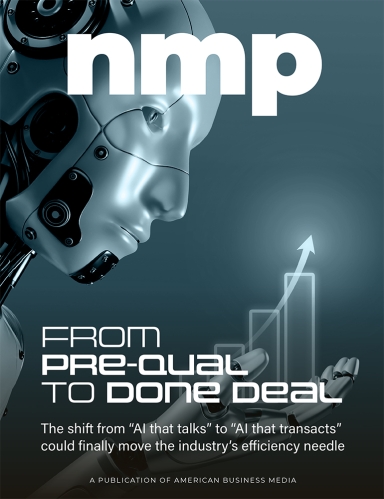
We’re moving from “AI that talks” to AI that transacts — safely, fairly, and explainably.
And that’s why this moment matters for every originator, underwriter, servicer, and regulator: deterministic, transactional AI isn’t just a tech milestone. It’s the foundation for the next decade of trust in mortgage lending.
Non-Agency originations could reach $500 billion this year. Are you ready to tap in?
AI makes human loan officers more essential, not less
Meet your your colleagues, both national and local, by attending an event in your area.