Pending home sales declined in July for the eighth time in the last nine months, a sign that the housing cycle downturn may be nearing the bottom, the National Association of Realtors said today.
Three of the four major regions registered month-over-month decreases, though the West posted a minor gain. Year-over-year, however, all four regions saw double-digit percentage declines, led by the West.
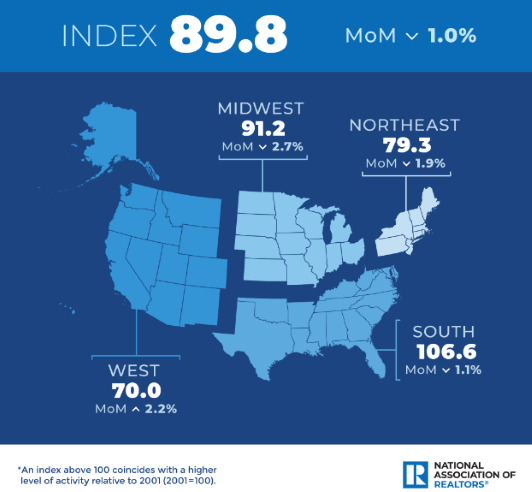
NAR’s Pending Home Sales Index (PHSI), a forward-looking indicator of home sales based on contract signings, slid 1% to 89.8 in July. An index of 100 is equal to the level of contract activity in 2001, which was the first year to be examined. Year-over-year, pending transactions sank 19.9%, NAR said.
"In terms of the current housing cycle, we may be at or close to the bottom in contract signings," said NAR Chief Economist Lawrence Yun. "This month's very modest decline reflects the recent retreat in mortgage rates. Inventories are growing for homes in the upper price ranges, but limited supply at lower price points is hindering transaction activity."
In June, housing affordability plummeted to its lowest level since 1989, according to NAR. Accounting for a 30-year fixed-rate mortgage and a 20% down payment, the monthly mortgage payment on a typical home jumped to $1,944, an increase of 54%, or $679, from one year ago.
"Home prices are still rising by double-digit percentages year-over-year, but annual price appreciation should moderate to the typical rate of 5% by the end of this year and into 2023," Yun said. "With mortgage rates expected to stabilize near 6% alongside steady job creation, home sales should start to rise by early next year."
Regional Breakdown
- The Northeast PHSI dipped 1.9% from last month to 79.3, and is down 15.4% from July 2021.
- The Midwest index retracted 2.7% to 91.2 in July, a 13.4% decline from a year ago.
- The South PHSI decreased 1.1% to 106.6 in July, a pullback of 20.0% from the previous year.
- The West index increased 2.2% in July to 70.0, down 30.1% from July 2021.
The National Association of Realtors is America's largest trade association, representing more than 1.5 million members involved in all aspects of the residential and commercial real estate industries.