Home price appreciation remained positive but subdued in April, according to the latest Home Price Index from Cotality.
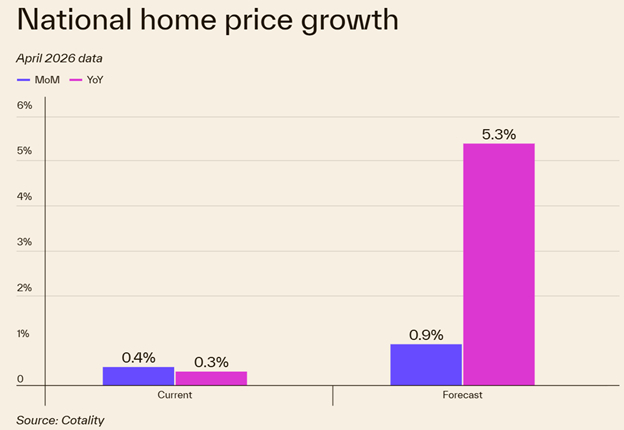
National single-family home prices rose 0.3% year over year in April and 0.4% from March. Prices are up 0.8% since the start of 2026, a pace that remains below the gains seen in recent years.
The report suggests the housing market is stabilizing rather than accelerating, with fewer markets posting annual price declines and stronger performance emerging in select regions despite persistent affordability challenges.
"The recent surge in mortgage rates has disrupted the spring homebuying season and reversed some of the affordability gains created by the lower rates seen throughout 2025," said Dr. Selma Hepp, chief economist at Cotality.
Hepp noted that market conditions vary widely across the country.
"Market strength suggests that some buyers remain insulated from mortgage-rate volatility and are supported by substantial home equity and stock market gains," she said. "Meanwhile, markets that depend more heavily on traditional mortgage financing and rate-sensitive buyers are seeing prices stay relatively flat."
Regional Divide Emerges
Several previously high-flying housing markets continued to cool.
Florida led the nation in annual home price declines, falling 1.6% year over year. Other markets showing signs of softening included the New York City metro area, Buffalo, Washington, D.C., Fresno, Phoenix and Nassau, Arizona, all of which posted negative three-month price changes through April.
Cotality said these markets may be hitting affordability ceilings after years of rapid appreciation.
At the same time, a number of Midwest and Northeast metros posted strong gains. Newark, N.J., recorded a 6.4% three-month increase, followed by Rochester, N.Y. (5.9%), Boston (4.9%), Cambridge, Mass. (4.8%), and Bridgeport, Conn. (4.7%). St. Louis, Kansas City and Milwaukee also posted solid growth.
San Francisco stood out as one of the strongest-performing large metros, recording an 8.1% three-month gain and the nation's highest annual appreciation rate among the 100 largest markets at 8.3%. Despite the recent surge, Cotality still classifies San Francisco as undervalued relative to long-term fundamentals.
What It Means
For lenders and originators, the data points to a housing market that remains resilient but increasingly segmented.
Borrowers in affordability-constrained markets may continue to face challenges qualifying for homes as elevated rates limit purchasing power. Meanwhile, stronger-performing markets in the Midwest and Northeast could present opportunities for purchase business as buyers shift toward more affordable regions.
The report also suggests that existing homeowners with substantial equity continue to play an outsized role in supporting demand, while first-time and rate-sensitive borrowers remain under pressure.
Looking ahead, Cotality expects home-price growth to accelerate modestly. The company forecasts national home prices will increase 5.3% year over year by April 2027.
Cotality's risk analysis identified several markets with elevated potential for future price declines, including Cape Coral-Fort Myers, Fla.; Lakeland-Winter Haven, Fla.; Tampa, Fla.; Marietta, Ga.; and Greenville-Anderson-Greer, S.C.
Nationally, 69 of the 100 largest metro areas are currently considered overvalued, while 23 are categorized as fairly valued and seven are classified as undervalued, according to the company's market condition indicators.