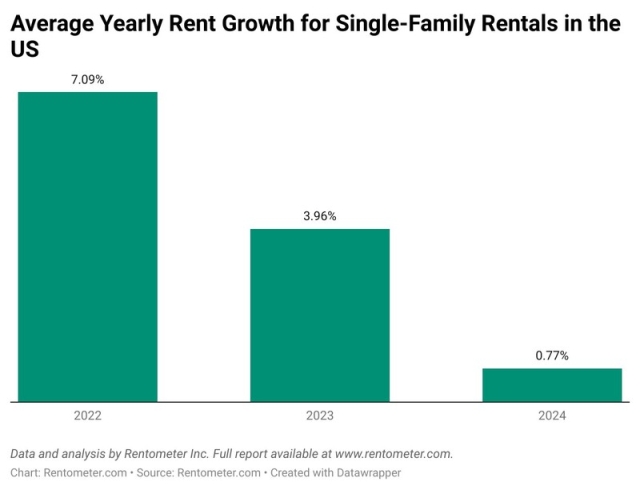
As home prices and mortgage rates remain high, creating significant affordability challenges, there’s also less incentive for renters to make the transition to home ownership. Nationally, average single-family rent growth slowed to roughly 0.8% in 2024, “the smallest increase in years,” according to a new report from Rentometer.
The report focuses on prices for three-bedroom single-family homes in nearly 860 cities across the U.S. The average single-family home rent was $2,357, and vacancy rates reached 6% in the third quarter of 2024 – the highest level in 26 quarters – putting downward pressure on rents.
Rentometer noted the apartment market "has suffered due to a glut of new units coming to market," and that those dynamics have also begun to impact single-family rents. The 6% vacancy rates have not been seen since the first quarter of 2018, according to the report.
The 0.8% rent increase last year is a steep drop in rent growth compared to about 7.1% year-over-year growth in 2022 and about 4% year-over-year growth in 2023.
“The rental market is undergoing a noticeable shift, as both apartment rents and the single-family rental segment – which houses 14 million Americans and has outperformed apartment rents over the past couple of years – experience a marked slowdown,” the report notes.
The Rentometer report comes amid signs of sharp declines in real estate investor optimism. The Winter 2024 RCN Capital/CJ Patrick Company Investor Sentiment Index for the fourth quarter of 2024 dropped 27 points to 97, its lowest point in a year.
Only slightly more than a third (35%) of real estate investors surveyed to produce that index said they believe the market is better now than it was a year ago, compared to more than two-thirds, (68%) in the third quarter of 2024. Real estate investors who said they believe market conditions have become worse nearly doubled from 13% in the third quarter to 25% in the fourth quarter.
More than half of real estate investors surveyed pointed to the high cost of financing as the biggest challenge they are facing. And nearly 70% of those surveyed said that insurance costs influence their investment decisions.
The report from Rentometer also found some significant regional rent disparities. For example, Midwest rents grew the fastest at +5.26% last year, while those in the Southwest actually saw a slight decline by -0.09%. Meanwhile, rent declines in the Sun Belt, including in Austin, Texas, and Tampa, Florida, highlight the influence of build-to-rent developments, though Rentometer said it expects that trend “may not last.”
In terms of affordability, the report found rents in Toledo, Ohio averaged $1,217, and Detroit, Michigan, averaged $1,308, offering some of the lowest rents among large cities.
On the other end of the affordability spectrum, California cities dominated high-cost rent rankings. Also, reflecting demand in affluent and tech-driven areas, the report notes that the average rent in Cambridge, Massachusetts was $5,687 and in Newport Beach, California was $7,316.