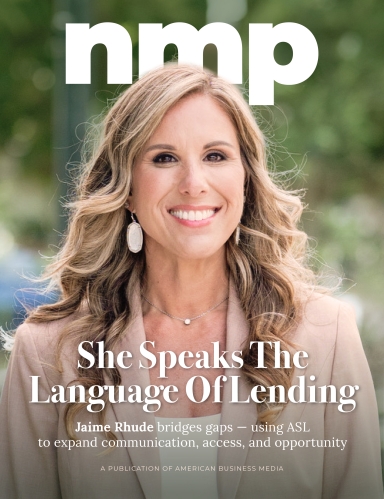
With roots in deaf culture and deep knowledge of VA loans, Future Home Loans’ Jaime Rhude bridges communication gaps other lenders don’t see
By Kathryn Fitzpatrick, special to National Mortgage Professional
Image captions
A bird hit Jaime Rhude’s shoulder as she was entering the testing center — a mildly frightening moment she describes not as an omen but as “weird.” This was the second time she’d taken the mortgage licensing exam. The first time, she failed, but she waited thirty days, studied, took practice tests, and went back for another shot. And then a bird — no species, no metaphor, just feathers and motion and impact, flew into her on the sidewalk.
Rhude, who today works for Future Home Loans in Melbourne, Fla., and closed nearly 100 loans last year, did not begin as a VA loan pro. She came from casinos. She couldn’t have anticipated the bird or the career change.
The casino isn’t a metaphor or an omen either. She spent ten years in the casino industry, working in a world (strangely like lending) where chance and calculation coexist. She earned a degree in healthcare management, which has nothing to do with her work, she admits, but she knows how to manage risk. She knows how to read people. And, above all, she knows how to survive in systems built for someone else.
Raised To Sign Before Speaking
What sets Rhude apart — aside from the bird thing — is that she grew up in a deaf family. A CODA (Child of Deaf Adults), Rhude’s mother, father, grandparents, and cousins are all deaf or hearing impaired. “I was raised to sign before speaking,” she says. “I had to do speech therapy growing up because I was in a deaf culture. That’s just how my life was. Somebody would ring our doorbell — the lights are flashing like a disco.”
She is fluent in American Sign Language (ASL) and regularly works with deaf clients, many of whom are referred by family. “They’re excited when they see someone who can sign to them,” Rhude explains. “The way they think is so different. The communication is different. It’s broken English. ‘I’m going to the mall’ becomes ‘I go mall.’ So if I didn’t know [ASL], it would be very hard to communicate.”
For deaf buyers, access to the kind of service Rhude offers is rare. Very few loan officers, Realtors, or attorneys are fluent in ASL — a critical barrier in a country where approximately 500,000 people use ASL as their primary language. A 2024 directory of signing-friendly real estate professionals listed just over 50 ASL-fluent agents in the entire U.S. In most cases, deaf buyers end up working with professionals who don’t sign and don’t fully understand how to accommodate their clients.
When that happens, even routine interactions can devolve into time-consuming exchanges over email or text. “Communication is huge in our industry,” Rhude says. “We have to communicate to our buyers. And then using a Realtor — I’m now working on their behalf to help them with the Realtor too, because they have to communicate with the Realtor. If the Realtor doesn’t know sign language, it’s a lot of writing and emails.”
And while captions, FaceTime, and messaging help bridge the gap, the lack of ASL-fluent professionals often forces deaf clients to be more involved in the homebuying process. “When I have clients that are Hispanic, the first thing they ask is, ‘Do you speak Spanish?’” she says. “It’s the same thing with sign. When they see that I do understand, they get excited because it’s not a very big language that people understand.”
“They’re excited when they see someone who can sign to them. The way they think is so different. The communication is different. It’s broken English. ‘I’m going to the mall’ becomes ‘I go mall.’”
>A CODA (Child of Deaf Adults) fluent in ASL, Jaime Rhude offers something most loan officers can’t: cultural fluency and communication access. Her ability to connect with deaf and hard-of-hearing clients helps bridge a systemic gap in the mortgage industry.
To elaborate, deaf buyers working with non-signing professionals often report needing to “do more work than necessary” just to keep up. For example, The National Association of the Deaf (NAD) and DeafFriendly Consulting repeatedly emphasize that deaf clients must often “educate” professionals about their rights under the ADA, request their own interpreters, or navigate inaccessible communication systems. In contrast, those who’ve had the chance to work with ASL-fluent professionals say the process is “significantly smoother and easier.”
Rhude’s cultural understanding, not just of the language, but of the way her clients think and process information, is just as vital. Deaf culture is visual, direct, and relies on specific cues. Professionals unfamiliar with that dynamic may unconsciously patronize or bypass their deaf clients. Rhude makes sure that doesn’t happen. “If I didn’t know sign, it would be very hard to communicate,” she says. “But because I do, they don’t feel like they have to work around me. I work around them.”
That ethos is at the heart of her work. Every video she posts includes captions. Every conversation is tailored. Every client gets her full attention. “You’ve got to be grounded,” she says. “You’ve got to meet people where they are.”
It’s a lesson she learned early, growing up in a deaf family. And one she learned again, years later, as a military spouse constantly moving, adapting, and watching the people around her get written off by a system that didn’t try to understand them.
“Every Time We Moved, I Had To Start Over”
Meeting people where they are is what ultimately led Rhude to VA lending. The same empathy that allows her to connect with deaf clients is what drives her advocacy for veterans. Living as a military spouse, she learned how easily people are dismissed because of circumstances beyond their control.
When Rhude met her husband, who was stationed at Patrick Space Force Base, her life moved in chapters. They moved to Indiana. She took a job in banking because it felt similar to the casino, in some ways. From there, it was Montana. Then Charleston, S.C. “Every time we moved, I had to start over,” she says. “They weren’t remote positions, especially in banking. You’re working in a facility.”
She had a hard time finding work at first. Employers would notice the gaps in her resume, the frequent moves, and dismiss her. “I just couldn’t get a job and I was frustrated, which is silly because I’m a military spouse, but they looked at it as, how long are you going to be in Charleston? And they didn’t want to hire. And I had a good work ethic.”
Her luck changed when she started going to coffee meetings with other military spouses in Charleston. Many were Realtors. She asked, “How do I get into mortgage?” One of them connected her with a lender who specialized in VA clients. “I called her right away after I left meeting those ladies,” Rhude recalls. “I said, ‘Hi, I’m Jaime. I want to get into mortgage. I’ve never done it, but I have a banking background.’”
The lender, Jenny Wellington at Premier Nationwide Lending, told her to get licensed — which led her, eventually, to that strange sidewalk moment with the bird. She passed the second time and began her mentorship before the pandemic hit.
The learning curve was steep. Mortgage wasn’t just banking with a different title. “I didn’t even know what I was getting myself into,” she says. “It’s a whole different world.” But she loved the work. “The best part about it was helping people get into houses.”
“Everybody thinks that VA loans are the hard loans, but it’s the best loan program out there.”
> As a Vetted VA loan officer and military spouse, Rhude specializes in helping veterans navigate a system many lenders misunderstand. She’s made it her mission to educate clients and agents alike about what VA loans really are: powerful, accessible, and worth the extra care.
Not every loan file is straightforward, and not every borrower fits cleanly into a box, but Rhude thrives in those gray areas, the places where human circumstances collide with rigid underwriting checklists. “You’ve got to ask the extra questions,” she says. “You’ve got to look for the workaround that still plays by the rules.” That mindset has allowed her to close files other lenders won’t touch. But it’s also why the losses stick with her.
When a deal falls through, it’s not just a line on a spreadsheet. It’s a person. “That $4,000, that was someone’s shot at stability. I don’t take that lightly.”
She brings that same sense of responsibility to every part of the job.
“It’s About Showing Up Where It Counts”
Today, Rhude is a one-woman force of nature. “It’s literally me and a processor,” she says. “I just brought on an LOA.” Her reach spans multiple states: she’s still active in South Carolina, despite relocating to Florida, and she shows up to closings whenever she can. She networks constantly, volunteers on local boards, and drops off business cards with handwritten thank-you notes and inspirational quotes. “They may not use me right away,” she said, “but when they start seeing me, they’re like, ‘You’re Jaime. Nice to meet you.’”
Rhude doesn’t believe in volume for its own sake. Instead, she focuses on building what she calls “a trust-based pipeline.” Many of the loans she closes started as conversations that went nowhere at first. “I’ve had borrowers circle back two or three years later,” she said. “They weren’t ready then. But I never burned the bridge. I gave them the information, told them what to fix, and followed up. And they remembered that.”
Her communication style is direct but never transactional. She’s not afraid to ask hard questions — income gaps, credit events, family logistics — but she does it in a way that feels collaborative. “I interview people without them realizing it,” she says. “I’m not grilling them. I’m gathering data, connecting dots. They think it’s a conversation, but I’m building their file in my head.”
That lets her anticipate challenges long before submission. She’s proactive about structuring files correctly, particularly for VA borrowers, whose scenarios often come with layered complexity. Joint entitlements. Overseas deployments. Thin credit files. Manual underwriting. “You’ve got to know what the VA will allow and what the lender might push back on,” she says. “You can’t just quote a rate and hope for the best.”
Still, she stays steady. She works out every morning. Writes handwritten notes. “It’s not about being everywhere,” she says. “It’s about showing up where it counts.”
And for Jaime Rhude, that begins with speaking the right language — whether it’s VA loans or ASL, she’s fluent in both.
“I’ve been there. I’ve moved from Montana to Florida. I know what needs to be in the power of attorney. I know the documents. I know what a commander’s letter should say.”
> Having relocated multiple times through military orders, Rhude brings firsthand PCS experience to each transaction, helping active-duty buyers manage remote closings, power of attorney documents, and everything in between.
Rhude got certified in VA lending almost immediately. “Just because of being a military family, I understand the process,” she said. “Going from casino to banking, I handled money, but money is different than loans.” She also took a credit analysis class so she could better read credit reports — a skill she already had from underwriting HELOCs and auto loans at credit unions.
She was determined to be more than just competent, though. “Everybody thinks that VA loans are the hard loans,” she said. “But it’s the best loan program out there.” Rhude is now a Vetted VA loan officer and speaks confidently about the nuances that others often misunderstand. “A lot of people think the home won’t appraise. Or that seller’s agents won’t accept a VA buyer. But that’s because they’re not educated in it.”
“You’ve Got to Look For The Workaround That Still Plays By The Rules”
She’s often surprised by how many lenders conflate VA guidelines with overlays. “The VA doesn’t require a credit score,” she said. “Lenders do. The VA doesn’t have a DTI cap either — just residual income requirements.” And that’s where borrowers can run into trouble: not understanding that a high DTI isn’t an issue, as long as residual income clears the threshold. “That’s where I spend time educating people,” she said. “You can have a 50% DTI and still get approved — but you’ve got to meet the residual.”
Her brokerage model helps her navigate those nuances. If one lender applies an overlay — say, a 640 minimum FICO — she can place the file elsewhere. “That’s the benefit of being a broker,” she says. “You can move a loan to someone who follows agency guidelines instead of blocking the file with arbitrary rules.”
That flexibility matters, especially in a lending landscape where the product is chronically underused. In fact, fewer than 15% of eligible veterans are currently using their VA loan benefit. According to U.S. Census Bureau and VA data, there are approximately 19 million veterans in the country. Yet only 3.7 million active VA loans are on the books, per reports from the Department of Veterans Affairs and the Mortgage Bankers Association.
Rhude can speak with unusual authority to those navigating the PCS system. “Buying a house sight unseen, all of that is so stressful,” she explains. “But I’ve been there. I’ve moved from Montana to Florida. I know what needs to be in the power of attorney. I know the documents. I know what a commander’s letter should say.” In fact, she regularly coordinates “alive and well” checks — a military requirement when a service member is buying a home remotely with a power of attorney. “A commander has to email and say, ‘Yes, I am alive and yes, I’m purchasing this home.’”
One of her favorite stories involved a veteran who served ten years in prison. “Other lenders had already turned him down, big box ones,” she said. But Rhude learned that the man had worked in the prison system the entire time, earning $15 an hour. “We reached out to the prison, spoke to one of the sheriffs, and got a letter stating he worked 40 hours a week. The underwriter took it, and I was able to close on that home.”
Not every story ends in a closing. She still carries the weight of an 80-year-old veteran’s failed loan. “He lost his earnest money. It was $4,000. And that sucks,” she says. “He had cancer. You’re trying to help someone, and it just doesn’t work out.”
platforms consolidate and vendors gain leverage, the lenders who stay disciplined about data, adoption, and exit terms will be the ones who keep control of their own tech stack













 Built with Shorthand