Single-family rents increased 3% year over year in April, marking a leveling off of the 6% annual increase seen in April 2023 according to CoreLogic’s latest Single-Family Rent Index (SFRI).
Declining 0.5% in April, rent growth for attached properties such as condominiums, townhomes, or duplexes saw their second consecutive month of annual depreciation. According to CoreLogic’s report, the declines in the attached segment are being driven by a subset of markets, “mostly those in Florida, but including Austin, Texas; New Orleans and Phoenix.” Rent growth for attached properties has declined nearly 15% since they peaked in early 2022.
With the Federal Reserve holding interest rates higher for longer, last week signaling the likelihood of only one quarter-point rate cut in 2024, whether sticky shelter inflation falls as demand for rentals rises remains to be seen. A recent Fannie Mae survey indicated most consumers believe it’s not a good time to buy or sell a home, and even as purchase listings rise in markets across the country, many buyers have withdrawn altogether.
“Annual single-family rent growth has solidified over the past few months, increasing at roughly the long-term trend,” said Molly Boesel, principal economist for CoreLogic. “However, monthly single-family rent growth gained momentum and was higher than usual for April. At the current rate, rents are poised to grow by roughly 3% through the end of 2024.”
That 3% growth rate is in line with historical averages.
The SFRI tracks changes in single-family rents across four price tiers, from 75% or less than the regional median to 125% or more than the regional median, as well as several major metros.
The higher-priced market segment of single-family rental properties (125% or more of the regional median) was the only to experience a year-over-year increase in the pace of rent growth, up 3.2% in April 2024 compared to 1.8% in April 2023. The lower-priced market segment (75% or less than the regional median) experienced the greatest year-over-year declines, from 6% annual appreciation in April 2023 to 3.1% annual appreciation in April 2024.
The lower-middle priced market segment (75% to 100% of the regional median) saw 3.5% annual appreciation in April 2024, down from 4.2% in April 2023, while the higher-middle priced market segment (100% to 125% of the regional median) rose 3.3%, down from 3.6% last year.
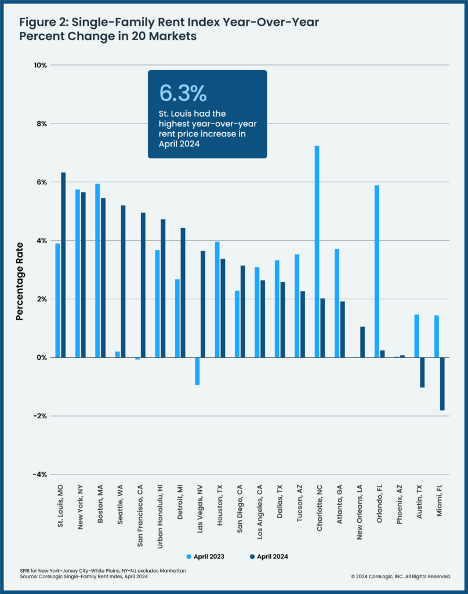
While St. Louis, the least expensive of the markets CoreLogic tracks with a March median monthly rent of $1,616, experienced the greatest annual increase in single-family rents (+6.3%), Miami posted the greatest annual rental prices losses (-1.8%). New York registered the second-highest annual gain at 5.6%, followed by Boston at 5.4%.
After San Francisco and Seattle saw single-family rents stagnate in April 2023, both of those metros experienced gains of roughly 4.5% in April 2024.
Conversely, after rising more than 7% in Charlotte, N.C., in April 2023, annual rent growth slowed to 2% in April 2024. A similar slowdown affected Orlando, Fla., where annual gains retreated from nearly 6% in April 2023 to roughly 0.25% in April 2024.