Supply holds the key to the spring buying season.
Right now, there are 44% more sellers than buyers, a near record gap, according to Redfin. And if supply grows, or even remains the same, spring may finally break out of its three-year slump, says First American Senior Economist Sam Williamson.
With buying power now ahead of the national list price, more houses have fallen within buyers’ budgets. Williamson notes in his latest forecast. But “whether price growth stays contained will depend, in large part, on how supply evolves relative to demand,” he notes.
“If supply remains tight and house-buying power stays ahead of list prices,” the economist predicts, “the spring home-buying season may break out of a three-year slump, even if just modestly.”
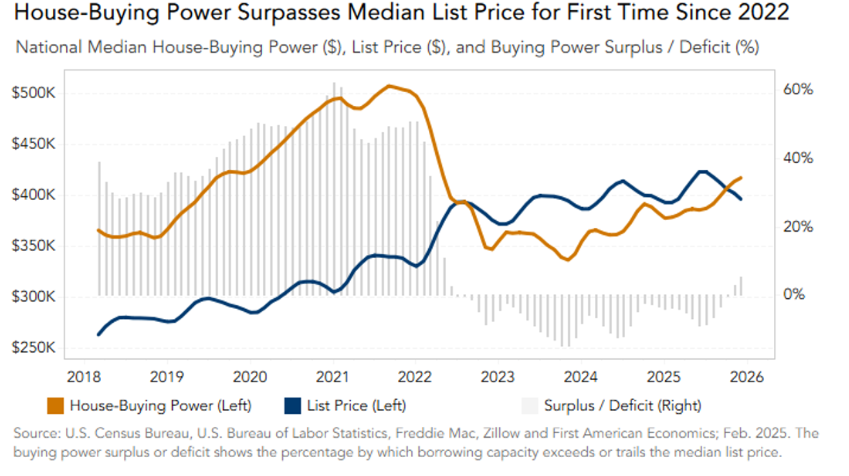
In December, buying power hit $417,000 on a national basis, 5% more than the national list price of $396.000. That’s still below pre-pandemic norms. But “the modest” difference alone “should support a stronger spring sales season,” Williamson offers.
First American’s house-buying power metric estimates how much home a buyer can afford based on median household income, the prevailing 30-year, fixed mortgage rate, and an assumption that one-third of a family’s pre-tax income is allocated to a mortgage payment with a 5% down payment. When rates fall or incomes rise, buying power also increases.
In the early months of the pandemic, buying power surged as mortgage rates dropped to historic lows, exceeding $500,000 by late 2021. List prices also jumped amid strong demand and limited supply, but at roughly half the pace of buying power.
As a result, the difference between buying and asking prices was roughly 50%.
But that dynamic reversed course in 2022, when rates climbed rapidly and buying power dipped below $340,000.
At the same time, list prices remained elevated, supported by tight inventory and the rate lock-in effect. The surplus flipped to a deficit, reaching a peak of 15% in late 2023.
Since then, the deficit has gradually narrowed. Mortgage rates have declined from their peak, household incomes have continued to rise, and price growth “basically flatlined.”
By December 2025, buying power returned “to surplus territory relative to median list price for the first time since 2022,” the First Am economist says.
December’s boost in sales coincided with the increase in buying power. But the statistic to watch is inventory, or the number of houses on the market.
“Whether price growth remains contained this spring depends on the supply of properties on the market,” Williamson advises.
The bottom line: An increase in supply will put a damper on prices but a decline will allow sellers to continue asking more.