Terminator Tech – NMP Skip to main content

COVER STORY

Terminator Tech

How to beat servicers
on refi recapture

By Katie Jensen, Associate Editor, National Mortgage Professional

COVER STORY

Terminator Tech

How to beat
servicers
on refi
recapture

By Katie Jensen, Associate Editor,
National Mortgage Professional

The early signs are subtle — a modest easing in rates, a slight bump in payoff activity — but anyone who has survived a refinancing wave can feel the shift. It’s the kind of market pressure that turns call centers into weapons and every past borrower into a potential target.

Servicers are already powering up their machines, using predictive engines to scrape borrower data in real time. Within the country’s largest servicing shops, agentic AI is being trained to reach past clients before their competitors.

In that fight, brokers are falling behind. Many aren’t touching their databases consistently. They need automated engagement, better retention tools, and a way to survive the industry’s feast-and-famine cycles without rebuilding headcount they can’t afford.

UWM and Lendware represent two distinct approaches to that problem. 

UWM’s tech (Mia + KEEP) is focused on mass outreach and speed: its voice-AI agent, Mia (Most Intelligent Agent), can call every past borrower in a broker’s database within minutes, hold natural conversations, surface rate-drop opportunities, and even act as a 24/7 inbound call handler. Essentially, UWM is equipping brokers with an always-on call center they don’t have to staff.

Lendware, by contrast, focuses on intelligence and precision. Its platform uses a predictive engine to analyze roughly 1,500 data points and predict which borrowers are most likely to refinance, take cash-out, or purchase. Its hyper-customizable CRM also equips loan officers with tailored context and CRM automations in their own voice.

According to executives such as UWM CTO Jason Bressler and Lendware CEO Josh Glantz, the next refi cycle may not hinge on competition between loan officers as much as between loan officers and increasingly sophisticated machine systems — a dynamic some brokers refer to as “Terminator tech.” Both leaders stress that these tools are designed to support, not replace, originators. “We don't think about AI as something to replace a loan officer,” Glantz said. Bressler noted that Mia “isn't allowed to quote rates … AI agents don't have NMLS numbers … she always refers back to the loan officer.”

Across interviews, sources also report that AI is already performing core refi tasks:

  • Auto-fills LOS during the intake call
  • Pulls credit (soft or hard)
  • Runs AUS
  • Calculates DTI
  • Reads & calculates tax returns
  • Reads & analyzes years of bank statements
  • Highlights questionable deposits
  • Auto-updates income/assets when new docs hit
  • Flags human error instantly
  • Automated voice/text/email follow-ups
  • Converses with multiple borrowers at once
  • Warm-lead conversion
  • Long-term nurture
  • DM-style custom AI scenario desk for lender/product selection
  • AI “blueprint” knowledge is based on thousands of real files

At the same time, major lenders are currently testing more “agentic” versions of AI capable of:

  • AI-to-AI fast-track with wholesale lenders
  • End-to-end origination automation
  • Agentic task-based processing

In a recent commentary, GoRascal CEO Scott Valins described hearing from one of his loan officers who questioned whether the profession would survive the decade, reflecting a growing unease about how far and how quickly AI may reshape refinance work. According to some originators, the shift feels less like assistive automation and more like a parallel workforce emerging inside the country’s biggest mortgage shops.

Brokers Scale With AI

Jason Bressler, United Wholesale Mortgage’s chief technology officer, often says “too many folks are trying to make a faster horse,” arguing that the industry still misunderstands what this moment requires. There is no faster horse, he insists, but there is an opportunity to reimagine originators’ entire workflow.

For UWM, that reimagining started with ChatUWM, a chatbot that gives brokers product guidance that was once limited to top performers. It later progressed to LEO, an AI agent built to protect brokers from misleading competitor quotes by verifying property values and debts through API calls. Upload a loan estimate, and LEO returns a second screen showing what the borrower actually qualifies for — a safeguard Bressler considers essential as call-center lenders inflate appraisals, omit known debts, or misstate income to lure borrowers.

But Mia represents the culmination of UWM's strategy. It’s a system operating at national scale that has already produced 14,000 refinance closings on its own. She is, according to Bressler, "a game changer and a technological revolution — not just for the mortgage industry, but for the entire technical landscape of any company. Nobody has built anything like we did, and we built it in-house."

UWM CTO Jason Bressler says he built systems like Mia as a counterweight to consolidation. It’s an attempt to “level the playing field,” between brokers and retail servicers, and they “don’t even have to send the loan to UWM in order to utilize it,” he said.

UWM CTO Jason Bressler says he built systems like Mia as a counterweight to consolidation. It’s an attempt to “level the playing field,” between brokers and retail servicers, and they “don’t even have to send the loan to UWM in order to utilize it,” he said.

Mia goes well beyond the typical duties of an auto-dialler or a pre-recorded voice-bot; it holds actual conversations with prospective clients — unscripted, in real time, with enough conversational fluency to keep borrowers engaged. Mia is what developers call a generative AI agent, capable of "full-on conversations around almost anything," within the guardrails that UWM's engineers have established.

Image of a sample Mia call summary.

Image of a sample Mia call summary.

Bressler also pointed out that UWM didn’t reserve Mia for its highest-volume clients, nor did it restrict her use to loans destined for UWM's pipeline. MIA is currently available free of charge to all 50,000 UWM broker partners.

"We built all this technology for our broker partners," Bressler emphasized. "Then we gave it away for free. We told them, 'You don't even have to use us.'"

 In practice, Mia performs four core functions:

  • 20-day post-closing calls to check in, answer questions, and reinforce the broker's brand.
  • 180-day nurturing calls to keep past clients warm.
  • Rate-drop triggers driven by UWM's internal algorithm that flags when a borrower can save money by refinancing.
  • A 24/7 inbound call agent, with a dedicated number tied to each loan officer's area code.

The economic advantages provided with MIA are straightforward: In a race for refi recaptures, a slight drop in mortgage rates is considered the starting gun, and it ricochets off an LO’s database flagging 50 or more past clients in need of a refinance. “There is no shot, even the best loan officer with her own loan officer assistant is going to call all 50 of those people," Bressler said. "Mia calls all 50 in three minutes."

Mia’s conversations follow one of two patterns: either borrowers express interest in refinancing to Mia directly, or they call their loan officer back, curious about who Mia is. "A lot of times, the borrower will just call the loan officer back, or email them and say, ‘hey, I just got a call from somebody named Mia. I'm not sure if it was AI, or if you had that person call me.’ Well, now you're immediately back in touch with your past client," Bressler explained.

The broader strategy, though, extends beyond automation efficiency. UWM is positioning its technology explicitly as a counterweight to industry consolidation. As the nation’s largest wholesale lender, UWM can rapidly upgrade tens of thousands of small and mid-sized brokers with technological capabilities of a major retail platform — and did it without sacrificing broker independence. 

“It’s almost a scare tactic,” Bressler said. “These large retail shops saying, ‘You can’t leave us because nobody has our technology.’ Well, that’s not true. You can get it all for free by becoming a broker.” Once brokers plug into UWM’s ecosystem, they’ll gain access to “much more powerful technology than any of these retail companies have,” he added.

That positioning sends an implicit warning about how competitive dynamics are shifting in the refi game. For originators looking to recapture that business, technology adoption is no longer discretionary. Those who resist won't lose their business to AI, but they'll lose it to other loan officers who have learned to wield it effectively.

While much of the market is watching for a refi-cycle spark, vendors are flooding inboxes with AI-branded tools that don’t hold up under scrutiny. “90% of these vendors and the products that are coming out that label themselves as AI are not AI,” Bressler said. To him, the risk isn’t just adopting the wrong tool — it’s falling behind while waiting for someone else to figure it out. “You have to get involved with it now. You can’t keep waiting … you have to educate yourself as quickly as possible.”

In the emerging AI arms race within mortgage lending, UWM represents the first large-scale demonstration of what recapture technology looks like when deployed at industrial volume. The rest of the industry is now attempting to match that capability, while independent brokers are searching for ways to compete.

Tech Support For Lone Rangers 

The broker who doesn’t have time to sift through 500 past clients is competing against platforms that do nothing but sift. It’s the Lone Ranger problem, and it’s exactly the scenario Lendware says its technology was built to solve.

Retail and wholesale servicers enter every refinance cycle with a built-in advantage: they already hold the customer. As AI accelerates inside the country’s largest mortgage shops, a parallel pressure is squeezing the broker channel: consolidation. Big platforms — Rocket, UWM, Better, and others — argue that the only way to stay technologically competitive is to join their ecosystem, adopt their proprietary software, and operate under their rules. Servicers know the rate, the payment history, and the loan term. What they don’t know, according to Lendware CEO Josh Glantz and Neo Home Loans Brian Gutierrez, is the borrower themselves.

“In every other industry, consolidation also frees up opportunities for additional disruption.”

> Josh Glantz, CEO, Lendware

“In every other industry, consolidation also frees up opportunities for additional disruption.”

> Josh Glantz, CEO, Lendware

Lendware Predict, the AI-driven evolution of Aidium’s CRM and modeling engine, is designed to give small and mid-size broker shops what retail servicers don’t know they’re missing: a continuously updated, behavioral portrait of every contact an originator has ever touched. 

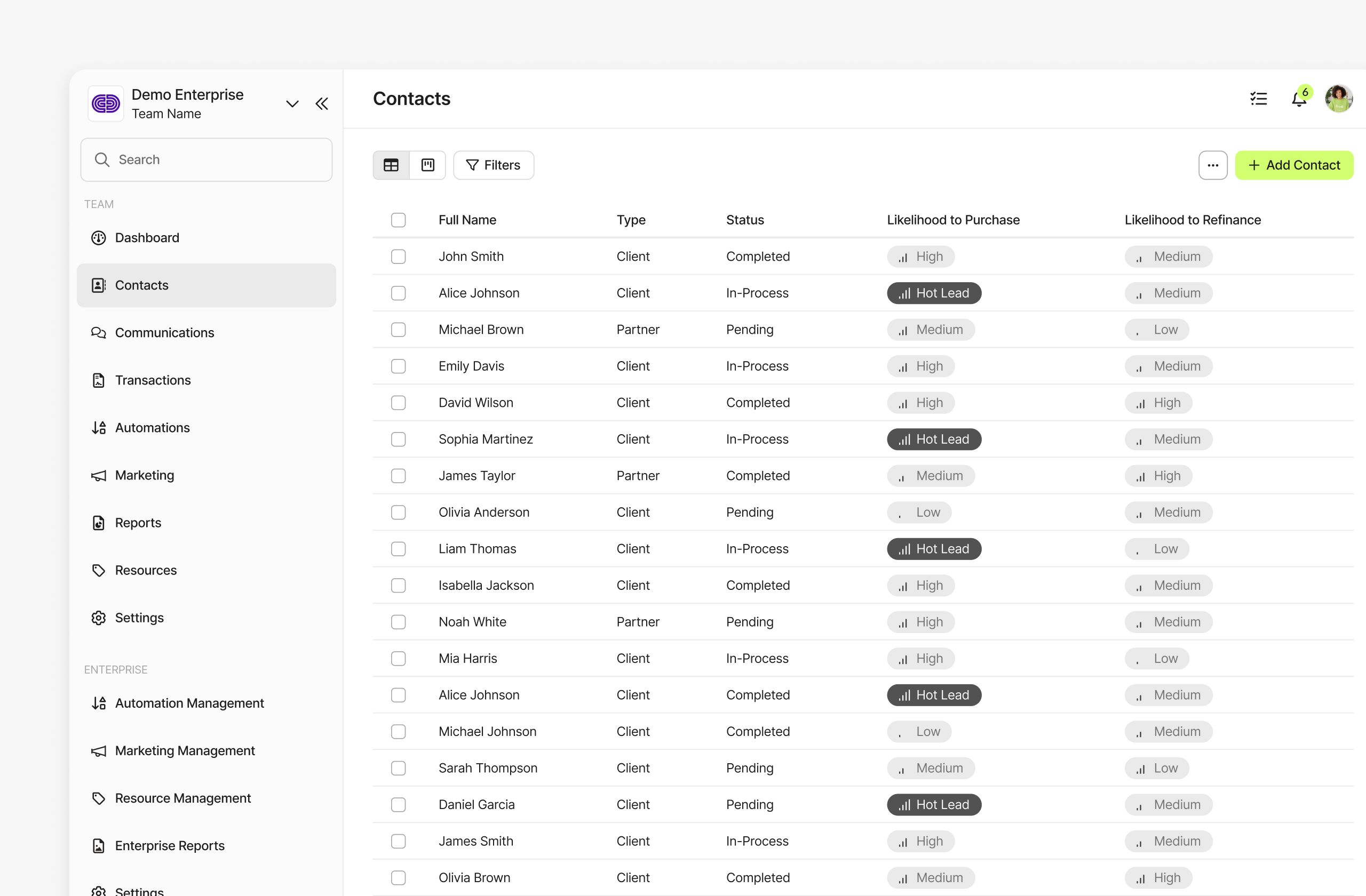
Lendware Predict, as CEO Josh Glantz explains, is designed to give brokers and originators something servicers will never have: a deep, behavioral, data-driven portrait of every lead and past client, refreshed in real time. “It picks old contacts and we can actually run that through our AI platform and give Brian a score for each of those borrowers or former leads,” Glantz explained. The platform ingests roughly 1,500 data points across a loan officer’s entire database — past borrowers, abandoned applications, long-cold leads, even referrals that never converted — and assigns each contact a probability score for needing a mortgage in the next three to six months. It identifies opportunities for refinances, cash-outs, HELOCs, and purchases. 

A sample Lendware Predict dashboard displaying a contact-level “behavioral portrait”—a kind of “who’s hot and who’s not” list—ranking borrowers by likelihood to purchase or refinance based on past interactions, engagement signals, and transaction status.

A sample Lendware Predict dashboard displaying a contact-level “behavioral portrait”—a kind of “who’s hot and who’s not” list—ranking borrowers by likelihood to purchase or refinance based on past interactions, engagement signals, and transaction status.

The impact on a single originator is immediate. Brian Gutierrez, a veteran mortgage advisor at Neo Home Loans (powered by Better), describes his old workflow — spreadsheets, rate buckets, public-record searches — as guesswork disguised as process. The scoring model changed that. “This scoring model has allowed me an opportunity to just be even more laser-focused,” he said. “Oftentimes, loan originators get this paralysis by analysis, and Lendware has allowed us a chance to really just be very, very tactful and very specific with who we're reaching out to.”

“You can be the Lone Ranger working for ABC Brokerage and have an even better, less archaic approach in your business.”

> Brian Gutierrez, Mortgage Advisor, Neo Home Loans

“You can be the Lone Ranger working for ABC Brokerage and have an even better, less archaic approach in your business.”

> Brian Gutierrez, Mortgage Advisor, Neo Home Loans

Servicers, he argues, play a completely different game. Their outreach is transactional: find the 6.75% loan, offer 6.25%, move on. But “those call center employees don’t know anything about that borrower’s situation,” Gutierrez said. 

The scoring model does. It flags the homeowner who quietly took on $30,000 in credit-card debt, the family who added a relative to the household, the parents whose children just left for college, the borrower who recast their loan, the young couple welcoming twins — all signals that shift a borrower from a rate-and-term refi to a cash-out, or from a cash-out to an upcoming purchase.

Image of a sample Lendware Predict page spotlighting a hot prospect.

Image of a sample Lendware Predict page spotlighting a hot prospect.

Gutierrez said the difference isn’t subtle: “It just allows the conversation to unfold … rather than just [having] a debt conversation.” Because scores update daily, he no longer wastes hours calling 100 cold leads to find 10 who might be ready. “It gives us an opportunity to get some at-bats before anybody else reaches out,” he said. 

For any brokers ignoring the shift towards AI integration, “You're going to lose out on opportunity,” Gutierrez warned. Lendware is attempting to guide brokers, he added, “They’re out here selling cars to loan officers that are still riding horses.” 

For Glantz, the Lone Ranger narrative is precisely the point. The platform is designed not to pull brokers into a closed ecosystem, but to attach to whatever LOS or CRM they already use — including Encompass, Kinman, Arrive, and LendingPad, he said. 

Lendware layers automation, sentiment analysis, AI-drafted messages, and workflow intelligence on top of that infrastructure. It also ships with prebuilt automations from high-producing teams like Gutierrez’s — operational templates most small shops would never have the bandwidth to build themselves.

“Lendware is kind of in that shift. They're out here selling cars to loan officers that are still riding horses.”

> Gutierrez

“Lendware is kind of in that shift. They're out here selling cars to loan officers that are still riding horses.”

> Gutierrez

And unlike the legacy CRMs that flood consumers with identical messages, Lendware’s strength is customization. Gutierrez said he’s seen real estate partners receive the same stock template email from four different loan originators. “When I go to that customizable point, I want my CRM to sound like Brian Gutierrez,” he said. “To this day there are still emails going out that look identical across mortgage platforms because they're all utilizing the same CRM.” 

This is where the Lone Ranger gains leverage: the ability to operate like a modern, data-driven retail shop without abandoning independence. “If you don't go with one of those platforms … you can be the Lone Ranger working for ABC Brokerage … and have an even better, less archaic approach in your business,” Gutierrez said. “If you're a Lone Ranger, this will level you up.”

Glantz frames the moment more broadly. Consolidation, he said, doesn’t eliminate opportunity — it creates it. “In every other industry, consolidation also frees opportunities for additional disruption,” he said. “Teams, or even entire companies that were rolled up, will then break off and start something new again.” 

In a refinance cycle defined by speed, data, and automation, the battleground is no longer just who can call the borrower first — it’s who can build the fastest, smartest tech without surrendering their independence. Lendware’s bet is that brokers don’t need to join a giant platform to win. They just need the right weapons.

Is AI The Only True Winner?

If UWM represents the industrial-scale future and Lendware the precision weaponry for independents, the next question is harder, and far more uncomfortable: what if AI eventually replaces loan officers altogether?

Researchers at MIT have already begun sketching the outlines of that possibility. In Project Iceberg 2025, a study that reads like a blueprint for the next phase of mortgage automation, the findings are blunt. Current AI tools are technically capable of performing tasks worth 11.7% of total U.S. wage value or about $1.2 trillion a year across an economy of 151 million workers and more than 32,000 distinct skills. Loan officers weren’t singled out, but much of the work MIT classifies as highly automatable, like document reading, data extraction, rule-based decision-making, templated writing, matches the workflows that define originators. And researchers say that's only the tip of the iceberg. 

Below the waterline sits a far deeper layer of invisible, cognitive tasks — the scanning, sorting, calculating, checking, logging, and assembling — that determine how a loan file is actually built. It is that submerged mass of labor that AI is already beginning to devour.

Fairway Home Mortgage COO Len Krupinski confronted that tension directly when discussing tech tools for non-delegated correspondent bankers. Even as he emphasizes Fairway’s culture of personal service, he’s candid about what agentic systems can do. “There's only so many loan officers that could be available at any given time, and the thing is, with agentic AI, it can make several calls at one time,” he said. “It’s the ultimate multitasker.”

Inside Fairway’s own tests, the shift is already material. Krupinski described “agentic sales assistants” as so convincing that “it’s hard to tell that you’re not talking to a human.” Borrowers rarely disengage, he said. “Most people don't even hang up because the conversation is going so well … they had to turn it off because they were getting so much business. There were too many leads coming in so fast.” 

It’s a dramatic revelation to not only Fairway, but any lender that’s built on a relationship-first model. “It's like the cold caller's almost being eliminated with this agentic assistant, and it's having better results than the cold callers — that's what I've heard.”

As a distributed retail lender, Krupinski insists that AI cannot replace the emotional bond between borrowers and Fairway’s originators. “If you do a good job for a customer, I don't think there's any technology that replaces that,” he said.

Inside Fairway’s own tests, that shift is already taking shape. Fairway Home Mortgage COO Len Krupinski described “agentic sales assistants” as so convincing that “it’s hard to tell that you’re not talking to a human.”

Inside Fairway’s own tests, that shift is already taking shape. Fairway Home Mortgage COO Len Krupinski described “agentic sales assistants” as so convincing that “it’s hard to tell that you’re not talking to a human.”

But that argument runs headfirst into the question Fairway’s own experiments raise:

If a voice-bot becomes so life-like that borrowers think they are speaking to a human, why wouldn’t they trust it? And if lenders believe only loan officers can and should earn that trust, why build AI models designed to imitate the very people they insist are irreplaceable?

That’s the paradox the industry has been dancing around. But Scott Valins, CEO of GoRascal, isn’t dancing.

In a recent post, Valins described a Zoom call with one of his most unfiltered originators. The LO didn’t bother with industry platitudes. “Scott … let’s cut the sh**. All this ‘AI won’t replace LOs who embrace it’ stuff? Our jobs are toast in ten years.”

Valins said he “didn’t totally disagree.” He recalled reading an article years before ChatGPT that listed the jobs most likely to be wiped out by AI. “Mortgage loan officer was top five.”

Working as if the role might not exist in a decade, he wrote, is “pretty motivating.” It forces evolution. And for all the reassurances circulating in the industry, Valins rejects the comfort narrative outright.

“We can keep telling ourselves AI will stay ‘agentic’ and be accretive and that we’ll slot neatly into the future,” Valins wrote on LinkedIn. “I think some real fear might be the best catalyst we have.”

Fear, instead of reassurance, might be the only honest reaction to an iceberg of automation that’s still revealing its shape. Every new AI tool is pitched as a way for loan officers to stay competitive. But if each one learns the job a little better, a little faster, a little more completely, at what point does “adaptation” become the very thing that speeds their extinction?

This article originally appeared in National Mortgage Professional, on the week of January 25, 2026.
About the author
Associate Editor
Katie Jensen is a mortgage news reporter at NMP.
Published on
Jan 22, 2026
More from NMP Magazine
NMP
Not Your Conforming Comfort Zone

Non-Agency originations could reach $500 billion this year. Are you ready to tap in?

Tom Davis
NMP
The Liquidity Squeeze In FHA Servicing

The long tail of loss mitigation is now coming into view as FHA’s post-pandemic relief tools give way to repeat defaults, exhausted options, and a swelling foreclosure pipeline

Katie Jensen
NMP
The NEXA Disruption

A bold rebrand tests the broker–retail divide

Katie Jensen
NMP
The More AI, The More LO

AI makes human loan officers more essential, not less

John Cady
NMP
Homes For People, Not Portfolios

Trump’s housing directive targets bulk buyers — but the real impact hinges on definitions, supply, and migration to build-to-rent

Seamus Nally
NMP
The Offense Mindset For M&A

Lenders turn consolidation into a competitive weapon

Katie Jensen
Connect with your local mortgage community.

Meet your your colleagues, both national and local, by attending an event in your area.