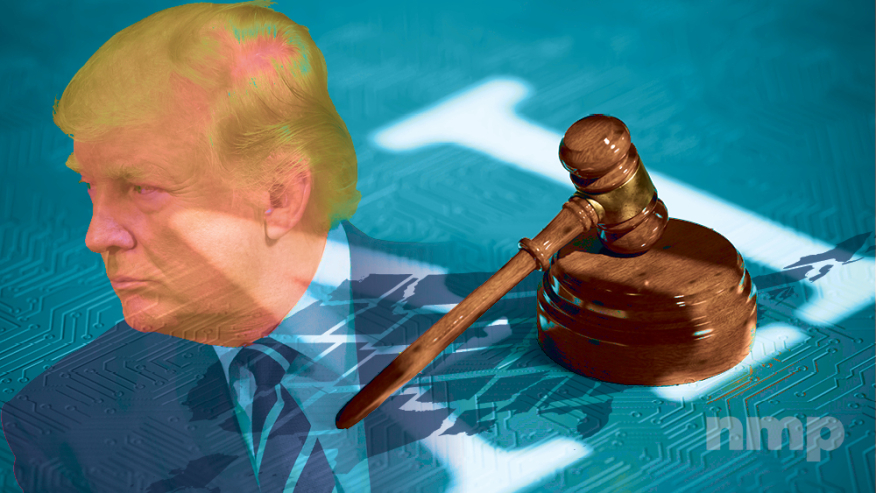
In response to what the Trump administration calls a growing patchwork of conflicting state regulations on artificial intelligence (AI), President Donald J. Trump has signed an executive order designed to assert federal authority over AI policy, while limiting state laws perceived as barriers to national AI innovation and competitiveness. The administration frames the action as essential for maintaining U.S. global leadership in AI technology, particularly in strategic competition with economic rivals.
The purpose of the order is to promote U.S. national and economic security by ensuring a “minimally burdensome national policy framework” for AI that supersedes inconsistent state rules. Trump’s new order explicitly references a prior executive order (Executive Order 14179 from January 23, 2025) that aimed to remove regulatory barriers to AI leadership, asserting that the U.S. remains in the early stages of the AI revolution and must avoid fragmented state regulation that could impose compliance costs and innovation hurdles.
A central component of the order is the formation of an AI Litigation Task Force within 30 days, to be led by U.S. Attorney General Pam Bondi. The Task Force will identify and challenge state AI laws that are inconsistent with the federal policy goal of limiting regulatory burden. The order authorizes legal action against state laws on grounds including unconstitutional interference with interstate commerce and preemption by existing federal statutes.
"There are clear potential benefits to this approach: greater national uniformity, reduced compliance burdens across jurisdictions, increased clarity for AI-driven businesses, and a regulatory environment that may accelerate innovation and investment," explains Brett Contreras, vice president of compliance for West Capital Lending. "At the same time, there are notable concerns, including the reduced ability of states to craft localized protections, potential limitations on algorithmic fairness laws, and the likelihood of significant litigation as questions of federal preemption are tested."
According to the order, within 90 days, the Secretary of Commerce is directed to publish an evaluation of existing state AI laws, identifying those considered “onerous” or in conflict with the national policy. This evaluation is also intended to identify laws that might compel AI developers to alter outputs in ways the federal government deems problematic, such as forcing models to alter truthful results or mandating disclosures that could conflict with constitutional protections.
“Technology does not stop at a state border. We believe strongly that a unified federal approach is necessary to avoid a confusing patchwork of state laws and regulations that would stifle innovation and raise compliance and borrower costs," said Mortgage Bankers Association (MBA) President and CEO Bob Broeksmit, CMB. “For decades, MBA members have embraced evolving technologies — including early automated underwriting tools, advanced fraud detection systems, and modern data analytics — to improve the borrower experience and strengthen operational efficiency. AI represents the next phase of this long-standing commitment to innovation."
The order also targets federal funding mechanisms. It instructs the Commerce Department to issue guidance on conditions under which states may be eligible for remaining Broadband Equity Access and Deployment (BEAD) Program funds. States with laws deemed obstructive may be rendered ineligible for non-deployment funding, and other federal agencies are to assess whether discretionary grants should be conditioned on a state’s regulatory posture.
In addition, the regulatory agencies such as the Federal Communications Commission (FCC) and Federal Trade Commission (FTC) will be directed to consider establishing federal reporting, disclosure, and preemption standards for AI models that would override conflicting state mandates.
The order also calls for legislative recommendations to Congress to establish a unified federal AI policy framework that would formally preempt conflicting state AI laws once enacted. It includes exceptions for certain state laws, particularly those relating to child safety, state AI procurement, and computer or data-center infrastructure, among other narrowly defined areas.
“We will work with policymakers on a legislative framework that builds on this executive order to provide durable guardrails, protect consumers, strengthen the mortgage system, and support a competitive marketplace,” noted Broeksmit. “A clear federal framework will give lenders and technology partners the certainty needed to deploy AI safely and responsibly.”
For the mortgage space, AI tools used in the lending process operate across state lines, making state-by-state regulation difficult for multi-state lenders to manage consistently. AI systems do not recognize jurisdictional boundaries, thus reinforcing concerns about any fragmented regulatory patchwork.
“Mortgage lending, it’s inherently interstate. There’s very, very, very few mortgage companies that only do business in one state anymore,” said Brian Vieaux, CMB, President of MISMO. "If I’m using AI, it doesn’t know to stop at Toledo, Michigan before it goes into Monroe, Michigan, or before it goes into Toledo, Ohio, right?”
As president of MISMO, Vieaux is tasked with developing standards for digital mortgage data in creating a common language for lenders, servicers, investors, and vendors to share information, while reducing costs and speeding up processes.
“From our perspective, deregulation’s never the goal as an organization. Alignment is the goal for us," added Vieaux. "The standards that allow the system to function while those debates play out help the system continue to flow and function.”
Supporters of the order argue it will reduce a costly regulatory patchwork and strengthen U.S. competitiveness in AI by providing clarity for innovators and aligning domestic policy with international strategic objectives. Critics — including civil liberties organizations and state officials — contend that preempting state laws undermines local authority to protect consumers and address specific harms related to AI, and that the federal government lacks the constitutional basis to unilaterally override state police powers without explicit congressional action.
According to advocates at the National Consumer Law Center (NCLC), the order seeks to undo important legislation states have already passed and future efforts to rein in far-reaching dangers of AI algorithms used by major corporations.
Lauren Saunders, associate director and director of federal advocacy at the NCLC, said: “States have a vital role in protecting the public from the myriad of known and unknown risks of AI, which can be used to improperly reject people for credit, jobs, and housing; freeze or steal bank accounts; abuse and share private data; and raise the cost of living through surveillance pricing.”
“Overall, the Executive Order marks a pivotal moment in the evolution of U.S. AI governance,” adds Contreras. “Whether it ultimately streamlines compliance or creates new legal challenges will depend heavily on how federal agencies implement these directives and how the courts interpret the boundaries of federal and state authority.”