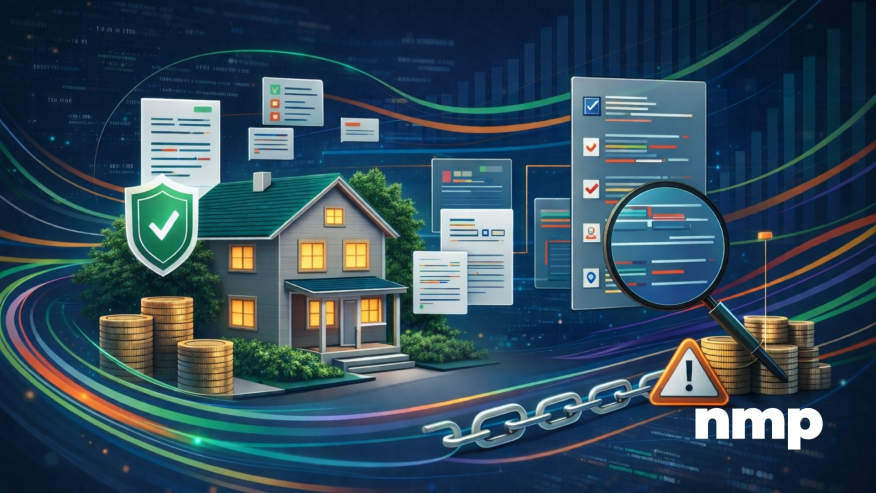
Mortgage lenders have never invested more in automation than they have over the past few years. AI-powered tools now touch nearly every stage of the loan lifecycle, from intake through post-close. And yet, despite this wave of innovation, one metric refuses to budge: cost per loan.
In conversations with lenders across retail, wholesale, correspondent, and non-QM channels, a consistent pattern keeps emerging. Teams have automated pieces of the process, but the work itself hasn’t gone away. In many cases, it has quietly increased.
This disconnect has a name: automation theater.
Automation theater happens when technology creates the appearance of progress without eliminating the underlying work. Documents are classified, data is extracted, and flags are raised, but humans are still required to recheck, validate, and reconcile the same information multiple times. The result is not efficiency, but invisible rework.
When Automation Adds Work Instead of Removing It
In theory, automation should reduce manual effort. In practice, many lenders find themselves validating, rechecking, and correcting outputs generated by the very systems meant to save time.
One operations leader at a high-volume lender put it simply:
"We've automated pieces of the process, but our people are still touching the same file multiple times. The work just moved."
This happens because automation often focuses on isolated tasks rather than the full flow of the loan. Documents are classified, data is extracted, conditions are generated, but confidence is never fully established. As a result, downstream teams compensate by checking the same information again.
The cost shows up quietly:
- Reopened conditions
- Late discovery of missing or inconsistent data
- Borrower re-contact
- Experienced staff fixing preventable issues
None of this appears as a system failure. It appears as "normal operations."
Another theme lenders raise consistently is the ability to be explained — not as a philosophical concern, but as an operational one.
Most teams are not opposed to AI. They are opposed to systems that introduce risk they cannot explain, defend, or audit.
Why Black-Box AI Slows Adoption Instead of Accelerating It
In many environments today, AI systems surface outputs without exposing how those outputs were generated. A value is accepted.
A condition is cleared. An exception is flagged. But the underlying logic remains opaque. Reviewers don’t know which documents were used, what confidence threshold was applied, or what validation checks occurred behind the scenes.
A compliance leader at a large lender described the tension this creates:
“When an AI system flags something, the first question is always ‘why.’ If we can’t answer that clearly, the work doesn’t stop. It just shifts to manual review.”
This lack of transparency triggers a predictable response. Teams compensate.
They recheck extracted data against source documents. They validate values against the LOS manually. They reopen conditions “just to be safe.” Over time, automation becomes something that must be reviewed rather than relied upon.
In regulated environments, this is not resistance to change. It’s governance.
Mortgage operations require traceability. When auditors review a loan months later, leaders must be able to show which documents supported a decision, when the data was validated, and how inconsistencies were resolved. AI that cannot expose its decision path creates friction not because it is inaccurate, but because it is unaccountable.
Ironically, this is how black-box AI increases cost per loan. Not by failing outright, but by introducing uncertainty that forces people back into the loop.
From a technical perspective, this problem is solvable. AI systems can expose confidence scoring. They can show document lineage. They can explain why a value was accepted, rejected, or flagged. But too often, these capabilities are treated as optional features rather than foundational design requirements.
When transparency is missing, trust never fully forms. And when trust is absent, automation adoption plateaus.
Task Automation vs. Validation Automation
As lenders look more critically at their automation investments, a clearer distinction is emerging between task automation and validation automation.
Task automation focuses on performing actions. Documents are indexed. Data is extracted. Conditions are generated. Files move forward.
Validation automation focuses on establishing confidence. It answers a different question: Is the data correct, consistent, and complete enough to trust downstream?
Many lenders have invested heavily in tools that automate individual steps but leave validation fragmented. Data may be extracted early, but it isn’t continuously cross-checked across documents, systems, and partner feeds. Completeness checks happen late.
Inconsistencies surface only when an underwriter or post-close reviewer opens the file.
That delay is expensive.
A head of underwriting described the impact this way:
“We don’t usually find problems right away. They show up later, when fixing them costs more time and more coordination.”
When validation happens late, downstream teams are forced into detective work. They compare values across documents. They reconcile discrepancies between systems. They reopen conditions that were previously cleared. Each step adds touches, delays, and borrower friction.
This is why many automation projects stall after pilots. The technology technically works, but the operating model doesn’t change. People are still responsible for catching issues, just later in the process.
Validation automation flips that model. Instead of relying on downstream review to catch errors, it continuously verifies data as it enters the system and as new information arrives. Exceptions surface earlier. Confidence is established sooner. Downstream teams receive files that are genuinely decision-ready.
As one operations executive put it:
“We don’t need more automation that moves files. We need fewer moments where someone has to stop and ask if the file can be trusted.”
That shift — from automating tasks to automating confidence — is where cost per loan actually begins to move.
What Lenders Should Demand From AI in 2026
As lenders plan for the next phase of automation, the question should not be “Does this use AI?” but “Does this eliminate work?” AI platforms should be able to answer the following:
- Why was this data accepted or flagged?
- How confident is the system in this decision?
- What documents and sources were used?
- What manual tasks were avoided as a result?
If a system cannot make its decisions visible, teams will continue to double-check it. And if teams keep rechecking, cost per loan will continue to rise, no matter how advanced the technology looks on paper.
The path to ROI is not more automation. It is better automation, designed to remove rework, surface only true exceptions, and earn trust across operations, compliance, and audit.
If you’re rethinking how automation should actually reduce cost per loan, see how TRUE MOS eliminates rework and surfaces only true exceptions across the loan lifecycle. Learn more about TRUE.