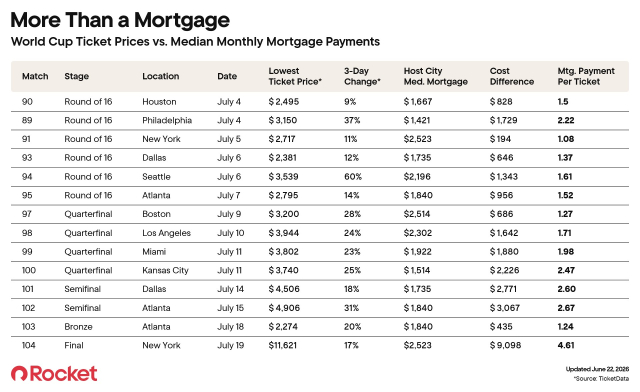
For some World Cup fans, the cost of one seat has climbed into mortgage-payment territory.
The World Cup kicks off Thursday in Mexico City, opening a six-week tournament across 16 North American host cities. FIFA expects the event to draw between 5 million and 6 million fans, but in several U.S. markets, the cost of attending in person has climbed into mortgage-payment territory.
The comparison has become part of a broader online backlash over World Cup ticket prices. A survey of 1,008 U.S. soccer fans by LiveSportsonTV found that 52% of them had given up on purchasing tickets because of the exorbitant prices.
Rocket recently compared the lowest available ticket prices for upcoming World Cup knockout-stage matches with median monthly mortgage payments in the host markets. The ticket prices were sourced from TicketData on June 22.
The most extreme comparison is the July 19 Final in New York, where the lowest available ticket was listed at $11,621. That is $9,098 more than the host market’s median monthly mortgage payment of $2,523 — or the equivalent of about four and a half mortgage payments for a single seat.
Rocket’s figures show that the mortgage comparison is not limited to the Final. Across the knockout-stage matches included in the analysis, the lowest available ticket price exceeded the median monthly mortgage payment in every listed host market, turning what is usually a housing affordability measure into a broader consumer-cost benchmark.
Ticket prices have also been climbing quickly. According to Rocket’s analysis, prices for the listed matches increased between 9% and 60% over a three-day period. The sharpest increase was in Seattle, where the lowest available ticket for a July 6 Round of 16 match rose 60%. Philadelphia’s July 4 Round of 16 match rose 37%, while Atlanta’s July 15 semifinal rose 31%.
The data turns the mortgage payment into a broader measure of consumer sticker shock. In most affordability conversations, the monthly mortgage payment is used to show how much homeownership costs. Here, it shows how far live-event pricing has stretched, with a single World Cup ticket exceeding one month of housing costs in every listed U.S. host market.
Bottom Line
For originators, the comparison is less about soccer than sticker shock. Housing costs are now the benchmark against which other major consumer expenses are judged — a sign that homeownership remains one of the clearest measures of financial pressure for American households.