Affordability Improves, But Typical Households Still Experience $25K Shortfall – NMP Skip to main content

Affordability Improves, But Typical Households Still Experience $25K Shortfall

Feb 15, 2026
Affordability Improves But Households Still Experience Shortfall
Managing Editor

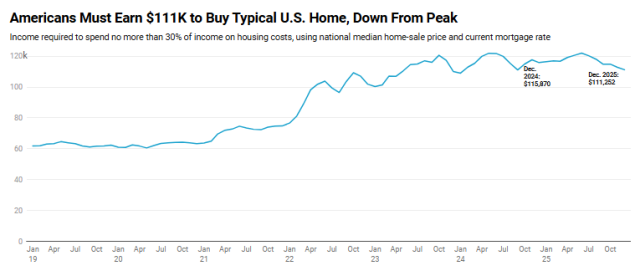
A new Redfin analysis finds buyers now need $111,252 to afford the typical U.S. home — down 4% year-over-year — as lower mortgage rates and slower price growth begin to ease affordability pressures in most major metros

A new analysis from Redfin reveals that U.S. homebuying affordability is beginning to ease after nearly five years of worsening conditions. As of December 2025, prospective buyers need an annual household income of roughly $111,252 to afford the median-priced home — a 4 % decrease from the roughly $115,870 required a year earlier.

Economists attribute the improvement to a combination of slightly lower mortgage rates and subdued home-price growth, which together have brought down monthly housing costs. Although the median home-sale price edged up slightly year-over-year to about $426,747, average mortgage rates dropped to around 6.1 %, easing the monthly burden to approximately $2,675 — down from near $2,800 last year.

Redfin’s report defines housing as affordable when monthly mortgage payments do not exceed 30% of household income, incorporating property taxes and current mortgage cost assumptions into its calculation.


The income needed to buy a home has been declining since November, providing some much-needed relief for U.S. homebuyers.


“The housing affordability crisis is showing signs of easing as costs come down slightly but meaningfully, opening the door for more Americans to make the jump to homeownership,” said Chen Zhao, Redfin’s head of economics research. “While housing remains historically expensive, the trajectory is finally starting to reverse, with the door to buying a home opening a bit wider rather than closing tighter. But while affordability is improving, Americans are contending with other obstacles on the road to buying a home, like nerves about layoffs and economic uncertainty.”

Affordability trends show broad geographic improvements: 37 of the 50 largest U.S. metropolitan areas analyzed registered year-over-year gains. The most significant progress occurred in Dallas, where the income required to buy a median-priced home fell by 7.4%, followed by Sacramento, California and Jacksonville, Florida.

Despite these gains, housing remains out of reach for many Americans. The typical U.S. household earns ~$86,185, roughly $25,000 less than needed to meet the affordability threshold nationally.


Year-over-year change in income required to spend no more than 30% of income on housing costs, nationwide


In select major markets, affordability has worsened. Buyers in Detroit, Chicago, and St. Louis must now earn more than a year ago to buy the median home, driven by rising local prices.

Redfin economists expect modest, continued improvement throughout 2026, assuming wage growth outpaces further increases in housing costs — a dynamic that could slowly expand access to homeownership.

About the author
Managing Editor
NMP Managing Editor Eric C. Peck has 25-plus years’ experience covering the mortgage industry. He graduated from the New York Institute of Technology, where he received his B.A. in Communication Arts/Media. After graduating, he…
Published
Feb 15, 2026
New-Home Mortgage Demand Slips Despite Widespread Builder Incentives

Applications fell 5.7% annually in July, while government-backed mortgages accounted for half of builder-affiliated loan volume

Aug 21, 2026
Fannie Mae Returns To Distressed-Loan Market With $214 Million Sale

The agency’s first nonperforming-loan offering in 13 months transfers 969 deeply delinquent mortgages to private buyers, including a small pool concentrated in Dallas-Fort Worth

Aug 20, 2026
Summer Rate Spike Knocks Pending Home Sales To Six-Month Low

Contract signings fell in every region during July, leaving purchase activity 30% below its 2019 level despite a larger workforce

Aug 19, 2026
Cash Sales Retreat, Giving Financed Buyers More Room To Compete

Cash transactions fell faster than the broader housing market in early 2026, but buyers without financing still accounted for nearly one-third of home sales

Aug 19, 2026
Mortgage Delinquencies Ease, But FHA Distress Keeps Deepening

Overall delinquencies dipped in the second quarter, but FHA serious delinquencies jumped 227 basis points from a year earlier as more troubled loans moved toward foreclosure

Aug 18, 2026
Credit-Score Choice Is Becoming Part Of The Mortgage Sales Pitch

One-third of consumers say they would consider switching lenders over older scoring models, making underwriting technology a potential borrower-retention issue

Aug 18, 2026