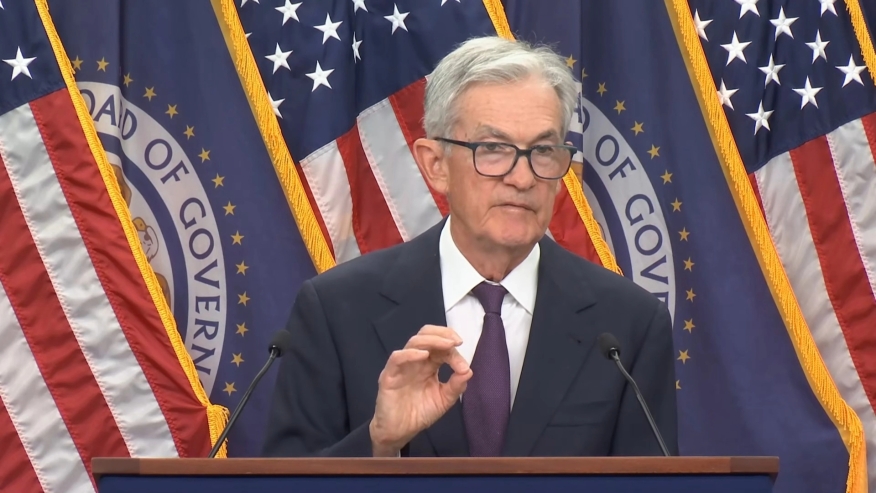
“In the near term, risks to inflation are tilted to the upside, and risks to employment to the downside — a challenging situation,” Federal Reserve Chairman Jerome Powell sized up the U.S. economic outlook, speaking at a press conference Wednesday afternoon. The Fed’s rate policy, he said, is moving “in the direction of neutral.”
The Federal Open Market Committee (FOMC) yesterday lowered the target range for the federal funds rate by 25 basis points to 4.00%-4.25%, citing a shift in the balance of risks as job gains slow and inflation remains “somewhat elevated” above the Fed’s 2% goal.
The Fed also will reduce its holdings of Treasuries and agency mortgage-backed securities: Quantitative tightening, or QT, at the Fed is where the agency shrinks its balance sheet by allowing maturing Treasury securities and MBS to roll off without reinvesting the proceeds.
At the presser, Powell framed the FOMC move as a “risk-management” step as downside risks to employment rise while near-term inflation risks tilt higher.
How Many Cuts, How Big, How Soon?
With only a small 25 bps rate drop yesterday, and that being the first rate move so far in 2025, reporters asked if more cuts are likely and tried to hone in as well on any potential cuts’ frequency and size.
Fed policy is “not on a preset course,” Powell stressed, adding that rate policy decisions will be made “meeting by meeting” of the FOMC. He noted, however, that only a 25 bps cut was at play in yesterday’s vote — there was “not widespread support [from the FOMC] at all for a 50-basis-point cut,” he said.
“I think we've done very large rate hikes and very large rate cuts in the last five years, and you tend to do those at a time when you feel that policy is out of place and needs to move quickly to a new place,”
Powell responded to one reporter. “That's not at all what I feel.”
“Certainly now, I feel like our policy has been doing the right thing so far this year,” he said.
Powell noted that about half of FOMC participants feel there could be two or more additional cuts this year, while others expect fewer — or none — underscoring the high uncertainty surrounding additional rate cuts.
On inflation, Powell said goods prices have increased, largely reflecting tariffs, with goods inflation around 1.2% year over year and contributing about 0.3-0.4 percentage point to core Personal Consumption Expenditures, or PCE.
In that vein, his “reasonable base case” remains that tariff effects will be “relatively short-lived” — a “one-time shift in the price level” — but emphasized that the Fed’s job is to ensure effects on goods prices don’t become persistent.
Longer-term inflation expectations remain “rock solid,” Powell said, even as shorter-term measures have ticked up.
Effects On, And Expectations For, Mortgage Rates
The Fed’s interest rates for interbank lending don’t directly affect long-term mortgage lending rates, but they do have a downstream effect, part of which has to do with market perception — a difficult thing to quantify. During the press conference, Powell reiterated that the Fed doesn’t set mortgage rates, but acknowledged there’s a link with policy rate changes.
“Mortgage rates may stay relatively flat in the short term since markets had already priced in this cut. However, consumers could benefit from lower short-term rates, making adjustable-rate mortgages — which closely follow the Fed’s moves — more attractive,” noted Bill Banfield, chief business officer at mortgage giant Rocket Companies.
“For consumers, it’s another signal that the cost of borrowing is gradually moving lower,” he added.
“The Federal Reserve’s decision to cut short-term rates yesterday should put more downward pressure on mortgage rates, which is good news for borrowers in the coming weeks and months,” said the Mortgage Bankers Association’s President and CEO Bob Broeksmit.
“Mortgage rates, along with longer-term Treasuries moving in advance of this dovish shift in monetary policy, reached their lowest point for the year last week, spurring a strong jump in refinance activity,” observed MBA Senior Vice President and Chief Economist Mike Fratantoni.
“If mortgage rates hold at these levels,” he added, “origination activity will be boosted, both for homeowners who purchased in the last three years and can realize considerable savings at these rates, and for potential homebuyers, who now have one more reason to look for a home, in addition to increasing housing supply in many markets.”
Meanwhile, United Wholesale Mortgage (UWM), the nation’s top overall mortgage lender, also views the FOMC’s policy move on Wednesday as a positive indicator for the mortgage industry.
“We’re optimistic about continued progress in rates coming down,” stated UWM Chief Strategy Officer Alex Elezaj. “At United Wholesale Mortgage, we’ve seen a significant increase in loan volume across the board, particularly with 30-year fixed mortgages.”
“We expect this momentum will continue to build,” Elezaj contended.
Labor Market Cooling — And Why That Matters
Powell pointed to a “less dynamic and somewhat softer” labor market: payroll growth has slowed to roughly 29,000 per month over the past three months, unemployment edged up to 4.3%, and hiring and job-finding rates are subdued — especially for younger workers and minorities.
With both labor demand and supply falling, the Fed judged it appropriate to begin edging toward neutral to support maximum employment, while hoping to keep inflation on track to reach 2% over time.
A reporter pressed Powell on the weakening job market. “If you had had that information, would it have changed your mind related to where the interest rates should be? Should there have been a cut earlier?” the reporter asked.
Powell appeared to admit the Fed was surprised somewhat by the softening of the labor market.
“We have to live life looking through the windshield rather than the rearview mirror, as you know,” he said. “And all I can tell you is we see where we are now and we take appropriate action — we took that appropriate action today.”
Housing Market Conditions
“I'm wondering how concerned you are,” a reporter posed to Powell, “that current rate levels are exacerbating housing affordability issues and potentially hindering household formation and wealth accumulation for a segment of the population.”
Housing, Powell responded, “is an interest-sensitive activity” and is “at the very center of monetary policy.”
“When the pandemic hit and we cut rates to zero, the housing companies were incredibly grateful,” he said. “And they said that really was the only thing that kept them going was that we cut so aggressively and provided credit and things like that, and they were able to finance because we did that.”
“The other side of that is when inflation gets high and we raise rates — and you're right, it does burden the housing industry,” Powell acknowledged. “Rates have come down a bit, and as that happens, we don't set mortgage rates, but our policy rate changes do tend to affect mortgage rates. And that has been happening, and that'll, of course, raise demand.”
Potential For Political Bias
Reporters pressed Powell about the Fed’s political neutrality following the swearing-in Tuesday of Stephen Miran — who, somewhat unusually, remains a White House official on unpaid leave while serving as a Fed governor. Powell insisted that “it’s deeply in our culture” to base decisions solely on data and that the Fed is “strongly committed to maintaining our independence.”
Multiple news outlets have noted Miran’s leave-of-absence arrangement, which has drawn scrutiny from Fed watchers and lawmakers. Notably, Miran dissented in the FOMC’s rate decision Wednesday, instead wanting a 50 bps cut — an uncommon first-meeting stance.
Yet Powell also made a broader cultural point: inside the Fed, he said, decisions are made on data, while in “another part of Washington” everything is filtered through politics.
“Look, it's deeply in our culture [at the Fed] to do our work based on the incoming data and never consider anything else,” he said. “Everybody who's at the Fed really feels strongly about that.”
“You'll know it by the way we talk about what we're doing — by the speeches that people give, by the decisions that we make. You'll know that we're just still gonna do that,” he continued. “We don't frame these questions at all or see them in terms of political outcomes.
“I think when you get to another part of Washington, everything is seen through the lens of, ‘does it help or hurt this political party, this politician’ — that's the framework. I think people find it hard to believe that that's just not at all the way we think about things at the Fed,” Powell emphasized.
“We're taking a longer perspective. We're trying to serve the American people as best we can,” he said. “I think you would be able to tell [if the Fed was politically biased]; I don't believe we'll ever get to that place,” Powell contended.
“We're doing our work exactly as we always have,” he said. “People are making their arguments, and we're having, really, a great discussion around these challenging issues.”
Powell’s Future
Sometimes, you can say a lot by saying nothing at all.
Asked once again if he might depart the Fed in May, Powell deflected the question, as he has done on multiple occasions: “I have nothing new on that for you today.” Powell’s term as Fed Chairman runs through May 15, 2026, while his term as a Fed governor then continues through Jan. 31, 2028.
On that note, the market and investors always prefer certainty — and Powell’s notable silence on his tenure at the Fed leaves some ambiguity.