Three brokerages go head-to-head, turn pressure into performance, and win the deal of a lifetime
By Katie Jensen, Special to National Mortgage Professional
COVER STORY
Three brokerages go head-to-head, turn pressure into performance, and win the deal of a lifetime
By Katie Jensen, Special to National Mortgage Professional
The first email looked suspicious. “My partner, Doug [Liska], got this very official-looking email, and I thought it was phishing,” recalled Jonathan Haddad, co-founder and President of Next Door Lending. As a business owner, his inbox gets inundated with fake invoices, phishing emails, and the occasional business broker scams that offer to help sell his company. At first glance, this email didn’t seem much different. “So, he comes to me, he's like, ‘Do you mind if I explore this?’ At this point, we had no idea who the company was. I said, ‘Sure, whatever — do your thing. I'm busy.’”
Jonathan Haddad, co-founder and President of Next Door Lending
Jonathan Haddad, co-founder and President of Next Door Lending
After several weeks of cryptic conversations between CEO Doug Liska and the faceless suitor, Haddad pressed his partner to get some answers. “Who is the company?” he asked. “He goes, ‘I have no idea, but we are going to find out. They're sending us an NDA. Once we sign it, they'll tell us who the company is.’ … All of a sudden, I get an email back with an LOI [letter of intent] and it says NerdWallet.”
The partners were so excited upon receiving the email that they called each other at the same time to revel over the news. NerdWallet, a large, publicly-traded brand, wanted to buy their brokerage. But elation quickly gave way to urgency when Haddad learned they weren’t the only ones in the running.
There were two other anonymous brokerages vying for NerdWallet’s hand, but only one would end up being acquired. The competition came down to what NerdWallet bluntly called a “conversion game.” Each brokerage would elect a five-person team to compete and whichever team converts the most leads into funded loans is the company that gets acquired.
So Haddad rolled up his sleeves and immediately got to work. “I picked five, myself included, and we didn't leave the office,” he said. “We sat there and worked every single client that walked in and we smashed conversion numbers. We doubled their highest purchaser of that lead flow and that was it.”
That relentless sprint by Haddad and his team secured the win, but it was only the beginning of their acquisition journey. What came next — navigating strategic alignment, painstaking due diligence, contract negotiations, and shifting roles — would test the partners far more than any conversion game.
The opportunity for M&A is ripe within the mortgage industry with activity expected to rise over the next few quarters. The law firm Hunton Andrews Kurth LLP. reported in May 2025 that it continues to see signs of increasing M&A activity. With interest rates holding steady, strategic acquisitions become an attractive option for buyers in growth-mode, looking to acquire new business lines or greater market share.
Haddad shares that sentiment as well, believing that his acquisition by NerdWallet will pave the way for more brokerages to get acquired. “I know people are watching it,” he said. “And if they're watching and they see it working out, I would not be surprised to see more acquisitions in situations like this — especially as broker market share continues to grow.”
Key Takeaways For Owners Entering M&A
Set Goals Early: Define success at the outset — whether it’s payout, performance, or long-term growth — so both sides know what they’re working toward.
Due Diligence Disrupts Normal Operations: Expect months of document-heavy scrutiny that can drain time and focus from daily business. Plan resources to handle both.
Legal Foresight Shapes Outcomes: The right contract clause — and the right attorney — can make or break the deal when unforeseen events arise.
Transparency Avoids Attrition: Clear, practical communication keeps employees engaged and prevents talent loss during uncertain transitions.
Duplicated Roles, Top to Bottom: From CEOs to department heads, overlapping positions mean some seats will disappear post-acquisition. Prepare for hard choices.
Strategic Alignment
At first, Samir Dedhia wasn’t looking to sell his company, LemonBrew Lending Corp. His team had built a real estate platform alongside mortgage, title, and insurance operations, with aspirations of becoming a one-stop-shop for homebuyers. But, in the aftermath of two refinance booms and a sudden interest rate hike, Dedhia knew the business had to pivot toward purchase lending. Still, he was focused on finding strategic partners rather than an outright buyer.
The connection with Real Brokerage Inc. (Real), a real estate brokerage, came almost by chance. Dedhia recalled meeting members of the team at a digital mortgage conference shortly after Real had acquired Expo Title. They were in the market for a mortgage arm to complement their consumer-facing vision, and the conversation began there.
Real asked if his company was for sale, and while he initially said no, the dialogue continued. Over time, the idea of a partnership evolved into something more serious. “For us, our vision was always this one platform, an integrated platform [or] ecosystem, if you will,” Dedhia said. “The reality was, we weren't able to do so alone.”
As discussions deepened, the idea of joining forces with Real became more compelling. Ultimately, Dedhia credited the cultural fit and entrepreneurial mindset of Real’s leadership, saying “They're grinders, they're builders. They get in the weeds just like us. I think that was a big piece of it.”
Key Takeaways For Owners Entering M&A
Set Goals Early: Define success at the outset — whether it’s payout, performance, or long-term growth — so both sides know what they’re working toward.
Due Diligence Disrupts Normal Operations: Expect months of document-heavy scrutiny that can drain time and focus from daily business. Plan resources to handle both.
Legal Foresight Shapes Outcomes: The right contract clause — and the right attorney — can make or break the deal when unforeseen events arise.
Transparency Avoids Attrition: Clear, practical communication keeps employees engaged and prevents talent loss during uncertain transitions.
Duplicated Roles, Top to Bottom: From CEOs to department heads, overlapping positions mean some seats will disappear post-acquisition. Prepare for hard choices.
Strategic Alignment
At first, Samir Dedhia wasn’t looking to sell his company, LemonBrew Lending Corp. His team had built a real estate platform alongside mortgage, title, and insurance operations, with aspirations of becoming a one-stop-shop for homebuyers. But, in the aftermath of two refinance booms and a sudden interest rate hike, Dedhia knew the business had to pivot toward purchase lending. Still, he was focused on finding strategic partners rather than an outright buyer.
The connection with Real Brokerage Inc. (Real), a real estate brokerage, came almost by chance. Dedhia recalled meeting members of the team at a digital mortgage conference shortly after Real had acquired Expo Title. They were in the market for a mortgage arm to complement their consumer-facing vision, and the conversation began there.
Real asked if his company was for sale, and while he initially said no, the dialogue continued. Over time, the idea of a partnership evolved into something more serious. “For us, our vision was always this one platform, an integrated platform [or] ecosystem, if you will,” Dedhia said. “The reality was, we weren't able to do so alone.”
As discussions deepened, the idea of joining forces with Real became more compelling. Ultimately, Dedhia credited the cultural fit and entrepreneurial mindset of Real’s leadership, saying “They're grinders, they're builders. They get in the weeds just like us. I think that was a big piece of it.”
Real completed its acquisition of LemonBrew Lending in December 2022 for an aggregate purchase price of $1.25 million. In exchange for Real’s superior technology, LemonBrew would provide the foundation for Real to offer mortgage services in-house. “It really wasn’t about the money per se — the upfront money, I’ll say. It was more about the growth opportunity,” Dedhia said.
Success looks different for owners who only want to sell off their company and those who plan to stay on, according to David Lykken, founder and president of Transformational Mortgage Solutions. Lykken has guided multiple M&A transactions throughout his career, including the acquisition of his own companies. When the owners intend to stay on and help scale the company post-acquisition, success hinges on performance and achieving those initial goals, he explained.
“You really have to decide … what is a successful merger, and what is a failed merger?” Lykken said. “If you get the criteria correct, about what works and what doesn't, then you're a lot better equipped to be able to accomplish a successful deal.”
In other words, the benchmarks you set at the beginning will become the scorecard everyone uses once the dust settles. That’s why Lykken stresses strategic alignment and early goal-setting are critical to success. In those first few meetings, he said the number one question buyers are asking themselves is “Why are you buying this company and what is the target?”
For most acquisitions, the objectives are clearly tied to performance-based metrics. In Haddad’s case, NerdWallet brings in so many leads through its platform and funnels them to Next Door Lending, which is expected to convert as many leads as possible into funded loans.
“They were highly interested in understanding the lead flow model,” Haddad said. “They drive a bunch of opportunities in and so that's what they were highly interested in. They loved our background [and] that we've dealt with it at a very high capacity.”
“We doubled their highest purchaser of that lead flow and that was it.”
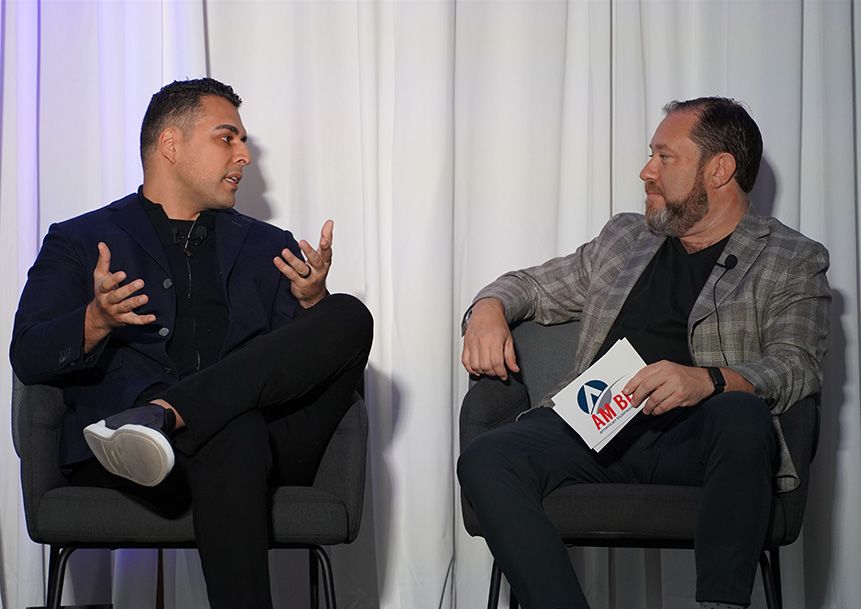
>Jonathan Haddad with Andrew Berman, CEO of NMP, at Originator Connect in Las Vegas. Haddad, owner of Next Door Lending, describing how his team beat out their anonymous rivals for the NerdWallet acquisition.
“We doubled their highest purchaser of that lead flow and that was it.”
>Jonathan Haddad with Andrew Berman, CEO of NMP, at Originator Connect in Las Vegas. Haddad, owner of Next Door Lending, describing how his team beat out their anonymous rivals for the NerdWallet acquisition.
Do Your Due Diligence
The key to preventing any roadblocks or disasters post-acquisition is ensuring both companies are doing their due diligence properly. The process is long, paper-heavy, and mind-numbingly detailed — usually stretching 45 to 180 days. But when it's done right, due diligence helps companies:
Identify and mitigate risk
Assess true enterprise value
Verify strategic alignment and synergy planning
Assess regulatory compliance, cybersecurity, and supply-chain risks
Gain operational and management insight
When two private companies link up, the exchange of documents can feel like a grind. But when the buyer is a public player, like reAlpha, NerdWallet, or The Real Brokerage Inc., the stakes shoot through the roof. Suddenly the SEC, investors, and auditors are peering over your shoulder, and one missed risk disclosure can ding your stock price before the ink dries.
Unfortunately for Dedhia, “Due diligence is one of those things that we didn't really know much about,” he said. “We were still juggling the business and handling the due diligence.”
Without the infrastructure that larger firms rely on, Dedhia’s team had to scramble to collect documents. “Documentation is key,” Dedhia said in hindsight. “Financials is obviously the biggest piece, but then having the backup to support every single number that we have whether it's loan officer compensation, operations, policies and procedures [including] how we make a decision, or who does what.”
But mortgage founders can easily prevent missing documentation with a little foresight. Since the mortgage industry is so heavily regulated, Dedhia said he already had most of the required documentation. Plus, modern technology allows them to house those documents securely online.
While some requests are mandated by regulators, Dedhia admitted that requests and probing questions from the buyer and their attorneys could also feel frustrating. “We immediately think, ‘Why the heck do you need that?’ and ‘What's the purpose of that?’” he recalled. “As long as we're just being transparent and honest with each other as a partnership, that's where I think you don't really have those quote-unquote surprises.”
Dedhia also admitted that his team underestimated the workload, and recommended outsourcing to keep production from slipping. “Because it is a pretty time-consuming piece of [the] transaction,” he said. “And if you're trying to still run your day to day and make sure numbers still hit … I think it's important to have someone there to help you. That's something that we learned after the fact.”
High-Stakes Negotiations
When Samir Dedhia sold LemonBrew Lending to Real Brokerage, the negotiations centered on creating a structure that kept both sides invested. The deal blended stock and cash with performance-based contracts for key employees.
Dedhia also cautioned entrepreneurs to be realistic about their projections, telling them to “always discount what you think the actual numbers will be,” he advised.
Negotiations can get intense, but Dedhia said he managed to keep the peace by encouraging collaboration. “It was more like, here’s what we’re thinking, here’s what you’re thinking — how do we put the two together? How do we be creative about it? And then ensure that we also have upside and long-term opportunities to grow Real as well,” he said.
Dedhia worked through the contract details with his own attorney alongside Real’s legal team. Still, much of the structure came from open back-and-forth between the two sides. Because those negotiations tend to get intense, Lykken stressed the importance of having a skilled attorney who can anticipate the unexpected.
“This is where having a good attorney is just so critical,” Lykken said. “There's many aspects of contract law with employment contracts, retention bonuses, and all the things that go into the language of our contracts. If it's well done, attorneys are worth their money in gold.”
Lykken’s own experience selling United Lending Group in the 1990s proved the value of legal foresight. He and his partners structured an earn-out on the acquisition, but the parent company later filed bankruptcy, creating “a black swan event” that was out of his control, he said.
But, a single clause written by his attorney saved the deal: “They said, ‘We’ll never file bankruptcy. That’s ridiculous. Sure, put that in there, we’ll sign it,’” Lykken recalled. “Well, guess what? We got the company back, [and] we were able to resell it as a result of that.”
“It really wasn’t about the money per se … It was more about the growth opportunity.”
> Samir Dedhia, who sold LemonBrew Lending Corp. to The Real Brokerage, Inc. — not for the upfront payout, but for the chance to scale within a larger ecosystem.
Whether it was a shot in the dark or sharp psychological insight, Lykken isn’t sure. But he admits it was like bringing up a pre-nuptial agreement to a newly engaged couple — the buyers didn’t want to acknowledge bankruptcy as a possibility, so they agreed to the clause.
The moral of Lykken’s story is to “find an attorney that knows the contract and make sure that that attorney is going to manage the due diligence,” he said.
Employee Retention / Attrition
One of the biggest perks of any merger or acquisition is the talent it brings. But if key players aren’t clued in or secured with contracts before the deal goes public, founders risk watching the very people who made the deal worthwhile walk out the door.
The hardest part of an acquisition for Dedhia wasn’t the paperwork or the negotiations — it was managing his people through uncertainty. “You have attrition,” Dedhia acknowledged. “When you talk about getting acquired, typically what happens is negative thoughts run through people’s minds.”
Lykken echoed that warning, noting that many failed deals stem from acquirers who take employee stability for granted. “Anytime you acquire a mortgage company, you're primarily acquiring it for the production,” he said. “If you don't do the due diligence talking to the originators … then it's fraught with potential problems.”
It's especially challenging when leaders cannot disclose information about the acquisition to their employees, fueling uncertainty and job insecurity. Since so much proprietary information is exchanged in due diligence, those who are involved in that process must sign a Non-Disclosure Agreement (NDA). Jamie Cavanaugh, CEO of reAlpha Mortgage which acquired Be My Neighbor Mortgage (BMN) in 2024, explained the difficulty in juggling silence with staff while spending long hours buried in documentation.
“It was uncomfortable [going through] months and months of being unable to completely share the whole vision,” Cavanaugh said. She also noted that those who are acquired by a public company will have to get used to withholding certain information, saying, “There's still non-public stuff happening all the time that we can't share.”
Cavanaugh described it as a careful balancing act: energizing her team with new opportunities while navigating the limits of what she could disclose during a public-company transaction. So, she leaned on clarity and incentives to keep people engaged: “You want to handle leads? You're about to have more than you've ever seen. You want to grow your business? You're about to have more tech tools, more support, and a bigger budget than you've ever seen in your career.”
By relaying the message in practical terms rather than asking for blind trust, Cavanaugh was able to avoid attrition while facilitating the acquisition of her company. “Yes, you're gonna help more people, and that's important. You're also gonna fill your bank account. And for your family, that's important,” she told them.
“Once you kind of take the fear away … I think it creates a different mindset amongst the team where there's excitement,” Dedhia added. “It comes from very clear, transparent, proactive communication.”
The Identity Shift
Some business owners like to think of selling their company as simply cashing in. For others, like Dedhia, it's the onset of an identity crisis. “The mortgage [side] was our baby, and I still feel like it's our baby,” he said.
But Dedhia cautions other entrepreneurs not to treat an acquisition like a funeral for their brand. “An acquisition isn't about losing your identity. It's just about amplifying it with the right partner,” he said. “Think of it from that lens that it's going to help you achieve your goals faster, potentially.”
Haddad had a similar experience with letting go of control and branding. “I love the name Next Door Lending. Our agents love it. You know what my agents love a lot more than Next Door Lending? NerdWallet,” he deadpanned. “It is hard to give up something that you believe in. However, that’s when removing the ego is very important.”
It was an ego death for Haddad, who warned fellow brokers not to kid themselves: “Don't pretend you don't have egos. That's the first thing we told ourselves.” But the real gut check was picturing himself as president one day, then being told by his new parent company a few months later, “‘Here’s the new focus — go sell it.’ That was petrifying to me,” he said.
Cavanaugh said her role now requires carrying pressure from every direction, a shift that forces CEOs to reframe their identity. “Every day I walk the line of how can I continue to speak into our division with credibility and authority, listen to what my parent company wants and needs, communicate with them on where we are versus where they want us to go, and then take all of that back to my team,” she said. “We absorb an enormous amount of pressure because it comes at us from everywhere. It's top, down, left, right, bottom, up — it's everywhere.”
But money has a way of softening the blow. As part of the $6 million acquisition deal between reAlpha and Be My Neighbor Mortgage (BMN), the BMN co-founders received $1.5 million in initial cash and $1.5 million in restricted reAlpha shares upfront, according to the 8-K filing. But the next $3 million in earn-out payments hinges on BMN hitting certain performance metrics.
“Specifically, each Earn-Out Payment will be payable in full if Be My Neighbor achieves certain revenue and earnings before interest, taxes, depreciation, and amortization (“EBITDA”),” according to the SEC filing. The disclosure also notes that earn-out payments will increase if BMN exceeds its revenue and EBITDA goals, or decrease if it does not meet those goals as set forth in the acquisition agreement.
In many cases, performance-based earn-outs are awarded to other leaders and employees at the company. NerdWallet paid $1 million in cash for the outstanding equity interest of Next Door Lending, but paid a much bigger price to keep its sales team motivated.
The SEC filing from NerdWallet states “Under the purchase agreement, certain employees of NDL [Next Door Lending] could earn up to an aggregate of $3.5 million of performance-based cash earnout awards, with the value of such earnout awards to be recognized as compensation expense following the close of the acquisition through 2028.”
Dedhia struck a similar deal with its buyer, The Real Brokerage Inc. which purchased his company for $1.25 million. Additional performance-based milestone payments of $2.5 million, in mostly cash, were scheduled over 36 months to retain LemonBrew’s management and key employees.
“It was uncomfortable [going through] months and months of being unable to completely share the whole vision.”
> Jamie Cavanaugh, CEO of reAlpha Mortgage, reflecting on one of the challenges that come with a public-company acquisition.
The high-stakes game continues as long as there is still money left in the pot. And that’s exactly what the buyer intends, Lykken explained, because those earn-outs don’t just sweeten the deal, they’re an integral part to ensuring that long-term goals are met. “Once the owners — the people that founded the company — get their money off the table, their motivation, their impetus to continue to grow the business … is muted, if not de-motivized,” he said.
On the other hand, if the buyer doesn’t believe that certain leaders are necessary to accomplish its goals, it doesn’t have to keep them. Uncertainty cuts both ways. At the top, duplicate titles — CEOs, CIOs, CFOs, heads of production — mean someone’s chair won’t be there tomorrow. The bigger the paycheck, the bigger the target. Below, entire departments can vanish overnight, folded into the parent company or wiped out altogether.
Even after the deal closes and the initial payments have been made, Haddad and Cavanaugh both admit they sometimes feel anxious, questioning whether their roles are at stake or subject to sudden change post-acquisition.
To quell those worries, Cavanaugh reminds herself: “It's how you learn to navigate that that differentiates you, and it's what keeps you from being awake all night thinking about ‘Am I going to have a job?’ I'm going to have a job for as long as I make myself valuable as a leader, as a former business owner, as a person who understands the needs of the company and the needs of the team and knows how to balance those two things equally as best as I possibly can.”
Haddad says he assures himself that his leadership is what made the team a valuable asset in the first place. “Mortgage is a ‘people industry’ and I bet … if you do decide to remove me, everyone's coming,” he said. “It's still a real risk. But the odds, in my eyes, are more in my favor.”
Haddad’s bet underscored the gamble every leader takes when signing away control. No amount of due diligence can guarantee the long-term survival of a business. But other broker owners can enter M&A with eyes wide open, knowing the deal is as much about risk as it is about reward.
Where Are They Now?
In the first quarter of 2025, following the acquisition of Next Door Lending, NerdWallet realized a 23% year-over-year increase in mortgage revenue, despite turbulent economic conditions and a high interest rate environment. Haddad’s newly integrated team contributed about one percentage point to the company’s overall revenue.
After acquiring BMN Mortgage in Sept. 2024, reAlpha experienced explosive revenue growth — up 1,909% in Q2 2025 — and significantly expanded its presence in the mortgage industry. However, profitability and cash flow remain challenges as the company absorbs acquisition costs and integrates new operations. The success of the acquisition will ultimately depend on reAlpha’s ability to improve operational efficiency, reduce costs, and drive consumer adoption of its AI-powered platform.
Following the acquisition of LemonBrew Lending, The Real Brokerage Inc. reported strong annual revenue growth in 2022, although operating losses increased due to investments in technology and new services. Ultimately, LemonBrew laid the groundwork for long-term platform enhancement, even as immediate financial effects were muted by integration costs and the modest acquisition size.
“Year one is probably the toughest year,” Dedhia said in hindsight. “There's new things that we're doing, new conversations that we're having, new ideas … even from a financial perspective, that first year is going to be a little bit tougher. Just be okay with that and know that it will improve and get better because, at the end of the day, if you're doing good work and continuing to hustle … things will fall into place.”
platforms consolidate and vendors gain leverage, the lenders who stay disciplined about data, adoption, and exit terms will be the ones who keep control of their own tech stack






















 Built with Shorthand