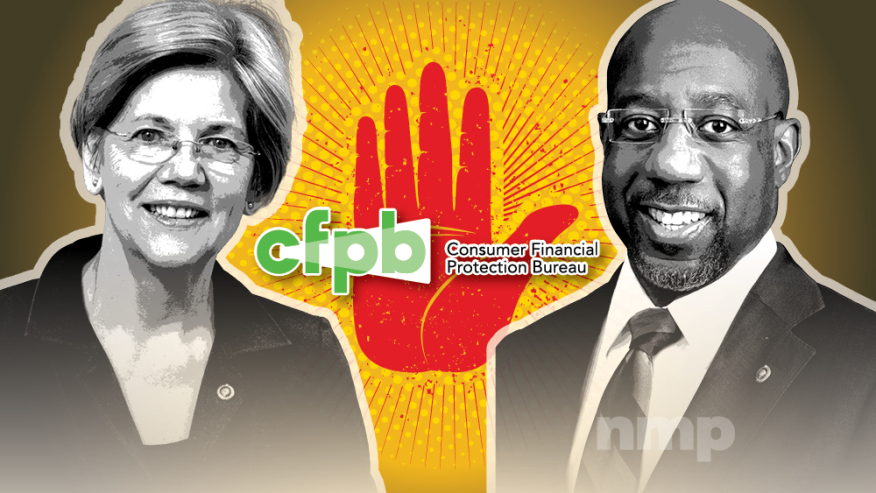
Senate Democrats, led by Sens. Raphael Warnock and Elizabeth Warren, are calling on Consumer Financial Protection Bureau (CFPB) Acting Director Russell Vought to withdraw a proposed rule that would eliminate disparate impact enforcement under the Equal Credit Opportunity Act (ECOA). The lawmakers warn the change would undermine civil rights protections that have been in place for more than 50 years.
In a letter dated February 4, the senators argue the proposal would enable discrimination in consumer lending, including mortgages, credit cards, and auto loans. The disparate impact standard allows regulators to challenge lending practices that disproportionately harm protected groups, even without proof of intentional discrimination. The Supreme Court has repeatedly upheld this legal framework.
The senators further warn that removing disparate impact protections would prevent lenders from establishing Special Purpose Credit Programs designed to expand homeownership access to marginalized communities. They characterize the proposal as benefiting industry at the expense of consumers and worsening the racial wealth gap.
Sen. Warren, who serves as Ranking Member of the Senate Banking Committee, joined Sen. Warnock and six other Democratic senators in the letter, including Sens. Angela Alsobrooks, Cory Booker, Catherine Cortez Masto, Andy Kim, Edward Markey, Jack Reed, and Chris Van Hollen.
The lawmakers also raised concerns about timing, noting the proposal comes amid an ongoing affordability crisis affecting housing and borrowing costs. They requested Vought rescind the proposed rule and brief the committee on the agency's response by February 10, 2026.
“The rollback of disparate impact enforcement under ECOA will also increase housing and other borrowing costs, which is particularly unacceptable during the current housing and affordability crisis,” said the senators in the letter. “Research has shown that protected classes of borrowers under ECOA, including women, people of color, and LGBTQ+ couples, often experience higher denial rates or are charged higher fees and interest rates compared to similarly situated borrowers or even other borrowers with worse credit histories. For example, between 2018 and 2023, Black mortgage applicants were more than two times more likely to be denied than white applicants with similar profiles, while Latino and Asian mortgage applicants were 1.5 and 1.2 times more likely, respectively, to be denied compared to white applicants. Similarly, “[s]ole female applicants are [nearly 30%] more likely to be denied a mortgage than sole males.” Another study found that between 1990 and 2015, “same-sex applicants are 73.12% more likely to be denied, and they tend to be charged up to 0.2% higher fees/interest [compared with otherwise similar, different-sex applicants].”
The senators described the administration's effort as an unjustified handout to financial institutions that would open the door to discriminatory lending practices.