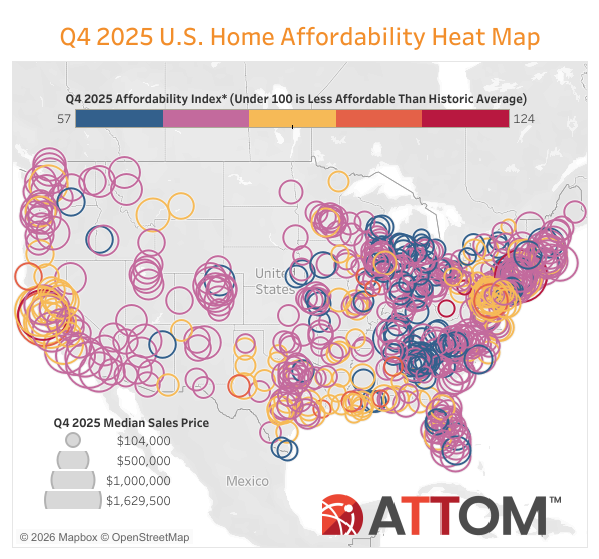
ATTOM’s Q4 Home Affordability Report paints a picture of persistent strain for prospective homebuyers across the U.S., even as modest improvements emerged late in the year. The Irvine, California-based analytics firm found that in 99% of the 594 counties analyzed, median-priced single-family homes and condos remained less affordable than historical norms, continuing a multi-quarter trend of affordability challenges.
While the national median home price held near a record high of approximately $365,185, typical wage growth continued to lag behind, constraining buying power for many households. Over the past five years, home prices rose about 54%, compared with a 29% increase in typical wages, according to Bureau of Labor Statistics (BLS) data used in the report.
Despite these pressures, indicators in Q4 pointed to slight relief. In 86% of counties, homes were more affordable than in Q3 of 2025, a shift attributed in part to modestly lower mortgage rates. Average interest on a 30-year fixed mortgage (FRM) fell from roughly 6.34% in early October to about 6.15% by year-end.
“Many Americans were priced out of buying a home in 2025, and affordability remains worse than historic norms in most markets,” said Rob Barber, CEO of ATTOM. “Still, modest, quarter-over-quarter affordability improvements in many markets at the end of the year offered some encouragement. Over the past five years, home price growth has nearly doubled wage growth, meaning home buying power in 2026 will depend not only on whether prices level off or decline, but also on mortgage rates and broader economic conditions.”
Affordability Metrics Remain High
ATTOM’s affordability calculation incorporates major homeownership costs — mortgage payments, mortgage insurance, property taxes, and homeowner’s insurance — relative to typical wages, assuming a standard 20% downpayment and a 28% front-end debt-to-income ratio. In 74.1% of counties, these expenses still consumed more than 28% of local wages, exceeding traditional affordability benchmarks.
On a national basis, typical monthly ownership costs in Q4 would have absorbed about 31.4% of an average worker’s wages. In nearly 30% of markets, these costs exceeded 43% of wages, a level often considered seriously unaffordable.
Regional and Local Trends
Affordability challenges were especially acute in parts of California and New York. Kings County, New York (Brooklyn) stood out as the least affordable, with required housing costs exceeding 100% of typical wages. Other high-strain counties included Marin and Santa Cruz in California, as well as Orange and Monterey Counties.
In contrast, several populous counties including Cook County, Illinois; Harris County, Texas; and Philadelphia County, Pennsylvania remained relatively more affordable, with homeownership expenses consuming a smaller share of typical local earnings.
What Lies Ahead?
Analysts say homebuying power in 2026 will hinge on how mortgage rates and economic conditions evolve. Though the recent reduction in borrowing costs offers some relief, affordability continues to lag long-term historical norms, keeping overall homeownership out of reach for many Americans.