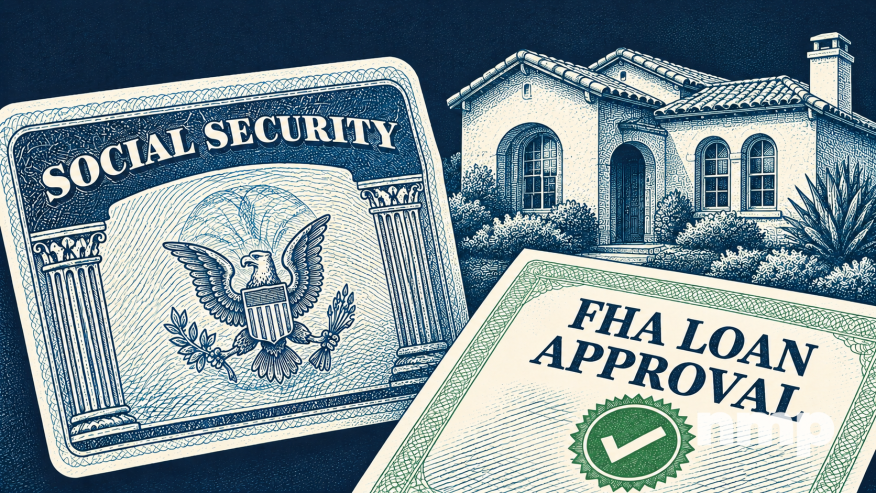
The Federal Housing Administration is preparing to implement a new data-sharing agreement with the Social Security Administration on Dec. 3, allowing HUD to verify identifying information for borrowers applying for FHA-insured mortgages.
The agreement, detailed in a Nov. 3 Federal Register notice, establishes an 18-month computer-matching program through which HUD will submit borrower names, Social Security numbers, and dates of birth to SSA for verification.
For FHA lenders and loan originators, the announcement brings renewed attention to a familiar underwriting requirement: ensuring that borrower identification information matches federal records before a loan receives FHA insurance endorsement.
The arrangement is not the first time FHA has used SSA records to verify borrowers. Existing HUD guidance already describes an overnight validation process, while federal records dating to at least 2024 document a computer-matching interface between HUD and SSA.
How The Verification Works
Under the new agreement, HUD will transmit identifying information from its Computerized Homes Underwriting Management System, or CHUMS, to SSA's Enumeration Verification System.
SSA will compare the information against its records and return a match or no-match response. When information does not match, the response may include an explanatory code. SSA may also return a code indicating that a death record was found.
The program covers borrowers, non-borrowing spouses, and other individuals listed on FHA mortgage applications whose information must be verified.
Borrowers must provide written consent through Form HUD-92900-A, the HUD addendum to the Uniform Residential Loan Application.
The agreement becomes applicable Dec. 3 and is scheduled to remain in effect for 18 months.
FHA Lenders Already Face Verification Requirements
Although the Federal Register describes the agreement as a new matching program, HUD's existing lender guidance shows that Social Security verification is already part of FHA loan processing.
Under FHA Connection's case-number assignment procedures, borrower names, Social Security numbers, and birth dates are checked against government records to confirm that the information belongs to the same individual and that the borrower is not recorded as deceased.
A HUD case-assignment guide also describes overnight SSA validation for borrowers and non-borrowing spouses. Results are typically available the following business day through FHA Connection's Holds Tracking function.
Federal records further establish that the underlying data exchange predates the December agreement. A June 2024 Federal Register notice described an existing computer-matching interface between CHUMS and SSA.
The November notice establishes the terms and safeguards for the new agreement, but does not announce a separate lender implementation deadline or changes to FHA underwriting eligibility standards.
The agreement also comes amid a broader Trump administration effort to tighten eligibility verification across federal housing programs.
In March 2025, HUD eliminated FHA mortgage eligibility for non-permanent residents, including DACA recipients, as part of an initiative to restrict access to federally insured financing. On Nov. 10, HUD announced separate, stricter citizenship and immigration-status verification requirements for federally assisted housing, highlighting its earlier FHA restrictions as part of that effort.
The new SSA agreement fits within that broader emphasis on verifying eligibility, although its stated purpose is narrower: confirming borrowers' Social Security numbers and identifying information.
What Happens When Borrower Information Doesn't Match?
FHA's operating procedures already establish the practical consequences of a failed verification.
HUD guidance states that an FHA case number may be assigned even when borrower identification has not yet passed validation. Loan processing can continue while the discrepancy is addressed.
However, a case with failed borrower validation cannot receive FHA insurance endorsement without the required acknowledgment from the appropriate HUD Homeownership Center.
Lenders can review the validation results through FHA Connection's Holds Tracking function, correct identifying information using Borrower/Address Change, and resubmit the information for verification.
HUD also directs lenders to contact the FHA Resource Center when additional assistance is needed.
Changes to a borrower's name, Social Security number, or date of birth can trigger another validation, with results generally available the next business day.
A failed match does not necessarily stop all loan processing, but an unresolved discrepancy can become an obstacle to FHA insurance endorsement.
What The December Agreement Means
The December agreement establishes a formal framework for exchanging borrower identification data between HUD and SSA, including verification results and explanatory codes.
It also reinforces the role of identity verification in FHA's existing mortgage insurance process.
For LOs, the operational takeaway is straightforward: accurate borrower information at application and case-number assignment remains important, particularly when names, Social Security numbers, or birth dates require correction.
HUD's published procedures already provide a mechanism for resolving failed validation, and the November notice does not establish additional lender-facing steps.
The new agreement takes effect Dec. 3, with existing FHA verification and endorsement requirements continuing to govern how lenders handle borrower identification discrepancies.