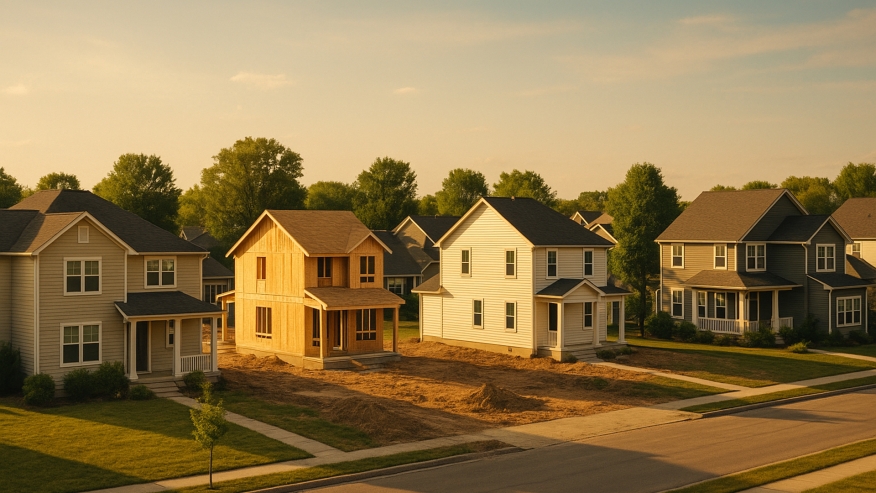
If Will Rogers were alive today, he might have said something like, “Land, they’re putting houses on less of it” rather than his more famous quote: “Land, they’re not making any more of it.”
The standard lot size in the U.S. used to be a quarter acre, or 10,890 square feet. But last year, Census Bureau data shows that two out of three (roughly 66%) newly built single-family houses sold were on lots on a fifth of an acre or less. That’s 9,000 square feet or fewer.
Smaller yet, 40% occupied lots of less than one-sixth of an acre, or less than 7,000 square feet!
The numbers reveal “stark changes in the lot size distribution and document a dramatic shift towards more compact building over the last two decades,” commented Natalia Siniavskaia, assistant vice president for housing policy research at the National Association of Home Builders (NAHB).
For homebuyers, that means if you want a house with some space around it, you should be looking at older houses — not newer ones.
“The persistent shift towards building spec homes on smaller lots is seemingly harder to explain against the backdrop of the pandemic-triggered suburban flight.” —Natalia Siniavskaia, Assistant VP for Housing Policy Research, NAHB
The median lot size of a new single-family detached home sold in 2024 was 8,506 square feet, or just under one-fifth of an acre. That’s slightly larger but statistically not different from the lowest on record median of 8,177 square feet set a year before the COVID-19 pandemic, noted Siniavskaia.
The median is for all speculatively built houses but does not include custom houses built on the owner’s lot. Census data shows the median lot size for custom single-family detached homes started in 2024 was one acre.
The shift in spec building toward smaller lots first became noticeable during the anemic housing recovery that followed the Great Recession. Over that period, the share of houses built on lots smaller than or equal to one-fifth of an acre rose rapidly, from 47% in 2010 to 61% just before the pandemic.
And the trend continued during the post-pandemic housing boom, with the share of smaller lots gaining an additional 4 percentage points during the last five years.
“The persistent shift towards building spec homes on smaller lots is seemingly harder to explain against the backdrop of the pandemic-triggered suburban flight and presumed shifts in preferences towards more spacious living,” the NAHB economist pointed out.
Rather, she explained, the steadily rising share of smaller lots “undoubtedly reflects unprecedented lot shortages confronted by home builders and their attempts to make new homes more affordable.”
A closer look at the lot size distribution shows the most dramatic shifts took place at the lowest end, with lots smaller than 7,000 square feet or under one-sixth of an acre increasing their share by 13 percentage points. At the same time, the share of lots between one-sixth and one-fifth of an acre increased from 20% in 2010 to 25% in 2024.
At the other end of the scale, lots exceeding half an acre shrank from 14% in 2010 to 9% in 2024. The share of lots between a quarter and half an acre declined from 24% to 19% over that period, while the share of homes built on lots between a fifth and a quarter of an acre declined from 15% to 7%.