





















The More AI, The More LO – NMP Skip to main content

The More AI,
The More LO

AI makes human loan officers
more essential, not less

By John Cady, special to National Mortgage Professional

The More AI,
The More LO

AI makes human loan officers
more essential, not less

By John Cady, special to
National Mortgage Professional

The conversation around artificial intelligence (AI) in mortgage lending has become exhausting. Every conference panel and industry publication seems to follow the same script: AI will transform everything. Efficiency will skyrocket. Costs will plummet. The future is now, and it’s automated.

What gets lost in all this enthusiasm is a simple truth that anyone who has actually originated mortgages already knows. The more we automate the mechanics of lending, the more valuable human judgment becomes.

AI has already changed our industry. Automated document verification, intelligent underwriting engines, and predictive analytics have eliminated countless hours of manual work. These tools are genuinely useful and the lenders who embrace them intelligently will have advantages. But what the technology evangelists consistently miss is that AI hasn’t replaced the core value that loan officers provide. It has revealed what that value actually is.

The Trust Problem

People have become extremely comfortable using AI for convenience. They’ll happily let an algorithm recommend what to watch on Netflix or which route to take to avoid traffic. Some even let it plan their vacations.

Trusting AI with major financial decisions is a little different. A mortgage represents the largest financial commitment most people will make in their lives. When borrowers are navigating this process, they’re looking for confidence that they’re making the right choice, not just efficiency.

This is where human loan officers become indispensable. They provide the ability to understand context, read between the lines, and apply judgment that extends beyond what appears in an application — things you won’t find in any algorithm.

Human loan officers … provide the ability to understand context, read between the lines, and apply judgment that extends beyond what appears in an application — things you won’t find in any algorithm.

Human loan officers … provide the ability to understand context, read between the lines, and apply judgment that extends beyond what appears in an application — things you won’t find in any algorithm.

What AI Actually Does Well

AI genuinely excels at processing structured data with remarkable speed and accuracy. It identifies patterns across millions of loan files. It flags potential issues early. It streamlines workflows in ways that benefit everyone involved.

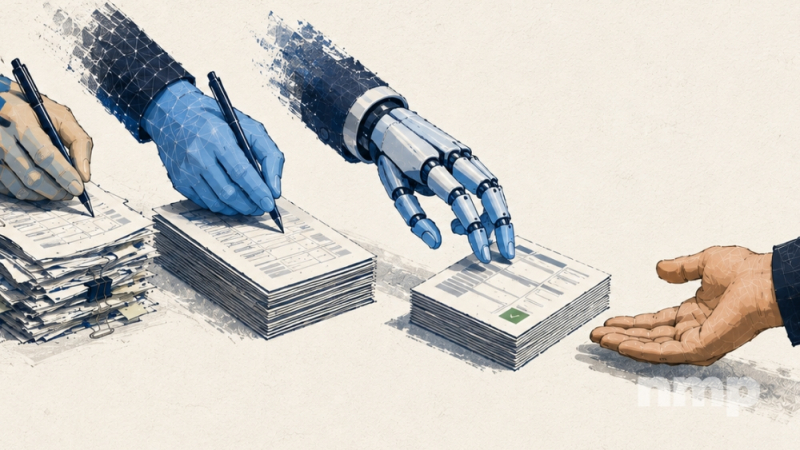
Loan officers who embrace AI-powered tools spend less time on paperwork and more time understanding people and solving problems. The administrative burden that has historically consumed so much of an originator’s day gets handled by technology that never gets tired or makes transcription errors. It’s also available 24/7/365.

But efficiency isn’t wisdom. Speed isn’t judgment. And processing power isn’t the same as understanding what actually matters to the person sitting across the table.

The Gap Between Data And Reality

Every loan file tells a story, but AI only reads the parts written in numbers. What doesn’t register in these systems is everything happening around those numbers.

For example, a good loan officer recognizes when a borrower’s stated timeline doesn’t align with their true situation. They notice when someone is asking questions that suggest deeper concerns about the purchase decision itself. They understand when market anxiety is masking legitimate affordability issues. AI doesn’t have the capability to pick up on or understand those nuances.

AI
processes data.
Humans
process meaning.

AI
processes data.
Humans
process meaning.

These insights come from experience and the kind of pattern recognition that develops through thousands of conversations with real people in complex situations. AI processes data. Humans process meaning.

Consider a self-employed borrower whose income has been volatile over the past two years. An automated system evaluates the numbers and spits out a qualification. A human loan officer asks why the income fluctuated and discovers that the borrower intentionally reduced their hours to care for an aging parent. They learn that the borrower’s business is now stabilized. They understand the full context and can provide guidance that serves the borrower’s actual circumstances.

This kind of nuanced understanding only scales through experienced professionals who use AI to eliminate administrative tasks so they can focus on the aspects of lending that genuinely require human judgment.

AI Strengthens The Human Element

It’s the elevation of what humans contribute, and not simply putting mundane, repetitive tasks in the hands of AI that represents the real transformation that’s come with its advent.

When loan officers are freed from routine administrative work, they have capacity for consultative conversations that define successful origination. They can understand a borrower’s long-term financial goals rather than just qualifying them for the immediate transaction.

AI creates an interesting dynamic around trust. As borrowers become aware that automated systems are handling parts of their application, they seek more human interaction for decisions that matter. They want a real person reviewing their situation and advocating for them.

Borrowers are happy letting AI handle document verification. But when it comes to discussing whether they should lock their rate now, whether they should pay points, or whether they can actually afford the home they’re considering, they want a human to help them think through the implications.

The Consultative Imperative

The best loan officers stopped being order-takers years ago and became financial advisors who help borrowers navigate complex decisions. This becomes more critical as AI handles mechanical work. When everyone has the same automated tools, differentiation comes from the quality of guidance. That means understanding tax implications, recognizing how interest rates affect refinancing strategies, and helping borrowers evaluate their purchasing power.

The most successful loan officers have already embraced AI to enhance their capabilities. They’re using technology to eliminate busy work and create space for high-value interactions that differentiate them.

Efficiency isn’t wisdom. Speed isn’t judgment. And processing power isn’t the same as understanding what actually matters to the person sitting across the table.

Efficiency isn’t wisdom.
Speed isn’t judgment.
And processing power
isn’t the same
as understanding
what actually matters
to the person
sitting across the table.

The Irreplaceable Factor

Mortgage lending is much more than just another financial transaction. For most borrowers, it’s an emotionally charged decision representing major life changes. Getting married. Having children. Relocating for career opportunities.

These transitions come with anxiety and questions that extend beyond loan terms. Human loan officers provide reassurance and guidance through overwhelming processes. They recognize when borrowers need detailed information and when they need simple clarity. They adapt their communication style to match individual personalities.

Writing is a medium of communication that represents language through the inscription of signs and symbols.

In most languages, writing is a complement to speech or spoken language. Writing is not a language but a form of technology. Within a language system, writing relies on many of the same structures as speech, such as vocabulary, grammar, and semantics, with the added dependency of a system of signs or symbols, usually in the form of a formal alphabet. The result of writing is generally called text, and the recipient of text is called a reader. Motivations for writing include publication, storytelling, correspondence, and diary. Writing has been instrumental in keeping history, dissemination of knowledge through the media and the formation of legal systems.

AI handles
mechanical work.
Humans provide
wisdom, context,
and genuine care.

AI handles
mechanical work.
Humans provide
wisdom, context,
and genuine care.

AI does none of those things. It can’t read emotional cues or recognize when someone needs more hand-holding. It doesn’t build the kind of trust that comes from genuine care.

This human element becomes more valuable as AI handles technical work. The best LOs understand that their job involves so much more than just processing applications efficiently. For them, it’s all about helping people navigate complicated financial decisions with confidence.

Looking Ahead

The mortgage industry will continue integrating AI capabilities. Borrowers benefit from faster processing. Loan officers benefit from reduced administrative burden. Lenders benefit from improved efficiency.

But this technological progress clarifies what the actual role of human originators should be rather than replacing them. The future isn’t humans versus machines, although that concept does make for a great sci-fi flick. Instead, the future will be built on humans working with machines to provide better outcomes than either could achieve alone. AI handles mechanical work. Humans provide wisdom, context, and genuine care.

Leveraging technology without losing human connection is already becoming the standard by which the best lenders operate. Those who view AI as a threat will compete on the wrong dimensions while neglecting the aspects of lending that genuinely require human expertise.

LOs need not worry that the increased role of AI will make them obsolete. It’s actually clarifying what they should have been doing all along: providing judgment, wisdom, and genuine partnership to borrowers navigating one of the most significant financial decisions of their lives — and that’s not a job any algorithm can do.

This article originally appeared in National Mortgage Professional, on the week of April 19, 2026.
About the author
CEO and President
John is the CEO and president of Citywide Home Mortgage, a Rate Company.
Published on
Apr 16, 2026
More from NMP Magazine
NMP
Underwriters Don’t Slow Down Loans. They Eliminate Uncertainty.

ndustry’s biggest bottleneck is not underwriting itself — it is the uncertainty that reaches underwriting too late in the process. When validation happens upstream, speed follows naturally.

Gerald M. Green
NMP
The Hidden Cost Of Talent

Retail veterans explain the calculation, the clawbacks, and the fine print

Katie Jensen
NMP
Not Your Conforming Comfort Zone

Non-Agency originations could reach $500 billion this year. Are you ready to tap in?

Tom Davis
NMP
The Liquidity Squeeze In FHA Servicing

The long tail of loss mitigation is now coming into view as FHA’s post-pandemic relief tools give way to repeat defaults, exhausted options, and a swelling foreclosure pipeline

Katie Jensen
NMP
The NEXA Disruption

A bold rebrand tests the broker–retail divide

Katie Jensen
NMP
Homes For People, Not Portfolios

Trump’s housing directive targets bulk buyers — but the real impact hinges on definitions, supply, and migration to build-to-rent

Seamus Nally

Webinars

The CEO Mindset: 5 Daily Successful Routines

In this webinar, NMP CEO Andrew Berman sat down with GMCC's James Jin, CEO and President, alongside four of th...

Webinar
May 28, 2026
Investor Confidence in Today’s Non-QM And Why Originators Are Paying Attention... A Virtual Town Hall

We host Angel Oak Mortgage Solutions for a special 2021 edition of their virtual town hall series they ran fro...

Webinar
Apr 08, 2021
How to Help Real Estate Pros in a Post-Refi World

Hear from Melissa Merriman, REALTOR® with The Melissa Merriman Team at Keller Williams, on what real estate pr...


Webinar
Mar 18, 2021
Connect with your local mortgage community.

Meet your your colleagues, both national and local, by attending an event in your area.