The NEXA Disruption – NMP Skip to main content

COVER STORY

The NEXA Disruption

A bold rebrand tests the broker–retail divide

By Katie Jensen, Associate Editor, National Mortgage Professional

COVER STORY

The NEXA Disruption

A bold rebrand tests
the broker–retail divide

By Katie Jensen, Associate Editor,
National Mortgage Professional

The minute NEXA Mortgage announced it was rebranding to NEXA Lending, abandoning the “brokers are better” rallying cry, industry peers half-expected its LOs to storm into headquarters and declare, “Your broker model is dead! It has ceased to be!” NEXA Lending, they say, is an ex-broker.

For years, CEO Mike Kortas was one of the industry’s loudest defenders of the pure-broker model rather than a “hybrid” non-delegated model. At the time, he claimed, “These brokers are doing the same thing that the retail companies were doing to loan officers for years,” by hiding the purchase advice and the coupon from their loan officers. That would allow the branch manager or company owner to secretly pad interest rates and earn a larger profit on the loan.

However, NEXA’s leaders confirmed that it will maintain its open purchase advice policy. For Kortas, transparency is one of NEXA Lending’s main differentiators from retail IMBs and, to prove that, he’s repeatedly said, “NEXA shares the purchase advice on every single transaction we do.”

That has stopped industry peers or self-appointed mortgage detectives from spinning their own theories about NEXA’s “true agenda.”

“You can read between the lines on what these moves mean,” one Facebook commenter warned. “When you run a broker shop with a mini-del option, it’s different — you’re still selling to wholesalers, which keeps everything transparent. But once you start transitioning into full correspondent lending with your own DE (delegated) underwriting and direct selling to investors, the transparency goes away.”

To set the record straight, Kortas said, “There’s no way that NEXA is going fully delegated — it would be detrimental to our way of doing business.”

Moreover, he said the rebrand wasn’t a pivot at all, but a formal acknowledgment of what NEXA has already become internally: a non-delegated lending platform built on transparency, scale, and technology. As of November 2025, nearly 60% of NEXA’s year-to-date volume was funded through the non-delegated channel — up from 40% in 2024, according to Modex. The shift, he said, is designed to make the company more accessible to retail LOs without abandoning the wholesale transparency that defined NEXA in the first place.

There was a notable lack of irritation and defensiveness from Kortas, who said, “I love the conspiracy theories out there. As long as they’re talking about me, I’m happy.”

While competitors poked, prodded, and held it up to the light, insisting the rebrand was proof that NEXA was no longer a pure broker, others cast it as “mostly dead,” and “not-quite-retail.” The newly hired Chief Strategy Officer, Tammy Richards, framed it in her own words, saying, “I don’t believe I’m in wholesale. I believe that I’m in a hybrid go-forward model that’s quite unique. It’s kind of a meld between wholesale and retail. It is the best of both worlds, and it really is the future of mortgage lending.”

He also pointed out that, depending on how you look at it, both sides of the debate are correct: NEXA still operates with broker-style transparency while also adopting the control and structure retail loan officers expect.

The speculation was also fueled by a pair of high-profile hires in 2025: Chief Growth Officer Geri Farr and Chief Strategy Officer Tammy Richards, both of whom brought deep retail experience into NEXA’s C-suite. Kortas and COO Jason duPont said the intention isn’t to transform NEXA into a retail lender, but to make the TPO channel more inviting to former retail LOs. Competitors are pursuing the same strategy and NEXA doesn’t plan to lose ground.

“Coming here and hearing that, we actually provide the purchase advice so that our loan officers can see what NEXA collected on that transaction, and how much you made — that is such a foreign concept to those of us coming over from the retail IMB world.”

> Geri Farr, Chief Growth Officer, NEXA Lending's reaction to NEXA’s open purchase advice policy.

“Coming here and hearing that, we actually provide the purchase advice so that our loan officers can see what NEXA collected on that transaction, and how much you made — that is such a foreign concept to those of us coming over from the retail IMB world.”

> Geri Farr, Chief Growth Officer, NEXA Lending's reaction to NEXA’s open purchase advice policy.

The New TPO Model: Stable And Supportive

NEXA Chief Growth Officer Geri Farr, a seasoned mortgage-industry executive, is mainly known for leading retail sales expansion at Bay Equity Home Loans and Kind Lending — but her roots run deep in wholesale. Prior to 2008, Farr was a top-producing wholesale account executive at Irwin Mortgage. In 2009, she joined NOVA Home Loans and managed profit and loss statements for all NOVA branches across Maricopa County, which is how she met Kortas, who was just an originator at the time.

Despite their diverging paths, Farr said they share a “corporate mortgage upbringing,” where “we were very much ‘raised’ the same way, in terms of how to originate a deal and build your business.” But, after nearly a decade of working for IMBs, Farr couldn’t imagine herself switching back into the TPO channel.

At first, when Kortas reached out to Farr last spring, she didn’t image that he’d say: “Geri, I really want you to come and be a part of this, to help NEXA develop, grow, evolve into who we’re meant to be: NEXA Lending.”

“As he was talking to me about that, I thought, ‘Wait, what? No, no, no — I’m a retail IMB girl,’” Farr said.

She admitted to having an outdated, pre-2008 perception of the TPO channel, which is common among retail originators and even their leaders, as duPont noted in NMP’s July cover story, “Assassin Recruiters.” Farr said, “Six months ago, I was one of them, thinking that brokers in the TPO world didn’t have any support.”

Farr knew that TPO originators typically make more basis points (bps) per loan than retail LOs. But, because they have to pay for their own expenses, she assumed their net income would be the same or less than retail LOs.

But her mindset soon shifted after she met with duPont, whose operational and recruiting success at NEXA caught her attention. That’s when Farr realized, “Brokers absolutely make more basis points [and] the broker bears the burden of all their expenses — that’s true,” she said. “The important piece is that the expenses are really low.”

COO duPont explained that a larger platform like NEXA Lending benefits from pricing with wholesale and correspondent partners such as United Wholesale Mortgage and Pennymac, which helps keep overhead low. Once those modest costs are subtracted, the broker’s net take-home income is actually higher than a retail LO’s.

As for loan officer support, she discovered that NEXA Lending also has dedicated teams taking care of its loan officers and their clients. That policy is reflected in another lesser-known NEXA slogan: “It’s not just a file, it’s a family,” marking yet another surprise for Farr.

But, the most shocking reveal was NEXA’s open purchase advice policy.

“I believe that I’m in a hybrid go-forward model that’s quite unique. It’s kind of a meld between wholesale and retail. It is the best of both worlds, and it really is the future of mortgage lending.”

> Tammy Richards, Chief Strategy Officer, NEXA Lending on NEXA no longer being a pure broker, as others cast it as “mostly dead,” and “not-quite-retail.”

“I believe that I’m in a hybrid go-forward model that’s quite unique. It’s kind of a meld between wholesale and retail. It is the best of both worlds, and it really is the future of mortgage lending.”

> Tammy Richards, Chief Strategy Officer, NEXA Lending on NEXA no longer being a pure broker, as others cast it as “mostly dead,” and “not-quite-retail.”

It’s a concept so progressive to retail professionals, Farr said, that most don’t even know what “sharing the purchase advice” means. “Coming here and hearing that, we actually provide the purchase advice so that our loan officers can see what NEXA collected on that transaction, and how much you made — that is such a foreign concept to those of us coming over from the retail IMB world.”

But now Farr is a staunch advocate for that kind of transparency. “Everything has to be transparent and honest,” she said. “Once you lose that trust, your foundation’s cracked, and you can’t put weight on that.”

By offering higher net income, low expenses, and strong infrastructure, NEXA’s model quickly extinguished Farr’s outdated beliefs and assumptions. “This operates really well,” she said. “And that was, again, my epiphany. I didn’t understand that until I really looked behind the curtain.”

Top Producer Reports Feedback

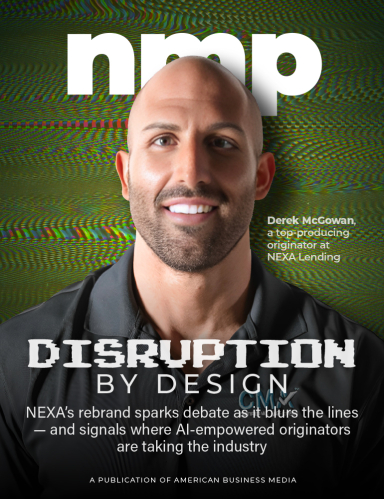
Derek McGowan, a top-producing originator at NEXA Lending, offers another look behind the curtain as one of the first LOs to pilot NEXA’s new AI stack, including technology developed by Tidalwave — in partnership with bevri.ai — and integrated into the company’s non-delegated lending platform.

His firsthand experience shows how the tools are reshaping loan origination — compressing days of document review and income calculation into minutes, auto-filling loan applications during live calls (with consented pulls/AUS), and running context-aware client follow-ups. Altogether, the system allows his 10-person team to scale without adding headcount, while maintaining high service levels.

For example, he described a common, time-consuming scenario with a self-employed borrower who sent in their tax returns late one evening as part of their loan application. “They have a pretty thick stack of tax returns that were scanned over,” McGowan said, so he used NEXA’s AI system to upload and analyze all of the returns at once. “Within 10 minutes it has scrubbed everything, giving us an income calc,” he said. “We can hover over it to see where the income count came from.”

When the AI finished scanning, McGowan realized his client had written off a significant amount of income. To qualify for a mortgage, he needed to pivot from a conforming loan to a bank-statement loan.

“That could take forever, though, trying to go through every deposit somebody has in their business for the last year,” McGowan said. But, again, the technology was able to scrub 12 months of bank statements within minutes and point out any questionable deposits. Once it’s finished scanning, the system calculates the borrower’s monthly income.

Overall, it drastically shortened a task that would have taken multiple days to just 40 minutes, McGowan estimated. Even his referral agent was in disbelief. “But really, the most important thing is they got back to the client with an answer,” he said, “and they didn’t have to do it the next day and possibly miss the house.”

The technology for basic automated application intake already exists, but McGowan’s AI-enhanced software doesn’t only scan documents — it actually thinks through them.

“AI is going to clearly disrupt the consumer-direct environment.”

> Mike Kortas, CEO, NEXA Lending on AI allowing each originator or team to have “their own consumer-direct” service, where a digital assistant is capable of handling outreach, follow-ups, and lead engagement.

“AI is going to clearly disrupt the consumer-direct environment.”

> Mike Kortas, CEO, NEXA Lending on AI allowing each originator or team to have “their own consumer-direct” service, where a digital assistant is capable of handling outreach, follow-ups, and lead engagement.

For example, while talking to a client on the phone, an AI bot fills in the customer’s loan application in real time, populating the LOS as the conversation unfolds. “As I could focus on the conversation, it’s inputting that into the system,” he explained. “I could just be verbally exchanging that over the phone, the system is hearing that, and it’s inputting that into the correct fields.”

That means no pausing to type, no after-call data entry, and no errors from rushing through details. McGowan calls it “a backbone that does the heavy lifting,” freeing him to focus on what matters most: the client’s story and the deal itself.

McGowan’s team also uses AI to manage lead follow-up, without losing the human touch. “Our AI caller will read the conversation that we previously had with the client and pick up from there,” he said. “If they want a live transfer, it’ll transfer it over to me or one of my team members.”

Unlike generic dialers, the AI knows each client’s history and can engage in two-way text, voice, or email communication. For clients still months away from buying, it checks in with reminders and status updates, ensuring no lead goes cold.

“It beats the heck out of not getting a response until morning,” McGowan added. “The people that we know, they’re just not ready yet. At least they are getting followed up with on a routine basis.”

Additionally, NEXA’s system can reduce friction by automatically updating data as new documents are uploaded. For example, “If a client uploads a new bank statement … it’ll update the assets in our file automatically,” McGowan explained. “It prevents a lot of the little human error that could happen throughout the process.”

Although McGowan and his team are still adapting to the technology, he said he’s already seen it pay off. “We’re closing more loans, but we’re still getting to things at the same time,” McGowan said. “It hasn’t slowed us down because we’ve been able to leverage the tech.”

That automation, McGowan noted, makes originators not only faster but sharper as well. With routine work handled by machines, his team spends more time advising and less time reconciling.

NEXA’s Emerging Tech Stack Includes:

  • AI for instant document and income analysis. Cuts days of manual review into minutes, giving borrowers faster answers and keeping deals on track.
  • AI Application-Intake Assistant for real-time loan origination. Enables same-call pre-approvals and eliminates repetitive manual entry.
  • AI Caller/Follow-Up System for nurturing long-term leads. Keeps long-term prospects engaged and responsive without burdening human staff.
  • AI Lead Dialer and Scheduler for rapid inbound-lead response. Shortens response time from hours to seconds and boosts conversion of online leads.
  • Automated Document Updater for continuous file accuracy. Maintains real-time accuracy and improves turn-times without manual re-checks.

How NEXA Is Deploying AI

Chief Strategy Officer Tammy Richards, who joined NEXA after senior roles at loanDepot, Kind Lending, and Caliber Home Loans, expects the new tech to enhance and redefine the structure of mortgage operations. At NEXA Lending, she said, “We’ll be using AI in ways that the industry has not used yet.”

Richards has been working to advance mortgage technology since the 1980s, when she helped develop Fannie Mae’s first loan-origination system (LOS). Unlike some lenders that disguise manual labor as AI in their systems, she says NEXA has “true AI,” meaning a natural-language processing and intelligent workflow automation that can interpret complex documents like divorce decrees and bankruptcy filings that traditional OCR could never handle.

NEXA’s next-generation LOS will act as “the wizard in ‘The Wizard of Oz,’” she said, where the system performs the complex calculations and rule checks behind the curtain while originators remain the visible experts guiding borrowers through the process. “We still are going to need humans,” Richards added. “The mortgage experts will be the Oz behind the curtain.”

Although Richards says she envisions a future where LOs will be supported by technology, instead of replaced, she also believes this evolution will permanently change certain roles within the industry. “All of the job codes that are currently in the mortgage industry will continue to evolve,” she said. “Processors may completely change. Underwriters will still be there, but doing 20 to 25 files a day. And the loan officer — that trusted advisor role — will become even more important.”

The result, Kortas believes, will be a mortgage operation that can expand capacity in boom cycles and contract during slow periods without the mass hiring and layoffs that have defined past decades.

Kortas said the company is already 90% finished with its voice AI system that can complete nearly an entire loan application by phone and automatically run AUS and AI prequalification in real time. “It sounds no different than if I called my daughter or my son,” Kortas said. “It sounds that real. It costs more money, no doubt about it, but it is there.”

Some originators believe technology belongs on the back end of the process to preserve the relationship-driven parts of their service, yet they’ll often admit the initial call with a potential refinance borrower is far more straightforward and less personal than a purchase transaction. A typical loan officer might make 10 to 15 prospect calls a day, while AI can make “20 times that without blinking an eye,” Kortas said. “Voice AI doesn’t get a headache. It doesn’t get sick. It doesn’t ask for time off. It just works nonstop.”

Kortas described it as each originator or team having “their own consumer-direct” service, with a digital assistant capable of handling outreach, follow-ups, and lead engagement.

That is precisely why Kortas believes, “AI is going to clearly disrupt the consumer-direct environment,” he said. “A company like West Capital Lending would only need about 10% of loan officers to do more volume than they’re currently doing. We’re gonna let AI do that for them, and that way every one of our loan officers can become their own consumer-direct.”

West Capital Lending has been one of the most aggressive recruiters in the consumer-direct space. In 2025, the mega brokerage added more than 700 mortgage loan originators, who were largely sourced from retail IMBs. But, so far, that expansion has helped drive the company’s total loan volume from $3.36 billion in 2024 to $4.54 billion in 2025.

“The way NEXA wins is that they’re a first adopter. There’s always advantages to that, and you can look at any company.”

> Jason duPont, Chief Operating Officer, NEXA Lending, on if the company’s artificial intelligence platform is so transformative, why sell it to competitors?

“The way NEXA wins is that they’re a first adopter.
There’s always advantages to that, and you can look at any company.”

> Jason duPont, Chief Operating Officer, NEXA Lending, on if the company’s artificial intelligence platform is so transformative, why sell it to competitors?

What Is NEXA’s New Strategy?

Kortas and COO duPont share that view, describing the AI rollout as both an efficiency play and a control mechanism for scaling. NEXA’s non-delegated correspondent model already gives originators flexibility with appraisals and underwriting that traditional retail lenders can’t match. Adding AI, they said, will allow the company to expand its capacity without the boom-and-bust employment cycles that have long defined the business.

That strategy, backed by NEXA’s “first adopter” mindset, is central to its growth plan. “Being first means you can continue to be ahead,” Richards said. “Because if everybody’s trying to catch up, you’re building the next best thing that needs to be in the industry.”

At first, NEXA loan officers can enjoy a relatively rare position in the broker space — offering consumers a true end-to-end service. But, Kortas and duPont revealed that the long-term plan is to license or distribute the technology through bevri.ai to other lenders and brokerages — even competitors.

“It’s a goal of mine,” Kortas said. “But it’s a goal that’s probably off into the horizon a bit.”

“We want to roll out all the tech we’re developing to the entire TPO channel, including the big brokers like Edge and Barrett,” duPont said. “If we can help the consumer, we can help the TPO space, we’ll win.”

So when it comes to NEXA’s strategy, a fair question emerges: if the company’s artificial intelligence platform is so transformative, why sell it to competitors?

“Well, the way NEXA wins is that they’re a first adopter,” said duPont. “There’s always advantages to that, and you can look at any company.”

“Being first means you can continue to be ahead — because if everybody’s trying to catch up, you’re building the next best thing that needs to be in the industry.”

> Richards on NEXA's AI rollout as both an efficiency play and a control mechanism for scaling.

“Being first means you can continue to be ahead — because if everybody’s trying to catch up, you’re building the next best thing that needs to be in the industry.”

> Richards on NEXA's AI rollout as both an efficiency play and a control mechanism for scaling.

The first mover strategy is a classic truism that contends innovation favors the first mover. In duPont’s view, the head start itself is the advantage: a chance to learn faster, scale sooner, and define the playbook before anyone else can copy it.

But not everyone agrees that getting there first guarantees victory. History is full of examples where the fast follower wins instead of the first mover, according to Jeff Reeves, co-founder and chief technology officer of Canopy Mortgage.

“Costco wasn’t the first to market in the wholesale space,” Reeves said as an example. Instead, it perfected the wholesale model through years of disciplined iteration and alignment across logistics, pricing, and member experience. Or, as Reeves phrased it: “It’s 50 innovations working in perfect harmony with each other. That’s why it works.”

True innovation, he said, isn’t about claiming new territory; it’s about refining the model until every moving part works seamlessly. “You don’t have to be first,” Reeves said. “You need to execute on simple principles with precision and discipline.”

He draws the same lesson from Apple’s iPod, saying, “Apple wasn’t first to market with MP3 players. They were actually late. But they connected with their customer,” Reeves said. “Their pitch wasn’t, ‘Hey, we have a 10-gigabyte thing with all this stuff.’ Their pitch was ‘1,000 songs in your pocket.’” He believes that simple, more human-like message reflected what Apple understood better than anyone else: the “why” behind consumer behavior.

Reeves suggests that both companies mastered the motivation of their customers, not just the mechanics of the product. Costco understood that shoppers weren’t hunting for novelty, but for reliability, value, and a frictionless experience. Apple reached the same insight in consumer electronics: people didn’t care about storage specs; they cared about what the device allowed them to do. That focus on emotional clarity over technological bragging rights, Reeves argued, is what separates true innovators from companies simply first to market.

Reeves’ point also echoes what loan officers see on the ground. Borrowers aren’t responding to technical specs or workflow changes, but they are responding to speed, clarity, and frictionless interactions. As NEXA originator Derek McGowan put it, “We’re in an Amazon society where people want it exactly how they want, and they want it now.” In his view, the demand for immediacy is what makes real-time income calculations, instant document analysis, and same-call preapprovals meaningful to borrowers. The technology matters less for what it is and more for how it satisfies the borrower’s underlying expectation: quick answers and confidence that they won’t miss a house waiting for someone to run the numbers.

In the end, NEXA’s rebrand and technology push mark a strategic line in the sand: a bet that transparency, non-delegated control, and AI-driven efficiency can coexist in the same platform without diluting the broker-first DNA that built the company. Whether the rest of the market sees that as evolution, contradiction, or simply the next phase of TPO lending, will depend on how quickly competitors adapt and how effectively NEXA executes.

This article originally appeared in National Mortgage Professional, on the week of April 19, 2026.
About the author
Associate Editor
Katie Jensen is a mortgage news reporter at NMP.
Published on
Apr 16, 2026
More from NMP Magazine
NMP
Not Your Conforming Comfort Zone

Non-Agency originations could reach $500 billion this year. Are you ready to tap in?

Tom Davis
NMP
The Liquidity Squeeze In FHA Servicing

The long tail of loss mitigation is now coming into view as FHA’s post-pandemic relief tools give way to repeat defaults, exhausted options, and a swelling foreclosure pipeline

Katie Jensen
NMP
The More AI, The More LO

AI makes human loan officers more essential, not less

John Cady
NMP
Homes For People, Not Portfolios

Trump’s housing directive targets bulk buyers — but the real impact hinges on definitions, supply, and migration to build-to-rent

Seamus Nally
NMP
The Offense Mindset For M&A

Lenders turn consolidation into a competitive weapon

Katie Jensen
NMP
LO UnComplicated

A forensic look at where LO compensation really goes

Katie Jensen
Connect with your local mortgage community.

Meet your your colleagues, both national and local, by attending an event in your area.