Production
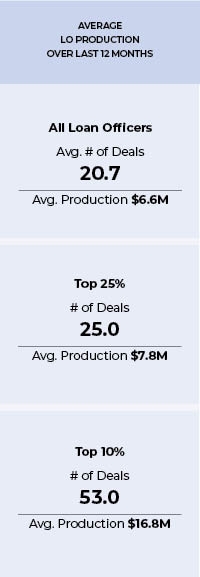
Over the last 12 months, loan officers averaged 21 units, or just under two loans per month, for $6.6 million in production. The top 25% of loan officers originated an average of 25 units, or just over two loans per month, and the top 10% originated 53 units, or about four loans per month, in the same period.
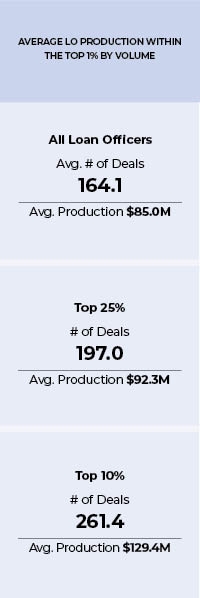
Of course, most lenders naturally want to attract the cream of the crop. So, what does it take to be in the top 1% of all loan officers in today’s market? Home prices vary by region, so looking at volume and units is essential to see the whole picture. Over the last 12 months, the top 1% of loan officers by volume averaged $85 million for 164.1 units. The top 25% of the one-percenters by volume averaged 197 units for about $92.3 million in production, and in the top 10% of the one-percenters, those originators averaged 261.4 units for an average of $129.4 million in production.
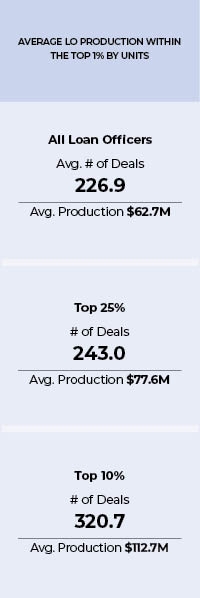
How does the elite group of one-percenters fall out when we look at units? Over the last 12 months, the top 1% of loan officers by units averaged $62.7 million in production for 226.9 units, translating to an average of 19 units per month. To be in the top 25% of the one-percenters by units, those originators averaged 243 units, and to be in the top 10% of the one-percenters, those originators averaged a whopping 320.7 units for the same period.
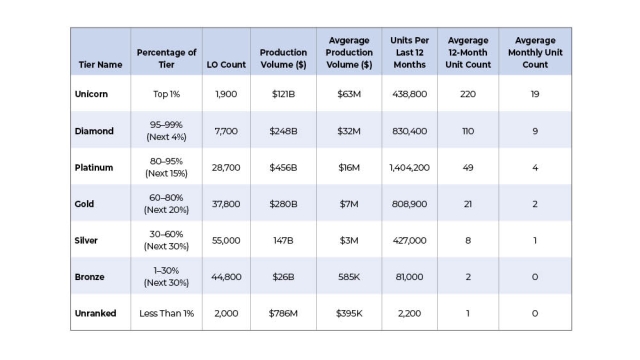
Those production numbers are incredible, but getting top producers to move to a new company is hard. So, where does the rest of the industry stand? To inform this, MMI divided loan officers into six tiers based on a rolling 12-month production volume. The chart at right outlines the percentage of loan officers in each category.
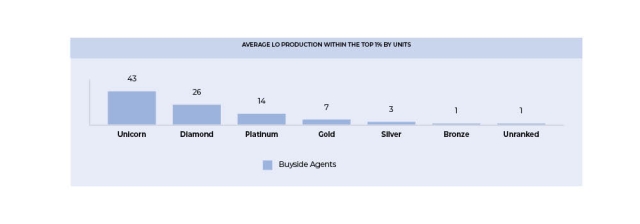
In addition to looking at production numbers, it’s also important to consider a loan officer’s referral partner network. MMI tracks the number of buy-side agents and found that the top 1% of originators work with at least 45 agents. The following 4%, or the Diamond Tier, work with 26 buy-side agents, while the next 15%, or the Platinum Tier, work with 14 buy-side agents. The subsequent 20%, or the Gold Tier, work with at least seven agents, whereas the next 30% or the Silver Tier, work with at least three agents. Because agents are typically the largest referring source of potential buyers to a loan officer, considering the number of buy-side agents a loan officer works with is another excellent lens to consider when recruiting loan officers for your teams.
Focus
Given all this data, how should a company set a minimum production standard when recruiting? The answer is that there’s no right way to set your criteria. Instead, companies should create a multi-tiered recruiting approach and recruit in each tier based on specific needs and the skill sets of their management teams.
For example, some managers are great coaches and could recruit in the Silver Tier, where loan officers average one unit per month, with the idea they could help those loan officers increase their production. Additionally, some managers may only want to talk to candidates consistently closing at least two units per month, which fall into the Gold Tier. Then, other managers may only want to talk to loan officers doing five or more units per month because they want to be more hands-off. Those loan officers fall in the Platinum Tier. Or you may have a manager in the 1% group who wants to open new branches with other loan officers producing at similar levels. They would search for candidates in the Unicorn Tier. In other cases, the company may set recruiting thresholds and require a minimum number of closed loans per month or a minimum amount of past production. As you can see from these examples, there is no one-size-fits-all solution for recruiting.
In conclusion, the dynamics of mortgage lending underscore the critical need for strategic recruitment practices. As the industry grapples with a significant decrease in the number of producing loan officers, a tailored approach to recruitment, grounded in a comprehensive understanding of current production metrics and referral networks, becomes essential. Companies must leverage detailed data to identify and engage with the most qualified candidates, prioritizing not just volume but the quality of relationships and interactions. In this competitive landscape, success hinges on the ability to adopt a nuanced, data-driven recruitment strategy that addresses the specific needs of each tier of loan officers. By doing so, firms can not only meet, but exceed, their recruitment goals, securing the top talent necessary to thrive in today’s market.