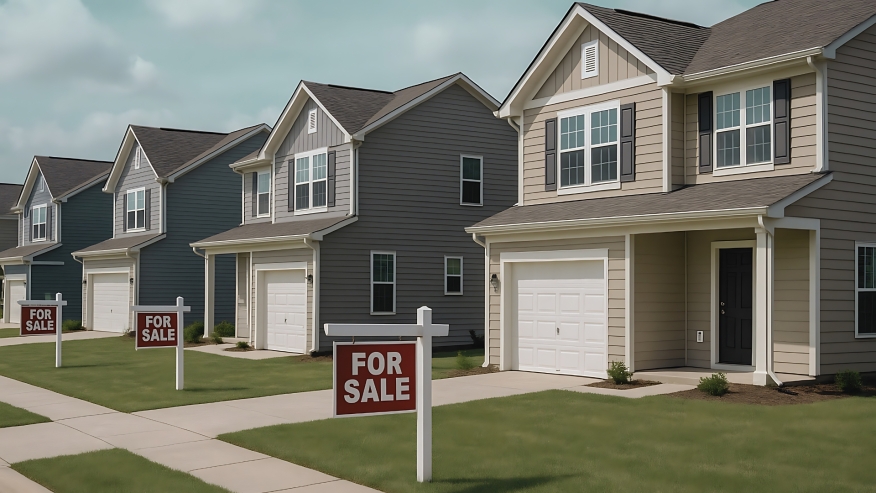
The supply of spec houses finished but unsold is rising — a sign that the new home market is struggling to remain in equilibrium.
The number of inventory houses, also known as quick move-ins, returned in July to a level last seen in late 2022, another period shaped by economic uncertainty and rate volatility, according to Zonda, a marketing and analytics firm that tracks 85% of new construction throughout the country.
Builders often start construction before they have signed contracts so they can have inventory on hand for buyers who need to move quickly. But when they have too many houses on hand, the carrying costs become burdensome.
To manage the increase, Zonda found that many builders are “finding the market” by offering incentives and pricing discounts. Sometimes, the cuts are substantial. At the same time, they are being extra careful about starting new spec houses — at least until demand shows some clear signs of improvement.
“For many consumers, QMIs [quick move-ins] provide a great alternative to resale supply,” said Zonda Chief Economist Aly Wolf, “given they are brand new and often come with builder incentives.”
“These homes aren’t flying off the shelf as they once did, though, so builders are being more cautious on new starts,” Wolf noted.
Zonda’s monthly snapshot also found that projects are no longer selling out faster than they can be replaced. The Irvine, Calif.-based company tracks 16,596 communities that are actively selling. That’s up 10% from last year.
“The national community count is up for the 8th consecutive month,” the company reported.
Pricing, meanwhile, was a mixed bag. For the first time since January, two price tiers increased. While entry-level houses dipped 1.1% to $325,690, move-up houses rose 0.4% to $518,194 and high-end places went up 2.6% to $923,048.
“While the price increases seem counterintuitive to reality, the rise could be a result of new communities opening at higher prices given land and construction costs,” Zonda explained.
In another survey, Zonda found that a third of all builders lowered prices in July, 61% held prices flat, and 6% raised prices. In June, by comparison, 39% of builders lowered prices month-over-month, 59% held prices flat, and only 2% increased prices.
Incentives are still common as builders try to address affordability constraints affecting their customers. In July, 58% of their communities offered incentives on to-be-built homes and 77% on quick move-in supply. But the use of incentives could be far greater, because these figures include only publicly advertised giveaways.
Overall, July’s new home sales were sluggish but steady. “Sales activity was flat month-over-month,” said economist Wolf. “For some builders, though, describing the market as ‘average’ may feel too generous as they continue to grapple with tighter margins, rising marketing costs, heavier incentive usage, and stronger competition.”
On a seasonally adjusted annualized rate, there were 668,318 new homes sold in July. That’s even with June’s rate but a decline of 6% from a year ago. On a non-seasonally adjusted basis, 56,928 homes were sold, 5.6% fewer than last year but 6.8% above the same month in 2019.
Zonda also counts pending sales, which were off 9% from a year ago. But on a month-to-month basis, seasonally adjusted new home sales increased by 1.4%.