When it comes to housing policy, most people have yet to form an opinion, according to a new survey from the Searchlight Institute. But they do seem to know one thing: making the permitting process easier and quicker will lower costs and lead to more homes for everyone.
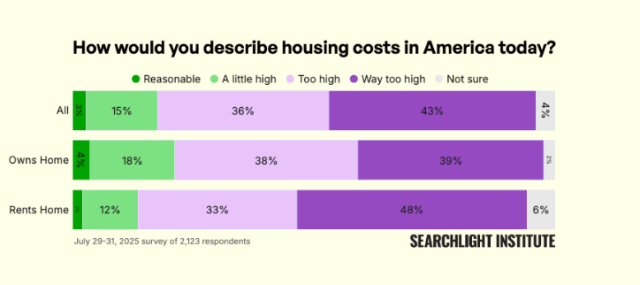
A strong majority of those who participated in the Searchlight Institute’s “What Americans Think About Housing” study believe houses are too expensive — or “way too high” for some. Renters, in particular, think it has become much more difficult to find a place of their own.
“Overall,” the think tank says, “it’s a bleak picture of the current state of housing prices.”
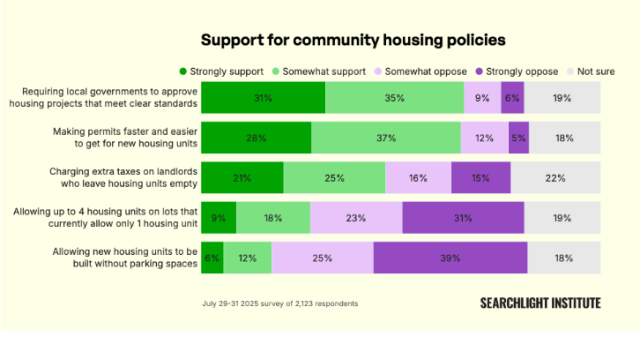
Moreover, when asked what they would do about it, a “high percentage” answered “not sure” across a variety of proposals being bandied about in D.C., likely meaning most have yet to form a strong opinion one way or the other.
Still, the policy change respondents most often favored was requiring local governments to approve housing that meets their standards. They voted for this despite the fact that a third believe that such requirements would increase housing costs.
To reduce costs, nearly 33% of those polled said they were in favor of reducing environmental regulations on new housing projects, barring investors from buying single-family homes, and boosting public spending. Yet, a significant minority believe each of those steps would lead to higher prices.
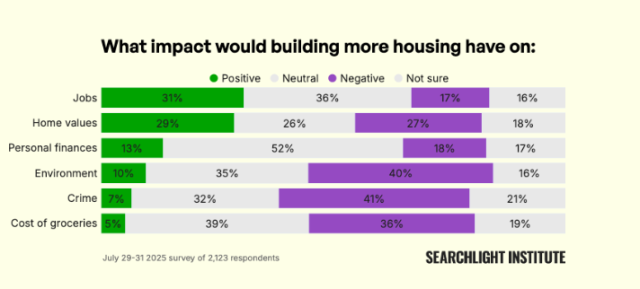
Increasing the nation’s housing supply — a proposal the White House seems to favor — would be good for their communities, according to 54% of those polled. But 44% felt it will raise prices at least slightly, compared with just 24% who felt it will lower prices, and 32% are not sure either way. This holds true across all age, race, and educational demographics.
Respondents said the primary drivers of high housing prices are investors using housing for profit, the high cost of building materials, and the rent-setting power of landlords. Fewer than one in 10 believe the length of time it takes to build housing is one of the biggest causes.
Still, the survey results “gave no indication” that people view housing prices as a temporary problem or one with a clear solution. Indeed, they are not optimistic about what lies ahead, as more than four out of five felt that it will be harder for young people to buy a house when they grow up.
Owning a home is considered the American Dream, of course — but it’s only a part of it.
According to the investment website Investopedia, the “American Dream” has seven other components: retirement, healthcare, raising two children and paying for college, buying new cars, taking an annual vacation, owning pets, and paying for a wedding.
Still, that dream is an expensive one. In total, the site figures, the American Dream may cost about $5 million for college-educated individuals to pay for all of those milestones over a 30-year span. Housing accounts for $957,594 — approximately 20% of that total — Investopedia says. The only larger component is retirement, with a price tag of $1,636,881 to retire comfortably.
“Even with a 20% down payment, a 30-year fixed mortgage at 6.69% would ultimately cost the homebuyer nearly double the purchase price to pay off the home, and that’s without HOA fees and maintenance costs,” Investopedia says.
It’s doubtful statistics like these will dissuade people from buying homes. After all, it is part of the American Dream. While everyone’s dream is different, nearly nine out of 10 people who participated in Investopedia’s survey said homeownership is part of theirs.