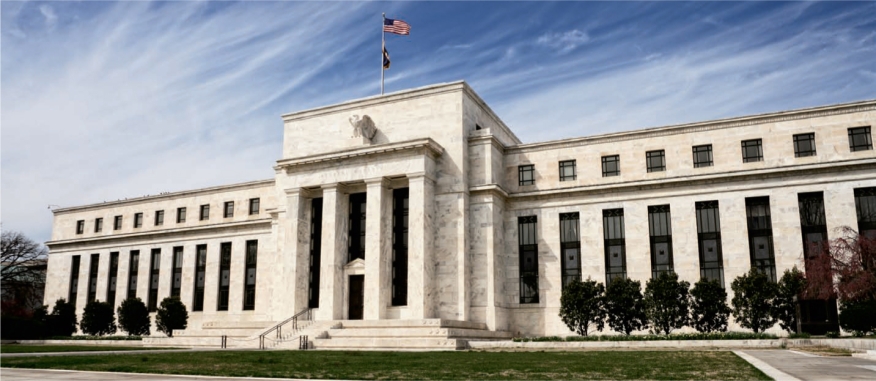
At the conclusion of Wednesday’s Federal Open Market Committee (FOMC) meeting, the Federal Reserve responded to lingering economic uncertainty and elevated inflation by lowering the target range for the federal funds rate by 0.25 percentage points to 3.75%-4%.
The Fed’s move marked the second time in 2025 that it slashed rates after September’s rate cut, when a streak of five consecutive meetings where the federal funds rate was held steady at 4.25%-4.50% was ended.
“Available indicators suggest that economic activity has been expanding at a moderate pace. Job gains have slowed this year, and the unemployment rate has edged up, but remained low through August; more recent indicators are consistent with these developments,” said the Fed in a post-meeting statement. “Inflation has moved up since earlier in the year and remains somewhat elevated. The Committee seeks to achieve maximum employment and inflation at the rate of 2% over the longer run. Uncertainty about the economic outlook remains elevated. The Committee is attentive to the risks to both sides of its dual mandate and judges that downside risks to employment rose in recent months.”
Voting in favor of the second rate cut of 2025 were Jerome H. Powell, Chair of the Federal Reserve; John C. Williams, Vice Chair; Michael S. Barr; Michelle W. Bowman; Susan M. Collins; Lisa D. Cook; Austan D. Goolsbee; Philip N. Jefferson; Alberto G. Musalem; and Christopher J. Waller. Voting against the action were Stephen I. Miran, who preferred to lower the target range for the federal funds rate by half a percentage point at the meeting, and Jeffrey R. Schmid, who preferred no change to the target range for the federal funds rate at this meeting.
“The FOMC met expectations with a 25-basis-point cut at its October meeting. The statement indicated that the Committee was more concerned about downside risks to the job market, although the last official data point was from August, hinting other data points showing further softening," said Mortgage Bankers Association (MBA) Senior Vice President and Chief Economist Mike Fratantoni. "Of note, there were two dissents to this rate cut decision, with Governor Miran preferring a 50-basis-point cut and Kansas City Fed president Schmid opting for no change in rates. MBA is forecasting another two 25-basis-point cuts to the federal funds target in December 2025 and then in the first quarter of 2026."
And for the housing market, another dip in rates could prove further savings for borrowers, as the MBA reported a 7.1% week-over-week improvement in mortgage application volume amid a continued dip in the 30-year fixed-rate mortgage (FRM).
“Mortgage rates decreased for the fourth consecutive week, with the 30-year fixed rate down to 6.30%, its lowest level since September 2024. This recent decline in rates spurred the second consecutive week of increased refinance activity, driven mainly by conventional refinance applications,” said Joel Kan, MBA’s vice president and deputy chief economist. “The ARM share of applications, which had been trending higher, dipped below 10% last week, as lower rates prompted more borrowers to choose fixed-rate loans. Additionally, the average loan size of a refinance application remained elevated at $393,900, as borrowers with larger loan sizes continue to be sensitive to rate movements. Purchase applications increased compared to a holiday-shortened week across most loan types. However, USDA applications fell more than 26%, impacted by the ongoing government shutdown.”
Those looking to take advantage of a continued decline in the rate market drove refi volume upward, as the MBA reported the refinance share of mortgage activity increased to 57.1% of total applications, up from 55.9% reported the previous week.
“Lower mortgage rates are a good thing for potential homeowners and the Fed is continuing its slow and steady approach to reducing the cost of mortgage lending, while keeping an eye on inflationary pressures,” said Dr Selma Hepp, Chief Economist, Cotality. “In fact, our data shows that pending home sales are rising year-over-year. This is a trend that will continue, especially when it is widely expected that the Fed will reduce rates one more time this year.”
First American Senior Economist Sam Williamson added, “With no November meeting on the calendar, October’s decision carries added weight. Markets have priced in a cautious cut, viewing it as a risk management move that preserves flexibility until clearer signals emerge. The shutdown’s impact on data availability may force the Fed to rely more heavily on alternative sources — private payrolls, spending trackers, and market-based inflation expectations — which, while useful, lack the depth of official government releases. If the shutdown persists, it would further cloud the outlook and complicate the Committee’s decision set, even as market expectations remain confident about another cut in December.”
The government shutdown has impacted several key agencies, including the Bureau of Labor Statistics (BLS), who posted on their site: “This website is currently not being updated due to the suspension of Federal government services. The last update to the site was Friday, October 24, 2025. Updates to the site will start again when the Federal government resumes operations.”
"The ongoing government shutdown has complicated the picture, limiting the flow of key economic reports and adding to the uncertainty surrounding the Fed’s outlook. Even so, the average 30-year fixed mortgage rate has recently dipped to its lowest level of the year, creating an opportunity for homebuyers and homeowners to take advantage of improved affordability," said Bill Banfield, chief business officer at Rocket. "While today’s rate cut is a positive signal, borrowers should view it as part of a broader trend rather than a single turning point – staying focused on their long-term financial goals and overall readiness.”
The BLS released its last unemployment report on October 1 covering data from August 2025. In it, the BLS reported that the national unemployment rate in August was 4.5%, not seasonally adjusted, little changed year-over-year.
Unemployment rates were higher in August 2025 than a year earlier in 243 of the 387 metropolitan areas, lower in 115 areas, and unchanged in 29 areas. A total of 30 areas had jobless rates of less than 3%, and eight areas had rates of at least 8%. Nonfarm payroll employment increased over the year in 18 metropolitan areas, decreased in one area, and was essentially unchanged in 368 areas.
Williamson noted: “The government shutdown has limited access to fresh employment data, leaving policymakers with less visibility into the underlying health of the labor market. This lack of clarity could spark more disagreement among Committee members, with some advocating for a pause and others pushing for a larger cut to hedge against downside risks.”