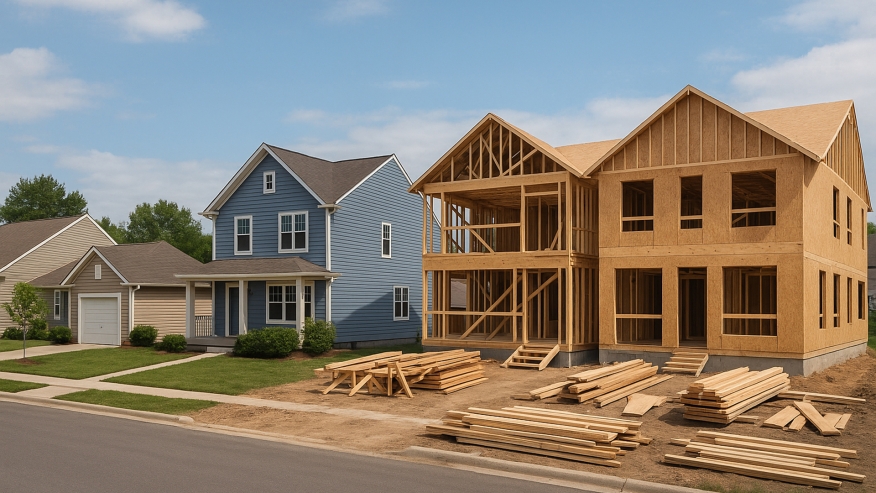
The U.S. housing shortage has reached an unprecedented level, with real estate search app Zillow reporting a deficit of 4.7 million homes nationwide. And that’s after a five-year construction surge that set records for housing completions.
The analysis signals both the persistence of borrower affordability challenges and shifting market dynamics driven by local supply constraints.
According to Zillow’s new report based on the latest Census data, 2023 saw 1.4 million homes added to the national housing stock. But that couldn’t keep pace with the 1.8 million newly formed families that year, pushing the total shortage up another 159,000 units.
“The unfortunate fact is that we still don't have enough housing in this country for people who need it,” said Orphe Divounguy, senior economist at Zillow. “Construction has helped prevent the housing deficit from ballooning, but it hasn't yet begun to close the gap.”
Doubling Up
An estimated 8.1 million families are now “doubling up,” sharing homes with non-relatives. Millennials are the most impacted in this regard, accounting for 38% of these arrangements, followed by Gen Z at 29%.
Cohabitation often masks deeper demand, since many of these households would likely purchase or rent independently if affordable options existed.
Zillow underscores that affordability has deteriorated sharply since 2019. A family earning the median income now needs a $17,670 raise to qualify for a typical home with 20% down — illustrating the financial strain first-time buyers face, even as mortgage rates have declined slightly.
Where Shortages Hit Hardest
The shortfall isn't evenly distributed, and, as with many things in real estate, comes down to localities. Among the 50 largest U.S. metros, the most significant housing deficits are concentrated in high-cost, regulation-heavy markets:
- New York City leads with a 402,361-unit deficit and a required income boost of nearly $100,000 to afford a typical home;
- Los Angeles and San Francisco follow with shortages of 338,750 and 139,990 units, respectively — and both have six-figure affordability gaps; and
- Washington, D.C., Boston, and Seattle round out the top shortage metros.
On the flip side, some cities are seeing less dire conditions or even modest improvements:
- Chicago posted a sizable reduction in its year-over-year housing deficit (-9.4%) and now requires virtually no income boost for a median-income family to afford a home; and
- Detroit, Cleveland, and St. Louis also show negative affordability gaps, meaning buying may be more accessible than in past years — though these markets still contend with legacy housing challenges.
Zillow’s analysis suggests that building momentum matters: cities with fewer zoning restrictions (like parts of Texas and Florida) saw more new housing and less price pressure. For instance, Houston, Atlanta, and Phoenix all reported gains in available units, with Phoenix leading the way at +7.8% year-over-year.
Building 'Smarter and Denser'
Zillow’s economists point to a need for greater housing density through zoning reform. Initiatives to allow accessory dwelling units (ADUs), duplexes, and triplexes — especially in single-family-only zones — could significantly ease the affordability crisis, they contend.
“More of these measures at the local level can help get more homes built and begin to ease this outsize financial burden for millions of Americans,” Divounguy said.
Borrower demand remains strong, but is stifled by inventory and affordability barriers. At the same time, emerging improvements in certain markets may present new opportunities for financing growth — especially where local policy is beginning to turn the tide.