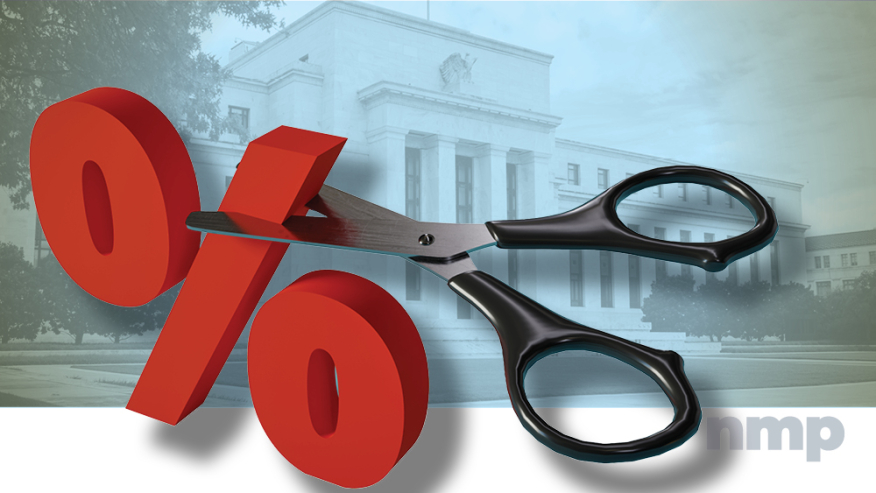
As was anticipated by many experts in the field, the Federal Reserve, at the conclusion of its December Federal Open Market Committee (FOMC) meeting 一 one of the last key economic events of 2025 一 decided to slash the federal funds rate by 0.25 percentage points to 3.5% to 3.75%, marking the third time in 2025 that the FOMC cut rates.
In late October, the Fed reduced the rate by 0.25 percentage points to 3.75%–4%, following mid-September’s rate cut also of 0.25 percentage points to 4.00%–4.25%.
Three members of the FOMC voted against the rate cut, including Fed Governor Stephen Miran 一 who supported lowering the federal funds rate by a half-percentage point 一 while Kansas City Fed President Jeffrey Schmid and Chicago Fed President Austan Goolsbee supported a pause in slashing the fed funds rate.
Those voting in favor of the monetary policy action were Jerome H. Powell, Chair of the Fed; John C. Williams, Vice Chair; Michael S. Barr; Michelle W. Bowman; Susan M. Collins; Lisa D. Cook; Philip N. Jefferson; Alberto G. Musalem; and Christopher J. Waller.
“In considering the extent and timing of additional adjustments to the target range for the federal funds rate, the Committee will carefully assess incoming data, the evolving outlook, and the balance of risks,” said the Fed in a post-meeting statement. “The Committee is strongly committed to supporting maximum employment and returning inflation to its 2% objective.”
Kiplinger reported that conversation about the state of the economy from the Fed has been nonexistent over the past week or so. From November 29 through December 11, participants in the FOMC meeting are mandated by a Federal Reserve policy that limits the extent they can discuss the economy and interest rates.
These "blackout periods" serve as a measure against corruption and information leaks to skew the financial markets. They begin the second Saturday that falls 10 days before the next FOMC meeting, and end the Thursday following the meeting 一 an unofficial practice that began during the 80s, made formal in 2011, and reaffirmed in January 2025.
“In assessing the appropriate stance of monetary policy, the Committee will continue to monitor the implications of incoming information for the economic outlook,” added the Fed in their post-meeting statement. “The Committee would be prepared to adjust the stance of monetary policy as appropriate if risks emerge that could impede the attainment of the Committee's goals. The Committee's assessments will take into account a wide range of information, including readings on labor market conditions, inflation pressures and inflation expectations, and financial and international developments.”
Mortgage Bankers Association (MBA) SVP and Chief Economist Mike Fratantoni added: “Inflation is well above the Fed’s target, but the job market appears to be softening, even as data to confirm that trend is still delayed due to the recent government shutdown. Thus, there is ammunition for both sides of the debate within the FOMC. The projections published from this meeting show the Committee does not see a clear path, with members indicating slightly faster growth, but similarly elevated inflation and a fed funds rate path that matches the September projections.”
Kyle Symoniak, senior vice president of capital markets at Rocket Mortgage, added: “Today’s 25-basis-point rate cut 一 the third this year 一 reflects the Fed’s response to a cooling labor market, even as recent shutdown-related reporting delays provide limited visibility into the latest jobs and inflation data. Mortgage rates drifted lower last week, then climbed and ended the week essentially flat. Today’s cut was largely expected and priced in, but the markets will look for further signals in the Fed’s comments as signs for what may come next. Today’s housing market is still defined by the lock-in effect. Homeowners who secured historically low rates four or five years ago are staying put, keeping inventory tight and amplifying the impact of every rate move."
Ramifications On The Housing Space
Upon news of a pending rate cut and its ripple effect on the housing space, the MBA reported that mortgage applications increased 4.8% week-over-week. The MBA’s Market Composite Index, a measure of mortgage loan application volume, increased 4.8% on a seasonally adjusted basis from one week earlier. On an unadjusted basis, the Index increased 49% compared with the previous week. The Refinance Index increased 14% from the previous week and was 88% higher than the same week one year ago. The seasonally adjusted Purchase Index decreased 2% from one week earlier, while the unadjusted Purchase Index increased 32% compared with the previous week, and was 19% higher than the same week just one year ago.
“Compared to the prior week’s data, which included an adjustment for the Thanksgiving holiday, mortgage application activity increased last week, driven by an uptick in refinance applications,” said Joel Kan, MBA’s vice president and deputy chief economist. “Conventional refinance applications were up almost 8%, and government refinances were up 24%, as the FHA rate dipped to its lowest level since September 2024. Conventional purchase applications were down for the week, but there was a 5% increase in FHA purchase applications as prospective homebuyers continue to seek lower downpayment loans. Overall purchase applications continued to run ahead of 2024’s pace, as broader housing inventory and affordability conditions improve gradually.”
Freddie Mac reported the 30-year fixed-rate mortgage (FRM) averaging 6.19% as of December 4, 2025, down from the previous week when it averaged 6.23%. A year ago at this time, the 30-year FRM averaged 6.69%.
"The Federal Reserve is making decisions with limited market data available,” said Dr. Selma Hepp, chief economist of Cotality. “However, much data still points to a softening labor market and inflation that remains persistent, keeping prices high heading into the holiday season. However, today's move will do little to improve home affordability as prices remain strong and mortgage rates are unlikely to slip under the 6% mark for a 30-year mortgage, which will keep cautious first-time homebuyers on the sidelines, and overall home buying activity seasonally slow until we come closer to the spring home buying season."
“As expected, the Federal Reserve is cutting interest rates for the third time, but when it comes to discussing the housing market, we need to pivot the discussion from the relentless pursuit of lower rates,” said Hector Amendola, CMB, president of Panorama Mortgage Group. “Instead, Panorama Mortgage Group is focused on affordability and what truly needs to happen to bring homeownership within reach of mid-market buyers. While lower rates can certainly help with affordability, they also tend to ignite demand which pushes prices even higher and ultimately puts more families out of reach. The more sustainable path is a housing market where prices stabilize and wages have room to catch up, combined with increased new home inventory that real everyday Americans can afford.”